






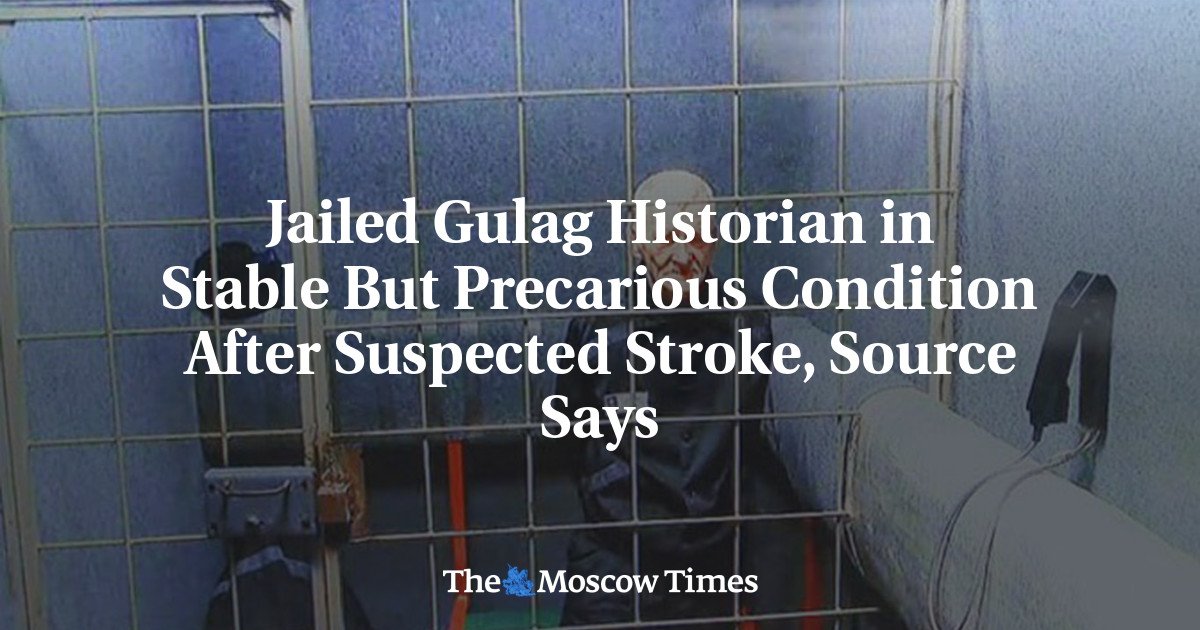
Jailed gulag historian Yury Dmitriev is in stable condition after a suspected stroke, but concerns remain over his access to adequate medical care, a person familiar with his case told The Moscow Times on Thursday.
Dmitriev, 70, is serving a 15-year sentence that his supporters see as retribution for his work uncovering Soviet-era atrocities as the head of human rights group Memorial’s branch in the republic of Karelia.
He was transferred to a prison hospital in the republic of Mordovia on Friday after experiencing “loss of coordination and severe weakness” that left him unable to stand, prompting his supporters to warn that his life could be at risk if he is not moved to a civilian hospital immediately.
Dmitriev is now conscious, moving around and has written a short note to his family, the source familiar with his case said, speaking on condition of anonymity for safety reasons. However, he is also experiencing problems with the left side of his body, including difficulty moving his left hand.
While prison medics told Dmitriev that he had suffered a medical episode, he believes he had a stroke, the source said.
“The prison hospital does not have the medical equipment necessary to understand the seriousness of the situation and whether it has stopped or is still in progress,” the source said.
Dmitriev’s lawyer has submitted a written request to prison officials seeking proper medical care for him, the source said.
The lawyer was denied access to Dmitriev over the weekend, with prison hospital staff confirming only that he was at the facility and “alive.” Staff later told the lawyer by phone that his condition was “stable” without providing further details.
People corresponding with Dmitriev have reported a decline in his health since 2025, and his allies have repeatedly warned that securing his release is a matter of life and death.
His support group said he had been placed in solitary confinement three times over the past four months for alleged infractions including performing morning exercises improperly and sitting on his bed before lights out.
As the head of Memorial’s Karelia branch, Dmitriev spent decades locating and exhuming mass graves of people killed under Soviet dictator Josef Stalin’s rule in the northwestern Russian republic that borders Finland.
He was arrested in 2016 on child pornography charges and acquitted in 2018, but the acquittal was overturned. He was subsequently convicted of sexually assaulting his adopted daughter, and his sentence was increased to 15 years in 2021. He denies wrongdoing.
Memorial, a co-recipient of the 2022 Nobel Peace Prize, has designated Dmitriev a political prisoner and says his prosecution appears linked to his work “preserving the memory of political repressions.”
The group says that he has “not had a single full medical checkup” since his initial arrest in 2016.


