



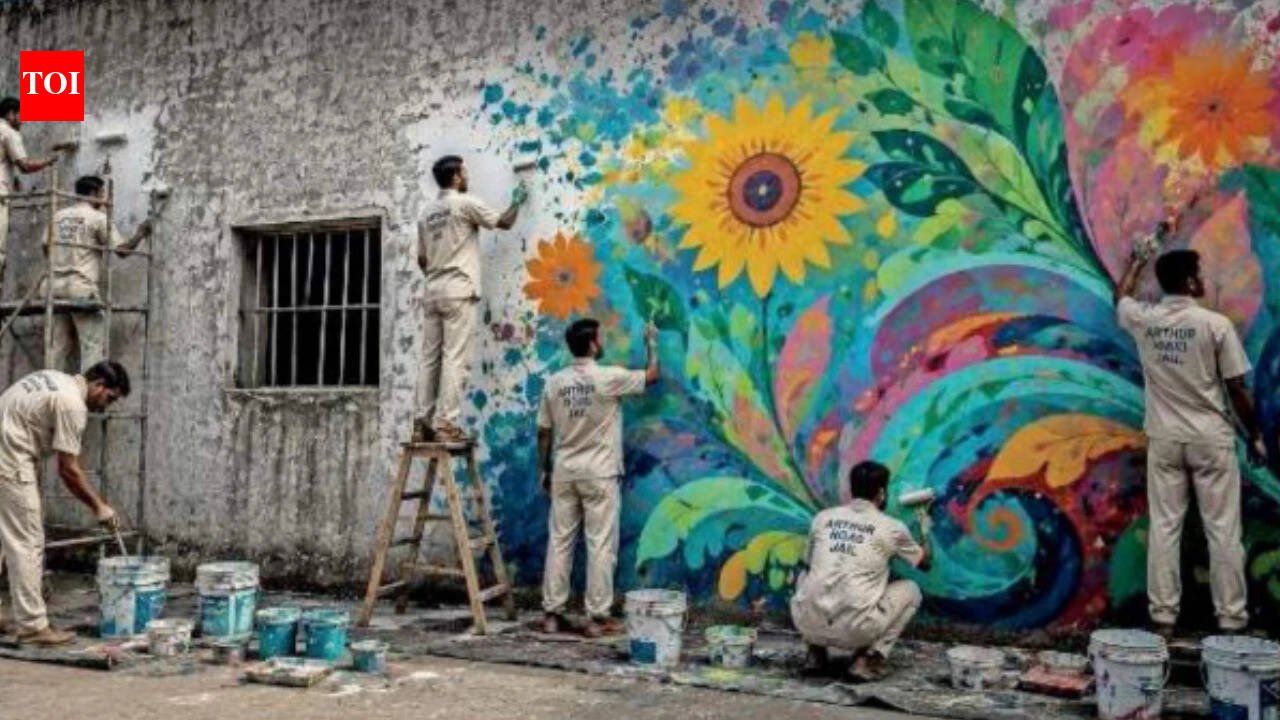
MUMBAI: Bacchu Khan (name changed), a former Arthur Road jail inmate who dreams of a Dubai job after undergoing a wall-painting course during his time in prison, said he took up the course as “it seemed something quite interesting and I thought I could take up commissions and contracts and make a living”.The course teaches inmates practical painting skills ranging from applying putty and preparing walls to advanced finishes, textures and decorative designs.“Now my mother is happy and doesn’t worry about me anymore,” he said. “She is happy with the life I have made for myself,” Khan said.The importance of such programmes extends beyond skill development. Nearly three-fourths of India’s prison population comprises undertrials, people who have been accused but not convicted of crimes.Many spend years awaiting the outcome of their cases, only to be acquitted or handed sentences equivalent to the time they have already spent in jail.For them, courses such as wall painting, lift repair and English speaking offer not just a distraction from prison life but a chance to rebuild careers and livelihoods after years lost to the judicial process.
Most popular educational and vocational courses at Arthpur Road jail
Arthur Road jail superintendent Harshad Ahirrao said convincing undertrials to join educational or vocational programmes remains a challenge.“The prison houses only undertrials who think they will be out in no time,” Ahirrao said. “Inevitably many end up spending three to four years at least here, but initially they are not concerned about learning something new. Convicted prisoners, on the other hand, know that they have to spend a long time behind prison walls and are more willing to sign up.”Ahirrao said the biggest impediment to scaling up educational and vocational initiatives inside the prison is the lack of space.“To conduct these classes you need a large hall or dedicated space, which is really hard to come by in a prison that is already heavily overcrowded,” he said.Mahipal Singh (name changed; 40) spent nearly two decades working as a spot boy on film sets in Mumbai before he too was arrested in a phone theft case.Inside prison, thoughts of his 12-year-old son, who had no one to care for him, tormented him day and night. To distract himself during the long lonely hours of prison, Singh too joined the wall-painting course.
Prof Vijay Raghavan
After his release, he found work at construction sites, and eventually secured regular employment in the sector.His son, now 17, has just finished his junior college and is fascinated by the stock market and plans to pursue a course in it.“Many don’t have anybody to guide them or speak for them, so they don’t know the correct path to take,” Singh said. “There should be more opportunities like these.”Sachin Bhinge, the course trainer and coordinator, said more than 650 inmates have been trained through the programme over the past five years.“We have been able to place around 50 inmates in jobs after release, while many others found work on their own,” Bhinge said.When asked about how contractors and companies react to and treat former prisoners working with them, he said, “To be honest, many times we don’t tell employers about their past. There are only two or three contractors we work with regularly.”According to Bhinge, one of the biggest challenges after inmates are released is simply staying in touch with them.“Most don’t have a stable address or even a phone number, so tracking them and following up becomes difficult,” he said.The wall-painting course is part of a broader shift in education and vocational training at Arthur Road jail. Alongside painting, lift-repair training has emerged as one of the most sought-after programmes among inmates.Avinash Gavit, senior jailer and in charge of education at Arthur Road, said inmates prefer courses that directly improve employment prospects after release.“These two courses are the most popular because inmates are able to find work in these sectors after leaving prison,” Gavit said. “Courses like welding, electronics and computers were very popular once and don’t attract much attention anymore. English-speaking classes on the other hand, however, have remained evergreen.”Ahirrao said English-speaking courses often give inmates hope that they may someday join respectable society.Gavit narrates an interesting event about a former inmate who became a stylist to the stars.“Many years ago a young boy from UP wound up in jail here, he took up our salon classes and after a few years here when he went free he joined the film industry, and now after many years he has become a hair stylist for some of the biggest stars in the industry, and they are none the wiser where he learnt these skills.”


