



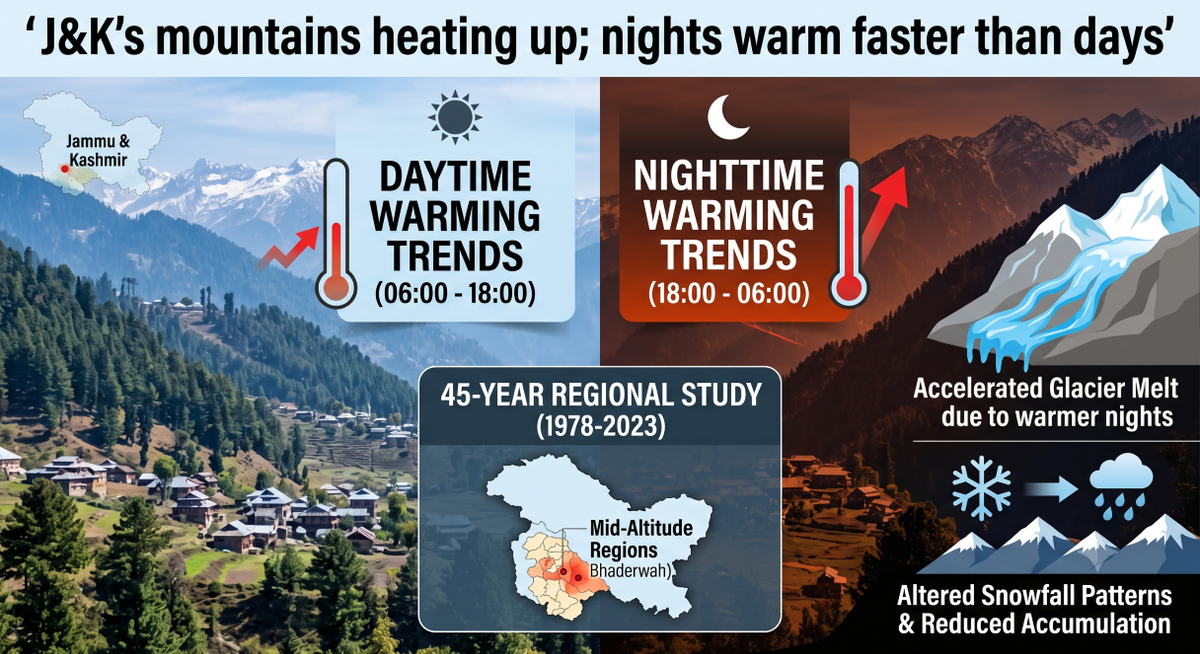
Srinagar, Jul 18: Jammu and Kashmir’s mountains are warming, but not in the way many would expect. A new study has found that night-time temperatures across large parts of the Himalayan region are rising far more rapidly than daytime temperatures, signalling a profound shift in the climate of one of the world’s most fragile mountain ecosystems.
The research published in a prestigious journal ‘Scientific Reports’, based on 45 years of observations between 1980 and 2024, paints a picture of a warming J&K marked by sharp geographical contrasts, seasonal variations and an emerging pattern of elevation-dependent warming.
Scientists analysed temperature records from the India Meteorological Department’s network of surface observatories across Jammu and Kashmir and combined them with global reanalysis datasets to examine long-term changes in annual and seasonal temperatures across the Union Territory.
The findings reveal that while warming is evident across much of the region, the increase is far from uniform. “Mid-elevation stations recorded the most pronounced warming trends, with Bhaderwah emerging as one of the fastest-warming locations, registering an increase in average annual temperatures of nearly 0.3°C per decade,” the research reads. “In contrast, lower-elevation stations such as Jammu recorded weak or statistically insignificant warming trends, with annual mean temperatures showing changes of around minus 0.1°C per decade over the study period.”
The most striking finding, however, was the rapid rise in minimum temperatures — the temperatures recorded during the night and early morning hours.
Researchers found that minimum temperatures increased by between 0.1°C and 0.5°C per decade across several mid- and high-altitude regions of Jammu and Kashmir.
“By comparison, daytime maximum temperatures rose much more slowly, increasing by only 0 to 0.2°C per decade at most stations,” the research reads.
During the pre-monsoon season, warming became even more pronounced, with some mountain stations recording night-time temperature increases of up to 0.6°C per decade.
Scientists say this pattern is a strong indicator of elevation-dependent warming, a phenomenon increasingly being observed across mountain regions worldwide where higher altitudes warm faster than neighbouring lowlands.
The study suggests that changing cloud cover, snow-albedo feedbacks, atmospheric moisture and shifts in land-atmosphere interactions may be contributing to the accelerated warming observed in the Himalayas.
Climate experts warn that warmer nights could have consequences that extend far beyond rising temperatures.
Night-time warming reduces the duration and intensity of freezing conditions essential for maintaining snow cover and glacier health. As a result, snow accumulates later in winter and melts earlier in spring, shortening the snow season and altering river flow patterns.
“For Jammu and Kashmir, where rivers such as the Jhelum, Chenab and Indus rely heavily on snow and glacier-fed water, these changes carry major implications for agriculture, hydropower generation and drinking water supplies,” the study adds. The findings add to a growing body of evidence pointing towards rapid climatic changes in the western Himalayas.
Previous studies led by noted earth scientist Prof Shakil Ahmad Romshoo have documented substantial glacier retreat across Kashmir over recent decades.
Research on the Kolahoi Glacier, often referred to as the Valley’s “water tower”, found an average mass loss of 0.91 ± 0.42 metres of water equivalent annually between 2013 and 2018.
Similarly, studies on the Hoksar Glacier reported annual losses of nearly 0.95 ± 0.39 metres of water equivalent, while satellite observations indicate that Kashmir’s snow-covered area has declined by nearly 23 per cent over the past five years.
Meteorologists believe rising temperatures may also contribute to increasingly erratic weather patterns already being witnessed across Jammu and Kashmir, including intense rainfall events, cloudbursts and flash floods.
The Union Territory has experienced an increasing number of extreme weather incidents in recent years, particularly across mountainous districts in the Jammu region.
Researchers based their findings on daily temperature observations collected from January 1, 1980 to December 31, 2024 through the India Meteorological Department’s network of manual surface observatories.
The data underwent multiple levels of quality checks and verification before being archived at the National Data Centre in Pune.
To ensure the reliability of long-term trends, scientists tested temperature records for possible discontinuities arising from station relocation, changes in instrumentation or alterations in observation methods.
The analysis found that almost all stations maintained statistically homogeneous records over the 45-year period, strengthening confidence in the observed warming patterns.
Researchers employed internationally recognised techniques including the Mann-Kendall trend test and Sen’s slope estimator to quantify temperature trends and assess their statistical significance.
The study concludes that Jammu and Kashmir’s warming is not merely a story of rising temperatures but of changing mountains, shrinking winters and increasingly vulnerable water systems.
For a Himalayan region already witnessing glacier retreat, declining snowfall and growing climate extremes, the message is becoming increasingly difficult to ignore. The mountains of Jammu and Kashmir are warming — and the nights are warming fastest of all.


