



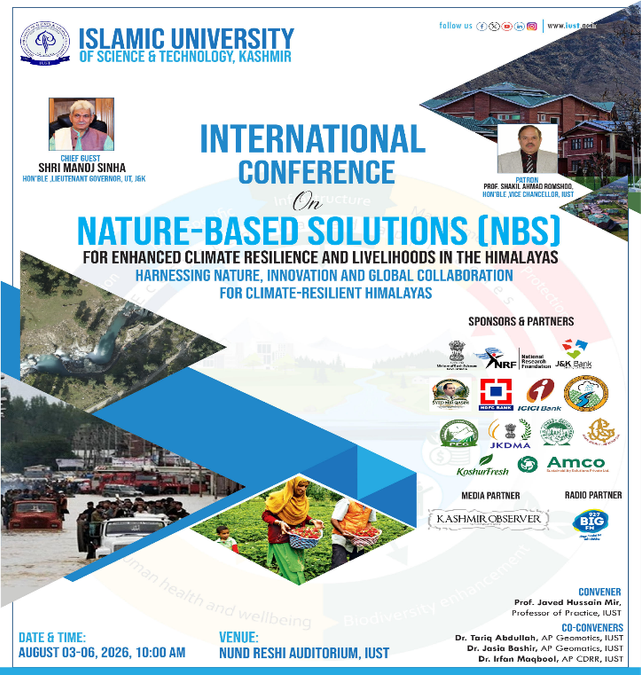
Awantipora, Jul 30: The Islamic University of Science and Technology (IUST) will host a four-day international conference on ‘Nature-based Solutions for Enhanced Climate Resilience and Livelihoods in the Himalayas’ from August 3 to 6.
The conference will be inaugurated on August 3 by the Honourable Lieutenant Governor of Jammu and Kashmir, Shri Manoj Sinha, as Chief Guest. The Honourable Chief Justice of the High Court of Jammu and Kashmir and Ladakh, Justice Sanjeev Kumar, will grace the inaugural session as Guest of Honour.
The international event will bring together policymakers, scientists, academicians, development practitioners, financial institutions, and businesses and civil-society representatives to examine how nature-based solutions can strengthen climate resilience, support livelihoods and contribute to sustainable economic growth in Jammu and Kashmir and wider Himalayan region.
The programme focuses on the climate-resilient Jhelum River Basin and Himalayas, wetland restoration, climate-smart forestry, sustainable agriculture and horticulture, urban resilience, human well-being, digital technology-enabled green enterprises, and climate finance.
Vice Chancellor IUST, Prof. Shakil Ahmad Romshoo, said, Jammu and Kashmir’s forests, rivers, wetlands and agricultural landscapes should be recognised as essential natural infrastructure that supports water security, disaster reduction, livelihoods and economic development. Conference Convener, Prof. Javed Hussain Mir, remarked that the conference would move the nature-based solutions discussion beyond environmental conservation.
A major highlight of the conference will be the High-Level Policy Dialogue on ‘Leveraging Nature-based Solutions for Fiscal Diversification and Resilience in Jammu and Kashmir,’ scheduled for August 6 at Amar Singh Club, Srinagar.
Chaired by Additional Chief Secretary, Shailendra Kumar, the senior policymakers, planners, academics, businesses and civil society will consider priority policies and investments for enhancing Jammu and Kashmir’s climate, and fiscal and economic resilience.


