






The Cambridge Dictionary defines introspection as the examination of and attention to your own ideas, thoughts, and feelings.
Introspection must be a ruthlessly honest endeavour. It’s not an exercise to impress others but to look inwards, reflect on what one is and what needs to be done to become the best version of oneself. It calls for taking ownership of one’s actions, of accepting mistakes and errors, if any, and of zealously working towards eradicating those mistakes and making amends, if so required.
There is no better example in Indian cricket of the use of introspection as a self-betterment tool than Ishan Kishan, the pocket-sized dynamite who has embarked on a sensational journey of reinvention that has made him one of the hottest properties, if only in the white-ball ecosystem for the time being.
To say that, at the beginning of 2026, his international career was at a crossroads will be a mild understatement. The destructive left-hander had worked himself out of favour as he allowed frustration, if not petulance, to get the better of him.
Overlooked from all three international playing XIs in the interest of team requirements and balance despite having done little wrong, Kishan took a leave of absence midway through the tour of South Africa in 2023-24, citing the need for a mental reset.
In choppy waters
But when he refused to obey the diktats of the Board of Control for Cricket in India and made himself unavailable to play domestic cricket for Jharkhand despite practising for IPL 2024, which was imminent, he found himself in choppy waters. In an unequivocal warning, the BCCI stripped him of his central contract – as it did with current T20I captain Shreyas Iyer. The unsaid message was clear – don’t take anything for granted.
Kishan had one of two paths to choose – wallow in self-pity, rail at the injustice of it all and allow himself to go to seed, or smell the coffee, accept that he had done himself no favours and wake up to the reality that if he aspired to represent the country again, he would have to not just produce the runs expected of him but to reiterate without any scope for doubt that he had learned his lesson.
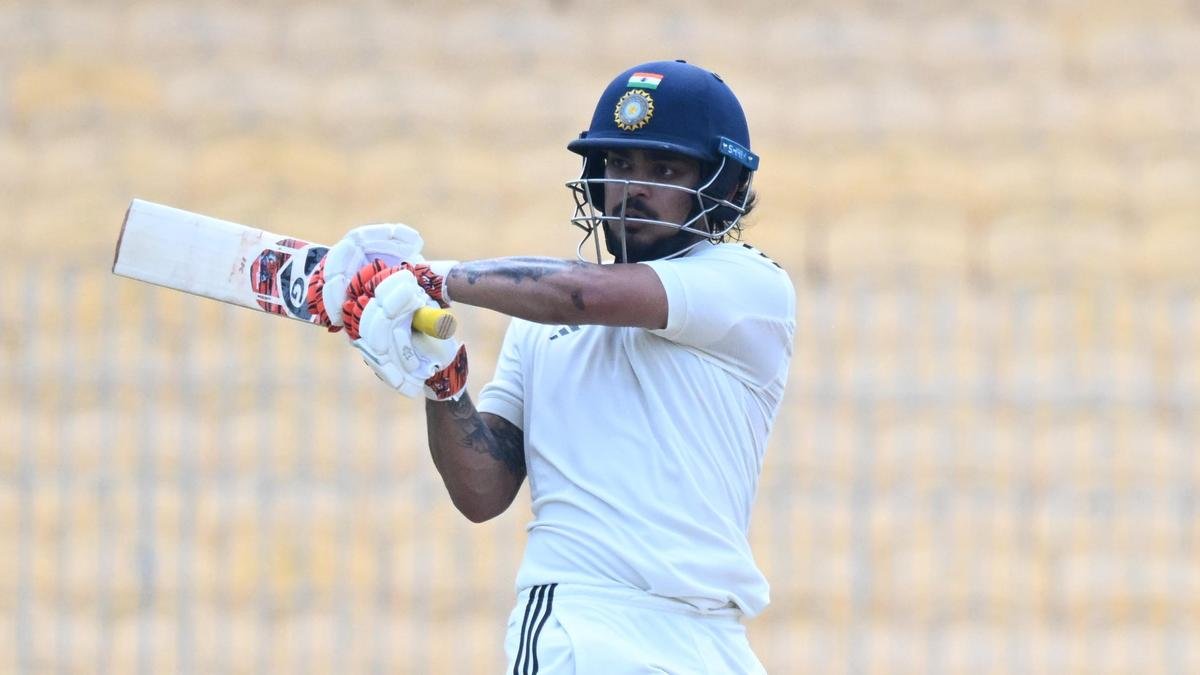
The left-hander is a mainstay in the T20I team.
| Photo Credit:
R.V. Moorthy
The Jharkhandi did all that and more. He was outstanding in domestic cricket across formats, not just batting with flair and keeping with assurance but also slipping effortlessly into the role of a leader. His tactical acumen revealed itself time and again, manifesting in a maiden domestic title – the 20-over Syed Mushtaq Ali Trophy – last season with the captain himself starring in the final with a brazen century.
As India grappled with opening woes ahead of the home T20 World Cup, where they would be defending the title won in Bridgetown under Rohit Sharma in June 2024, Kishan suddenly emerged as a very obvious and viable option. That the mandarins occupying the corridors of power had forgiven him became obvious when Suryakumar Yadav, the skipper, called up the younger man and asked him if he would win the team the World Cup.
Clearly, it wasn’t a call Suryakumar made on his own. He would have consulted his bosses before approaching Kishan during a brief but very pithy chat. “Chhotu, World Cup jitayega?” the captain asked the wicketkeeper-batter, who responded with, “Bharosa karogey?” (Will you trust me?). Suryakumar’s reply was instantaneous — “Chal, kiya” (Done). And just like that, Kishan was back in favour, back in business, back doing what he loves the most.
Celebrating the reintegration
Needless to say, Kishan kept up his end of the bargain. He celebrated his reintegration with international cricket with scores of 76, 28 and 103 in his second, third and fourth outings back, against New Zealand in India’s final engagement before the World Cup. All these knocks came at No. 3, but with Sanju Samson suddenly blowing cold, he was thrust into the role of the opener-wicketkeeper at the World Cup, where he reeled off 20, 61, 77, 18 and 0 in the first five fixtures.
However, India were unable to get off to meaningful starts as opponents started to exploit the all-left opening salvo with off-spinners of varying quality.
Abhishek Sharma was in the middle of a horror run and therefore to break up the monotony of two left-handers, the think-tank took a punt on Samson, brought him back as opener and stumper and pushed Kishan down to No. 3 from the Super Eight fixture against Zimbabwe onwards. Samson came to the party with breathtaking knocks in the last three matches, including in the semis against England and the final against New Zealand, but Kishan didn’t seem the drop to one-down with 38 (24b), 10 (6), 39 (18) and a whirlwind 25-ball 54 in the title clash.
Chhotu did help Suryakumar lift the World Cup, but while his fortunes have continued to be on the upswing, the man who created history by becoming the first to oversee a successful title-retention campaign was immediately dumped without so much as a thank you.
His T20I heroics have brought Kishan back into the ODI mix as well. In June, he marked his comeback with a frenetic 125, off a mere 79 deliveries, against Afghanistan in Lucknow, in what was just his second 50-over international in 32 months. By this time, he had led Sunrisers Hyderabad for the first half of IPL 2026, with regular skipper Pat Cummins travelling with the squad but not cleared to enter the fray by Cricket Australia.
Even though he knew that he was only keeping the seat warm for the Australian Test and ODI skipper, Kishan wasn’t a stand-in captain in the strictest sense. He brought his tactical acumen and man-management skills into play, led from the front and left the team in a good space – and handily placed to make a charge for the playoffs – when the Aussie reassumed charge.
Cummins was quick at every opportunity to laud Kishan’s leadership skills in his absence, their mutual respect apparent from the repeated discussions the nominated captain had with the man who had led in his absence when the two were reunited on the field of play for the second half of the season.
Distinct and stated desire
Kishan isn’t merely content with white-ball laurels, though. At least among Indian batters, there is a distinct and stated desire to represent the country in Test cricket. Tilak Varma, the gifted 23-year-old, said as much on the eve of the ongoing Duleep Trophy final, where he is leading South Zone against Kishan’s East.
The 28-year-old was part of India’s T20 title-winning squad.
| Photo Credit:
Vijay Soneji
Tilak has made a name for himself as an exuberant, new-age T20 player, a reputation that has landed him the vice-captaincy of the national side, and it won’t be long before he becomes a 50-over certainty too. But he is consumed by the ambition to play for the country in the five-day format.
Since debuting in the Ranji Trophy for Hyderabad when he was only 16 years old, the rangy left-hander has stacked up an average of 55.77 from 24 First Class matches. He has often been unable to represent his state in the red-ball game because invariably, India’s players are involved in some T20 outing or the other during the Ranji Trophy, but it’s only a matter of time before Tilak gatecrashes the Test side as well.
In that race, he has Kishan for company and competition. Obviously, the shorter man is considerably older than Tilak and has greater experience of first-class cricket – 66 matches before the Duleep final, an average of just under 40 and nine hundreds with a best of 273. Kishan’s red-ball quest is anything but straightforward.
The effervescent Rishabh Pant is the designated wicketkeeper-batter who is relishing his second coming at the international level after a long break following his terrible car accident in December 2022, while Dhruv Jurel has stolen a significant march as the gloveman-in-waiting.
Jurel’s Test debut came when Pant was recuperating from a series of surgeries, and he immediately caught the eye with his agility and compactness behind the sticks and his composure and technique in front of it. In only his second Test, he steered the team to a tense victory in Ranchi in the company of current skipper Shubman Gill and has stacked up two centuries in his last seven Tests.
How highly he is rated by the leadership group is evidenced by the fact that he is in the Test XI as a specialist batter, occupying the No. 6 position so that he can split left-handers Pant and Ravindra Jadeja.
His last Test knock was a flowing unbeaten 115 in Colombo a fortnight back and even though he is widely regarded as a terrific player of spin, it is hard to see him being dislodged when India play their next Test, in seam-friendly Wellington in November.
Work cut out
Kishan knows therefore that he has his work cut out, but no one also knows better than him that hard work can take you places you had never imagined were accessible. His statement-making double-hundred in the Duleep final in Chepauk is exactly the kind of start to the domestic First Class season he would have envisaged, and one can rest assured that when he is not on India white-ball duty, he will torment bowlers whilst masterminding Jharkhand’s fortunes in a leadership capacity.
Listening to Kishan speak over the last few months is a refreshing, eye-opening experience. One can see the deep impact of losing the central contract and finding himself in the dumps, but one can also easily make out that he has now become a more mature, grounded and realistic human being who has still retained his innate impishness and the slant towards mischief. Clarity of thought is evident every time he opens his mouth, a clarity that is a spillover from his awareness in the middle.
In Ishan Kishan’s fall from grace and his willingness to not just climb back on the horse but become a champion jockey again is a shining example of the wonders self-belief and commitment to the cause can catalyse. The intelligent young man is no longer chasing shadows or slaying inner demons. More power to him.


