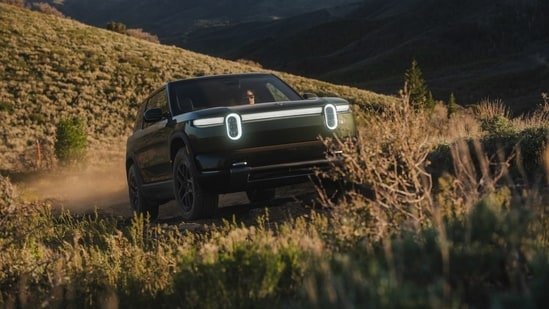
American EV automaker Rivian—you know, they make the ones with the sad-laughing clown eyes?—held its media drive for the new R2 SUV near Park City, Utah, two weeks ago. I’ll spare you the clinical detachment: It’s awesome. I want one. And I’ll buy one. In exactly one year. Please don’t tell my wife.
The Rivian R2 Performance (seen here in Launch Green) is the American EV automaker’s third production vehicle, after its large and luxurious R1T pickup and R1S SUV.
Actually, I rate Rivian’s winsome, innovation-packed new terrain droid among the finest vehicle designs in the world, not least because it looks convincingly like an SUV, with a culturally relevant two-box profile, taller-aspect wheels and tires (32 inches), higher ground clearance (9.6 inches), steeper windshield angle, a flat hood and roof and a squarer cross-section. That, if you will permit me, is what Americans want their SUVs to look like—not some robotic lawn mower from an off-world golf course (I’m looking at you, Toyota bZ).
The bestselling EV in the U.S. is Tesla’s Model Y, which is so not an SUV. The R2 exploits the Model Y’s greatest weakness.
Through early 2027, Rivian will be releasing its R2 midsize SUV in stages. The line debuts with the R2 Performance, on sale now, equipped with dual motors packing combined 656 hp and 609 lb-ft of torque.
Overcoming the aerodynamic drag inherent with a trad-core design was a degree-of-difficulty multiplier for Rivian’s team, requiring lots of computer simulation and iterative, millimeter-scale noodling. The details can be hard to see: Note that the windshield wipers sit in a recessed area (scuttle) below the hoodline, so they won’t disturb the airflow over the windshield. Please enjoy the enveloping, silk-stocking smoothness of the window framing around the cabin greenhouse. With help from such AI-optimized slipstreaming, the R2 Performance’s 88 kWh battery pack can carry it an estimated 330 miles, just edging out the Model Y Premium (327). Tick that box.
The R2—a bit bigger than a Toyota RAV4, for comparison—is the California-based automaker’s third product, after the large and luxurious R1T and R1S, pickup and SUV, respectively. The first batch of R2 Performance vehicles is on sale now, starting at just under $60,000—roughly $25,000 lighter than the R1S. Late this year, Rivian plans to release the R2 Premium ($53,990, to start). In early 2027, the single-motor R2 Standard should drop, with a starting price of just $44,990. I figure I’ll have to tell my wife something by then.
In some ways, the R2’s general excellence is just good timing. Starting almost from scratch, the R2 program could take advantage of recent advances in car-building and the global supply chain (China). Most first-gen EV programs were required to adopt conventional electrical architectures, comprising dozens of electronic control modules (ECMs) dedicated to specific functions—windows, doors, wipers, brakes—all connected with miles of heavy wire. The R2’s new zonal control architecture is neatly loomed to three big processors. The shorter runs of wire reduce overall weight by 44 pounds and make the production less vulnerable to chip shortages.
The Rivian R2’s minimalist cabin decor is rendered in restrained tones using premium textiles. The center touch screen runs on Rivian’s operating system, Rivian OS. The R2 does not support Apple CarPlay.
Another sign of maturity: the R2’s body-mass index. This midsize five-seat, four-door, dual-motor SUV, with a palpably rigid mixed-metal monocoque and body panels, weighs 5,000 pounds, at most. That’s roughly a full ton lighter than the R1S and 455 pounds lighter than the current Toyota 4Runner TRD Pro, a close IC-powered equivalent.
Typically and historically, high battery costs have tended to displace customer-facing value—nice things we cannot have, like a top-shelf audio system, premium upholstery and trim, up-to-date comms and connectivity. The R2 Performance wants for nothing compared to its price peers. The tech-invested will surely enjoy interfacing with the R2’s unique Haptic Halo selectors set into the lateral arms of the steering wheel. These electronically damped wheeled selectors offer three axes of input, using microtorque feedback to imitate the bump and tug of physical detents. Many find them quite intuitive. I’m going to need practice.
The wheelie-dealies allow drivers to navigate the R2’s devilishly smart, wickedly fast UX, which splashes its crisp, legible graphics and impish animation across both the binnacle display and the one in the center dash. Input latency is no longer a thing. Note: The Rivian does not support Apple CarPlay; instead, it has its own device connection protocol and embedded navigation in the Rivian OS.
Haptic Halo controllers are among the 2027 Rivian R2’s innovations. Set into the lateral arms of the steering wheel, these three-axis controllers use microtorque feedback to imitate the bump and tug of physical detents.
The highlight of any walkaround is the R2’s powered hatch window, which is so practical I can hardly contain myself. Surfboards, ladders, long-stock lumber, the perennial Christmas tree—all of it can stick through the open hatch window long enough to get where you’re going.
On road or riprap, the R2 Performance is a hoss. Our example, upfitted with the Launch Package specification, did just that, ripping away from red lights like a spooked tarpon, and me just hanging on. In the Rally mode (exclusive to Performance models), the battery floods the front and rear-mounted AC synchronous motors with up to 646 hp worth of juice. Rivian reports an official 0-60 mph time of 3.6 seconds. Meanwhile, the combined 609 lb-ft of torque computes to 4,400 pounds’ towing capacity.
With a maximum 230 kW charging rate, the R2 can regain about 150 miles of range in 15 minutes, the company says, or 10%-80% capacity in under 30 minutes. The R2 uses a NACS charging plug, and the cars have access to Tesla’s network of superchargers.
Price is parity’s final frontier. The R2 Performance edition starts at $57,990. That includes the whole smash: the full 656 hp electro-tune, with rear-biased, dual-motor AWD and 21-inch tires. However, if you call the White House in the next five minutes (not really), Rivian is offering the Launch Package as a no-cost option, including the tow package, the Nvidia-powered driver-assistance technology (Autonomy+) and Launch key fob.
There’s not a mass-market EV in the world with more rizz for the money. I trust my wife will agree.
2027 Rivian R2 Performance with Launch Package
The R2 Performance edition starts at $57,990. That includes the whole smash: the full 656 hp electro-tune, with rear-biased, dual-motor AWD and 21-inch tires.
Base price $57,990
Price as tested $61,485
Propulsion All electric, with dual AC synchronous motors, 88 kWh, 400V lithium-ion battery pack, rear-biased, multi-mode/terrain all-wheel drive.