






Versatility, by virtue of what it signifies, is attractive to the universe at large. In a nutshell, it denotes the ability to perform a gamut of roles.
For an actor seeking this tag, it may involve portraying a psychopathic villain in one film and a romantic hero in the next. A vocalist evokes admiration when possessing the mellifluous tone and meticulous training to sing a classical composition just as effortlessly as a pop chartbuster.
Red, pink and white
For a cricketer, versatility in the modern world means the ability to excel across all three formats. A batter must have the gears to score runs when a duel is stretched to five days as when it is condensed to 20 overs. A bowler must have the wherewithal to strike with the red or pink ball in Tests, and stem the run-flow in the limited-overs game.
Even when international cricket was a duopoly of Tests and ODIs, it was those of the majesty of Viv Richards, Sachin Tendulkar, Wasim Akram, and Glenn McGrath, among others, who seamlessly juggled both formats. Now that there is also the slam-bang spectacle hankering for attention, an amalgamation of more diverse skills is required to earn all-format acceptance. Such elasticity is naturally the preserve of a select few.
The requisite ingredients, however, may not suffice in the current climate. The responsibility for that lies at the door of the decision-makers who draw up exhausting, unrelenting schedules.
Rewind to the first week of October as a case in point. Even as one Indian team was stationed in Japan with the aim of retaining gold in the Asian Games’ T20 competition, another was kicking off earnest preparations for next year’s ODI World Cup in southern Africa with a home series against the West Indies.
Concurrently, India-A was facing Australia-A in a four-day contest in Puducherry while a Rest of India outfit, comprising six players who have represented the country, was jostling with Jammu & Kashmir in a five-day Irani Cup fixture in Srinagar. Among four teams catering to different durations, multiple players with all-format credentials lay scattered.
Later this month, too, India will embark on a jam-packed tour of New Zealand comprising five T20Is, five ODIs and two Tests. Even as the five one-dayers take place, an India-A contingent, featuring members of the 50-over outfit like K.L. Rahul and Dhruv Jurel, will endeavour to get accustomed to the surfaces via three red-ball matches ahead of the Tests. Furthermore, there will be a gap of merely three days between the ODIs and the Tests.
In the circumstances, India’s head coach Gautam Gambhir considers it unfeasible to expect players to turn up across all formats. It is worth noting that when the feisty former opener had taken up the coveted job in July 2024, his desire was for the players in form to be in the thick of the action at all times, and not preserve themselves under the garb of workload management.
But now that he has a more intricate understanding of their compulsions, Gambhir has revised his opinion.
“Ideally for any coach, it is better that as many players as possible play all three formats. Continuity is very important. But regardless of what the coach and selectors want, there are going to be very few all-format players going forward. You will have to keep rotating your players, whether it is spinners or fast bowlers. For Test preparation, you will have to give your batters breaks as well from white-ball cricket,” he told broadcaster JioStar in September.
Worrying trend
Should a paucity of players covering the whole spectrum concern the sport’s stakeholders?
Undeniably, for the game is enriched when individuals transcend a specific format and sprinkle magic. Specialists, of the ilk of Cheteshwar Pujara and Alastair Cook in white flannels or Kieron Pollard and Sunil Narine in coloured clothing, have their place in the sun, but the allure of greatness coming with no caveats is far more powerful.
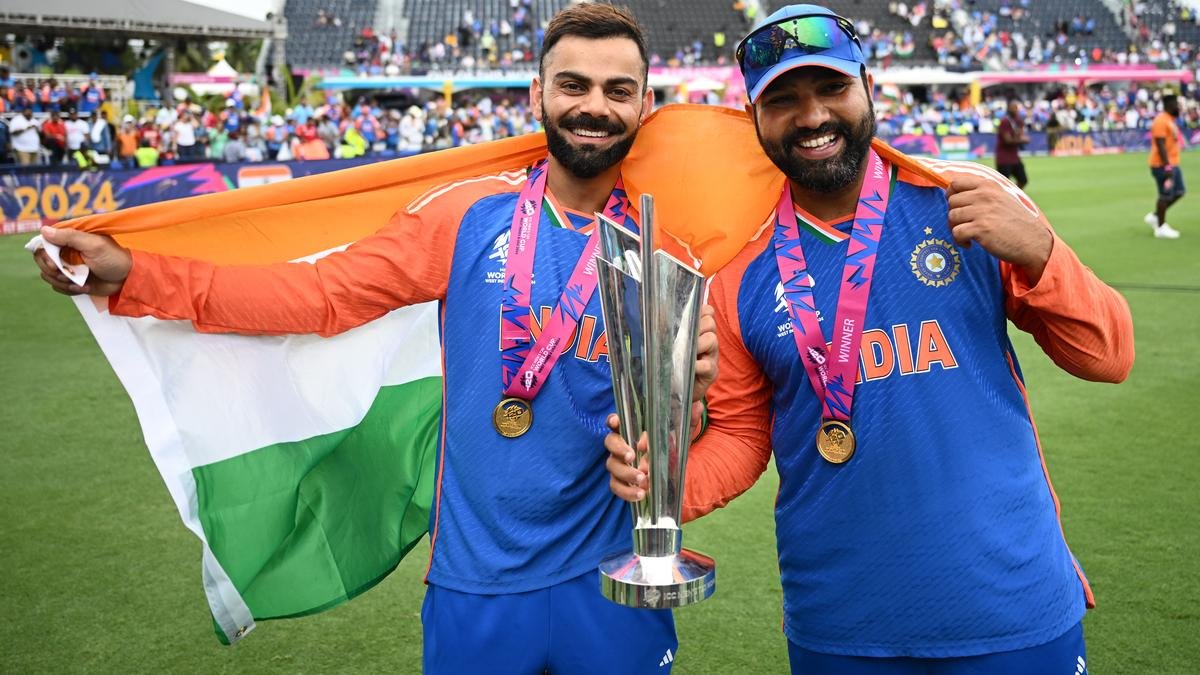
The larger-than-life standing of Virat Kohli and Rohit Sharma, by dint of their impact spanning formats in their pomp, is a shining example.
Among the young Indian batters teeming with promise, only Shubman Gill has featured in all genres over the last 12 months. The Test and ODI skipper was ubiquitous in the latter half of 2025 before being dropped from the shortest version ahead of this year’s T20 World Cup.
Two out of three: Shubman Gill has flourished in Tests and ODIs, but the fast-changing demands of the shortest version have cost him his T20I spot.
| Photo Credit:
Getty Images
While a taxing schedule inconvenienced the suave stroke-maker — Gill had to captain India in a Test against the West Indies in Ahmedabad three days after the Asia Cup final against Pakistan in Dubai — the fast-changing demands of the T20 game also became a factor.
Gill’s strike rate of 138.59 in T20Is, perfectly fine for an aggressive batter some years ago, was not quite in keeping with the pyrotechnics that Abhishek Sharma and Sanju Samson could offer. With Vaibhav Sooryavanshi bursting onto the scene subsequently, Gill has drifted further away from the T20I scheme of things.
It provides food for thought: the influx of greater aggression in the five-day game may convey the impression that the methods across the three modes overlap more than ever before, but the needle is moving at such a blistering pace in T20s that even someone with Gill’s all-round prowess could be perceived to be a tad archaic.
If the canvas is expanded to the global landscape, Travis Head and Harry Brook spring to mind for their all-pervasive presence. Indeed, they belong to a group of four, alongside Gill and Bangladesh’s Najmul Hossain Shanto, who have played more than 20 Tests, 20 ODIs and 20 T20Is each since the start of 2024.
While the 32-year-old Aussie benefits from occasionally being rested for bilateral white-ball assignments, Brook, 27, is working his way around an insanely busy calendar. He is England’s white-ball skipper, and the fulcrum of the Test team.
Always on: As England’s white-ball skipper and fulcrum of the Test team, Harry Brook is working his way around an insanely busy calendar.
| Photo Credit:
Getty Images
For the few pacers who crisscross formats, the strain is infinitely higher. More than their attributes needing alterations, their endurance is put through a rigorous examination.
Jasprit Bumrah and Jofra Archer can testify. Both quicks are formidable whenever available for their respective countries, their inimitable gifts of speed and swing never distinguishing between genres. But what they haven’t been blessed with are injury-resistant bodies. It compels India and England to wrap their spearheads in cotton wool and unleash them for the very elite battles.
An era winds down
Australia has been fortunate in this regard to be served by the pace triumvirate of Mitchell Starc, Josh Hazlewood and Pat Cummins. Until Starc’s T20I retirement last year, all three sacrificed comfort for all-round supremacy, and were suitably rewarded with an ICC title in each format.
But the Australian pacers are nearing their twilight. Kohli and Rohit, meanwhile, are just playing the 50-over version in the quest for a swansong next year. Will these greats represent the last of a kind? Or will the game continue to facilitate all-format stardom? That will dictate whether the virtue of versatility remains attractive to the cricketing universe.


