






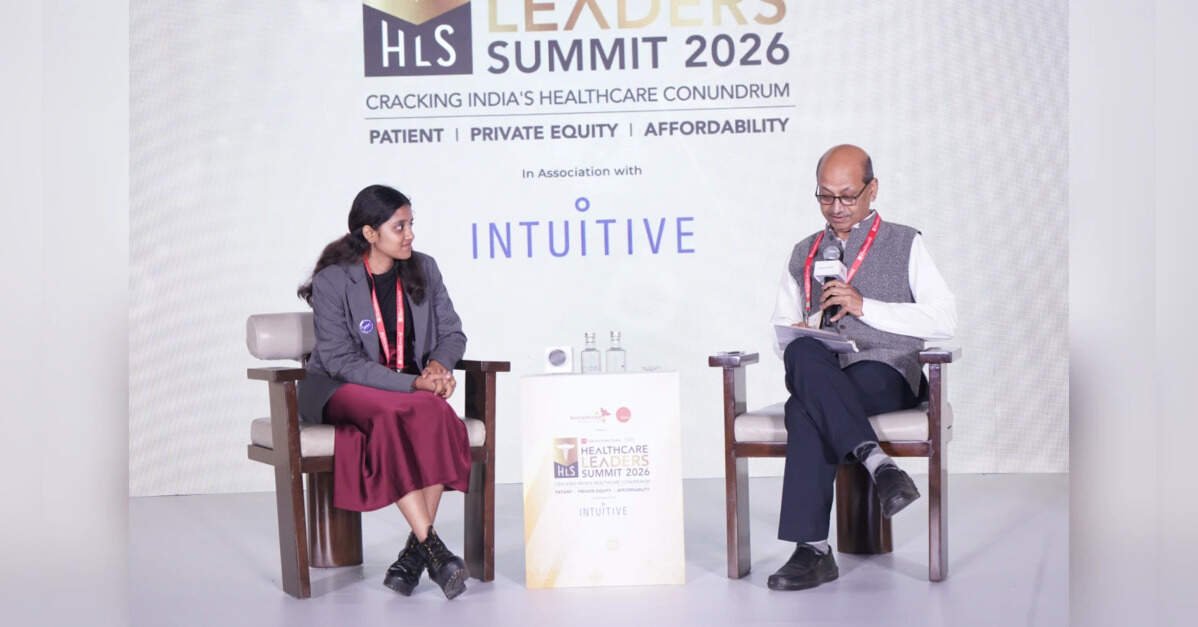
New Delhi: India’s medical education system has expanded rapidly over the past decade, but the growth in seats has not translated into equal access, said Dr. Chaitra B A, President, Medical Students Association of India (MSAI), the country’s largest student-led medical body with nearly 25,000 members.
Speaking at ETHealthworld’s Healthcare Leaders Summit, sixth edition, at a panel titled “The Real Story of Medical Education Expansion in India: Accessible, Affordable or Illusion?”, Chaitra discussed the gap between the expansion of medical education capacity and its actual accessibility. The session was moderated by Dr. Rajib Dasgupta, Head, Centre for Social Medicine and Community Health, Jawaharlal Nehru University (JNU).
Growth without accessibility
Describing the Indian medical education system as “broken,” Dasgupta asked, “Do you think it’s too harsh a judgment?” Chaitra pushed back on the framing, while acknowledging the underlying problem. She said undergraduate and postgraduate medical seats have almost doubled over the last decade, but the numbers alone don’t tell the full story.
“The numbers don’t exactly mean that they are affordable or accessible to everyone. There still remains regional disparity, and there still remains financial disparity too, she added.
Responding to Dasgupta on the sharp gap in seat availability across states, Dr Chaitra said, “The national average stands at roughly 75 seats per million population, ranging from a low of 21 in Bihar to close to 150 in some southern states, with Puducherry a significant outlier at around 2,000 seats per million.
“How many of these seats are actually accessible to an average Indian household? Most of these colleges are private colleges, and not everyone would be able to afford them.”
She noted that in Bihar, a single graduating doctor is effectively expected to cater to 40,000 to 50,000 patients, compared to 5,000 to 10,000 in states like Karnataka or Telangana. “That disparity is what concerns us,” she said.
The cost of becoming a doctor
Turning to affordability, Dasgupta asked what strategies MSAI would propose “to minimize the cost of medical education,” and whether the association had a vision on this.Dr.Chaitra said the financial burden of medical education should not fall on students or institutions alone.
“We would like to propose a multi-disciplinary approach. We don’t want all the burden of cost to fall only on the student or only on one institution. It should be a conjunction between the government, the private institution and the students with government scholarships or subsidies, partial cost-sharing by students, and subsidised rates from institutions.”
Dasgupta raised the Parliamentary Standing Committee on Health and Family Welfare’s December 2025 recommendation that state-government fee structures apply to at least 50 per cent of seats in private colleges. Dr. Chaitra called it a necessary step, but flagged a gap between policy and ground reality.
“What actually happens is there might be another transportation fee, hostel fee, accommodation fee, and many other miscellaneous fees. What we exactly need is transparent financial accountability, so that whoever is getting into that institution knows upfront as to what they are committing to.”
On the future workforce itself, Chaitra said motivations among her generation are shifting in response to declining public trust in MBBS-only graduates, pushing more students toward postgraduate specialisation, which she added has its own complications.
She stressed that increased medical education capacity means little unless it is matched with equitable access, consistent training standards, and financial transparency.


