



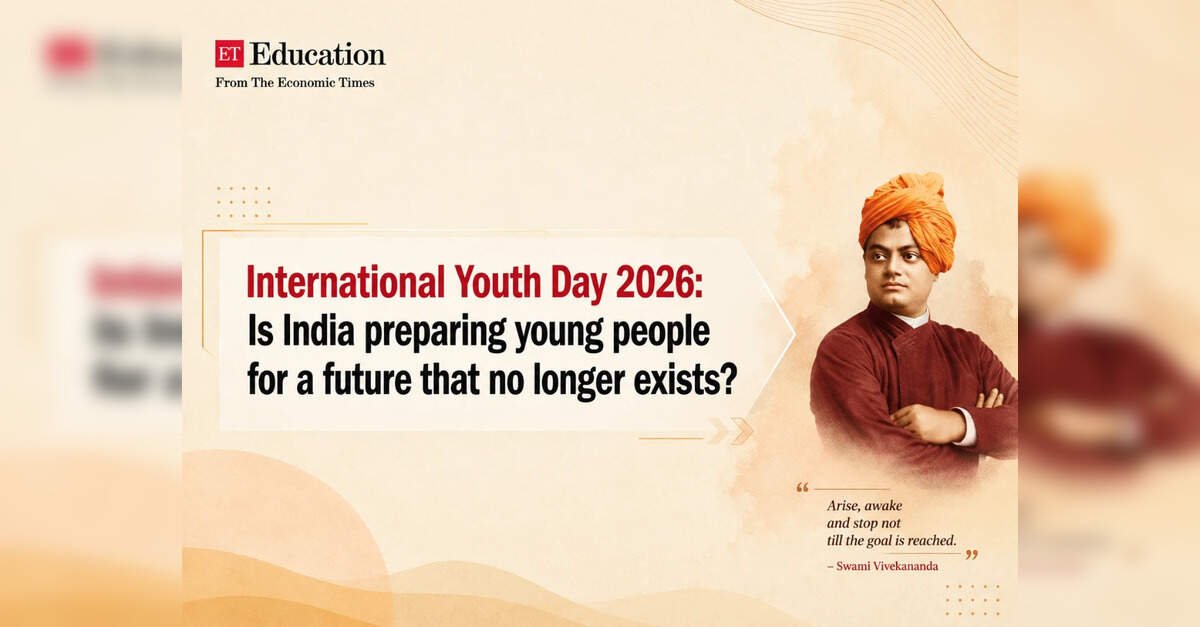
India’s youth do not need a longer runway. They need a different direction.
“The ignited minds of the youth are the most powerful resource on the earth, above the earth and under the earth.” – Dr APJ Abdul Kalam
India has never lacked ambition. It has never lacked talent. What it cannot afford to lack now is relevance.
Every generation inherits a world from the one before it. But today’s young Indians are inheriting something far more unpredictable: a world where artificial intelligence is rewriting jobs, entrepreneurship is redefining careers, climate and geopolitical shifts are reshaping economies, and the half-life of knowledge is shrinking faster than ever.
On International Youth Day (12 August), the central question is no longer whether India has enough young people. It is whether India is preparing them for the world they are actually entering.
Degrees are multiplying. Universities are expanding. Skills are becoming a national priority. Yet a deeper question continues to linger across classrooms, campuses and boardrooms: are we preparing young people for the future, or preparing them for a future that has already disappeared?
To understand how education can rise to this challenge, ETEducation reached out to some of India’s most distinguished education leaders, university heads and institution builders. We asked them two questions that go beyond policy and strike at the heart of the country’s education debate.
Q1 | The reality check
Is India preparing young people for the future, or preparing them for a future that no longer exists? What is the biggest illusion our education system continues to promote to students today?
This question exposed a striking pattern. Across universities, schools and industry, leaders argued that the greatest illusion education continues to promote is that degrees guarantee security.
For many, the problem is not access to education. It is the definition of education itself.
Dr Vidya Yeravdekar, Chancellor, Symbiosis International University, believes the system is still preparing students for employment, but not necessarily for employability in a world transformed by AI, automation and entrepreneurship
“India is preparing its youth for employment, but not always for employability in a world being reshaped by AI, automation and entrepreneurship. The biggest illusion our education system promotes is that academic credentials guarantee career security. The future will reward those who can learn, unlearn and reinvent themselves continuously. Education must therefore move from preparing students to pass examinations to preparing them to solve problems.”
That idea of adaptability over accumulation appears repeatedly throughout the responses.
Shishir Jaipuria, Chairman, Jaipuria Group of Educational Institutions, argues that the future will reward application, not simply knowledge.
“Indian education system has made creditable strides in expanding access to learning, but it needs to evolve continuously to prepare young people for the future that is so hard to predict, owing to the incredible speed at which Artificial Intelligence is developing. But one thing is certain. The future will not reward knowledge as much as its application. Our education system needs to make a seismic shift from testing knowledge to a new paradigm wherein critical thinking, problem solving, collaboration and creativity become the cornerstones of learning and assessment. There has to be a greater focus on vocational education as well. The National Education Policy 2020 has already nudged us in the right direction. The education system needs to take the next leap to make learning resilient and competency-based. The future belongs to those who can learn, unlearn and relearn.”
Several leaders pointed to an even deeper concern: education is still organised around yesterday’s definitions of success.
Dr Arun Mohan Sherry, Director, IIM Shillong, says the system continues to overvalue credentials.
“India is preparing many young people for yesterday’s definitions of success rather than tomorrow’s realities. The biggest illusion our education system still promotes is that academic credentials alone guarantee meaningful careers. In an AI-driven world, adaptability, critical thinking, ethical judgment, creativity and lifelong learning will matter far more than memorization or static expertise. Our challenge is to cultivate learners who can continuously evolve, not just graduates who can pass examinations.”
For others, the gap is structural.
Dr Sunder Raju, Chancellor, Atria University, Bengaluru, believes academia has not kept pace with the speed of change.
“Academia’s bane is its comfort in a siloed world, delivering yesterday’s knowledge to today’s young adults. Faculty training has barely shifted to match. When curriculum refreshes every seven years in a world changing every two, we fall five to seven years behind, and it compounds. So parents hide behind the degree as the only metric, and industry rues the lack of ready students. We must raise sharper questioners.”
The conversation then shifts from curriculum to culture.
Radhika Bharat Ram, Joint Vice Chairperson, The Shri Ram Schools and Founder Chairperson, KARM for Young Indian Women, argues that the real illusion lies in how we define learning itself.
“The biggest illusion is that learning is about remembering the right answers. If the youth has to be ready for this increasingly complex world, we need to move from rote to a love for learning, based on curiosity, creativity, and critical thinking. The future belongs to lifelong learners. I would, therefore, make learning more friendly, experiential and connected to everyday life, so young people graduate with confidence and the ability to adapt. Also, providing social-emotional scaffolding is critical to ensure that every youth feels safe, supported and confident enough to learn, explore and express themselves.”
That emphasis on ambiguity and human capability becomes even more pronounced in the next response.
Prof (Dr) Vijay Tiwari, Vice Chancellor, Shri Ramswaroop Memorial University, believes the future will belong to those who can navigate uncertainty.
“India’s youth are entering a world where technology, AI and global economic shifts are redefining opportunities almost every day. Education, therefore, cannot remain limited to degrees, conventional curricula or examination outcomes. The biggest illusion is that academic achievement alone guarantees success and a single skill may be sufficient. Eventually multidisciplinary and cross function dependency of the processes shall survive. We must train student to deal in ambiguity. When the instructions are not clearly defined, human mind can perform better than AI machines, as evident with ambiguous prompts. Skills cannot be competed with only the mix of skills, interfaced with different streams with undefined dependencies and ambiguities may survive. We must equip young people with curiosity, critical thinking, adaptability, creativity, digital fluency, ethical values and the ability to continuously learn, innovate and lead.”
The strongest reminder may be that education should not merely prepare young people for change. It should prepare them to create it.
Anju Soni, Principal, Shiv Nadar School, Noida, frames that responsibility with clarity.
“I believe our responsibility is not to predict the future for children, but to prepare them to shape it. The biggest illusion education can create is that there is a prescribed path to success. In a world being reshaped by AI, geopolitics and constant environmental change, young people need more than grades and knowledge; they need the skills to navigate a BANI (Brittle, Anxious, Nonlinear and Incomprehensible) world. They need curiosity, critical thinking, empathy, resilience and, above all, the confidence to question, create and navigate the unknown.”
And finally, Nandita Abraham, Dean, BITS Design School, Mumbai, captures perhaps the most profound distinction of all.
“The biggest illusion is that a degree equals preparation. It equals exposure. India’s education system still designs for the job that exists at graduation, not the problem that will exist five years later. We train students to answer questions someone else has already framed. The world ahead will reward the ones who know how to find the question. That is a completely different skill, and most institutions are not teaching it.”
Q2 | The next generation
If the first question diagnosed the problem, the second explored the redesign.
If you were redesigning higher education for a 20-year-old in 2026, what would you remove before deciding what to add, and why?
The answers were surprisingly consistent: remove rigidity, remove rote learning, remove disciplinary silos, remove the obsession with degrees and content coverage.
Dr Vidya Yeravdekar begins with a bold proposition.
“India’s challenge is not a shortage of educated youth, but an education system still designed largely for a predictable world. The greatest illusion we perpetuate is that a degree, by itself, is a passport to success. In an era of AI and constant disruption, the real currency will be adaptability, curiosity, creativity and the ability to keep learning. Education must prepare young Indians not merely for jobs, but to shape the future of work.
If I were redesigning higher education for a 20-year-old in 2026, I would first remove rigid disciplinary boundaries, rote learning and the assumption that a degree is the destination. I would then build an ecosystem where technology, entrepreneurship, liberal learning and social responsibility intersect. The university of tomorrow must develop problem-solvers and responsible innovators, young people equipped not simply to participate in India’s growth story, but to lead it.”
That redesign, many argue, must be anchored in the real economy.
Shishir Jaipuria believes universities must become more closely aligned with industry and entrepreneurship.
“If we look deep into the Indian business ecosystem today, we notice a great hunger for entrepreneurship. Youngsters have high aspirations to try out their own entrepreneurial ideas, thanks to a favourable environment facilitated by technology and government support. The higher education has to be in sync with these ambitions. It has to be more and more aligned with industry reality rather than be steeped in textbooks. We need to remove the over-reliance on theories and bring in actual sectoral rigour in higher education. This will help us mitigate and remove the skills gap observed in industries. The emphasis has to be on continuous learning, innovation and upskilling so that the graduates have the resilience and adaptability to evolve with the ever-changing jobs market.”
For Dr Arun Mohan Sherry, the priority is breaking academic silos.
“If I were redesigning higher education for a 20-year-old in 2026, I would first remove rigid, siloed curricula and the overemphasis on rote assessment. Before adding new technologies or subjects, we must create space for interdisciplinary learning, real-world problem-solving, entrepreneurial thinking and human-centered skills. The future belongs to graduates who can connect knowledge across domains, collaborate effectively and learn continuously.”
The next step is changing what society values.
Dr Sunder Raju challenges the dominance of the degree itself.
“We are creatures of inertia. Too much of teaching still presumes learning was complete the moment a student entered the classroom, breeding a learning rigor mortis from day one. I would shake that loose by loosening the degree’s grip as our sole metric. Generative AI will supply most specialised domain knowledge, so articulation, collaboration and the ability to implement from the start become the real measures. The sooner, the better.”
Radhika Bharat Ram expands the redesign beyond curriculum to equity and agency.
“I would begin with removing the way we judge both the educators and the educated, bringing in value for problem solving and risk-taking, along with removing the rigidity of higher education, challenging the fixed disciplines, classrooms and timelines.
I believe that a 20-year-old today needs a multi-disciplinary appreciation and approach, aided with exposure to different fields, real-world experiences and diverse perspectives.
As equal stakeholders, I would focus on the role of higher education for women. It has to go beyond academic achievement, to ensure financial independence, negotiation, risk taking and decision making on her terms. Education must enable her voice, choice, comfort with money and self-belief.”
The redesign also has to acknowledge how this generation actually learns.
Prof (Dr) Vijay Tiwari argues for flexibility, technology and real-world immersion.
“If we were redesigning higher education for a 20-year-old in 2026, we would move beyond rigid curricula, rote learning and the traditional separation between academia and industry. The delivery methods should be innovated and also duration of such engagements should be suitable to the attention span of Gen Z. More pictures, movies, audio visual contents, related with social media and also the informal methods/visits/industry engagements. Exposure of the students to live situation, interaction with the elderly, conversation on human value system etc. would be in order. Education should become more flexible, interdisciplinary, experiential and technology-enabled. Students must have greater exposure to research, entrepreneurship, emerging technologies, global perspectives and real-world challenges. The objective should be to develop not just employable graduates, but responsible innovators, creators and nationbuilders.”
For Anju Soni, the most important reform is giving students ownership of their learning
“If I were redesigning higher education for a 20-year-old in 2026, I would move away from rigid disciplinary boundaries and the idea that learning is confined to classrooms or defined by a degree. I would create greater space for exploration, interdisciplinary learning, research, entrepreneurship and real-world problem-solving. Most importantly, young people should have the agency to shape their learning, use AI ethically and develop the judgement to lead in an uncertain world while retaining empathy and valuing human relationships.”
And Nandita Abraham ends with a powerful reminder that the future cannot be taught through excess.
“I would remove the obsession with coverage. The belief that more subjects, more credits, more content equals better education. It doesn’t. Before adding anything, I would create space: unstructured time, live problems with no known answer, and the experience of failing in a low-stakes environment. A 20-year-old in 2026 needs judgment, adaptability, comfort with ambiguity and the confidence to act without complete information. No syllabus teaches that. Proximity to real problems does.”
Beyond degrees, towards capability
The conversation does not end with universities. It extends to the relationship between education and work itself.
As Shilpa Dua, CHRO, NIIT Limited, puts it:
“The future of India’s youth will not be defined by credentials, but by their capacity to learn, unlearn and turn learning into value. As technology disrupts faster and innovation cycles shorten, a degree can open a door, but capability will define how far you go. Education must therefore move beyond knowledge to build learning agility, real-world problem-solving and the confidence to innovate. Stronger industry-academia partnerships can make this shift real. India’s greatest advantage will be the youth that isn’t just ready for the future of work but the one who shapes it.”
That sentiment finds a broader social echo in the words of Shyam Menon, Vice Chancellor, BML Munjal University:
“Celebrating International Youth Day assumes added significance in these times, when it has become as clear as daylight that it is the younger generation that is showing us the way forward, transforming our perspectives and bringing new life to our society through their courage and their readiness to speak the truth and act without fear.”
Dr D Subhakar, Vice Chancellor, Amity University, Bengaluru, reinforces that the real shift is from acquiring knowledge to creating value.
“The biggest illusion is that knowledge alone is preparation. Recall is now the cheapest commodity in the world; what young Indians need is judgement, curiosity and the confidence to keep learning. It is no longer enough to ask what our graduates have learnt. We must ask what they can do with it. That belief in what young people can create, not merely seek, guides everything we do at Amity.”
The real test of International Youth Day
International Youth Day is often celebrated through numbers: demographic dividend, enrolment rates, startup founders, innovation rankings. But this conversation suggests that the real test is different.
A country does not become future-ready because it has millions of young people. It becomes future-ready when its young people can question assumptions, work across disciplines, learn continuously, use technology ethically, and solve problems that do not yet have names.
The leaders in this feature may disagree on methods, but they agree on one fundamental truth: the future will not reward those who know the most. It will reward those who can become more than what they know today.
And perhaps that is the most important lesson of International Youth Day 2026.
The question is no longer whether India’s youth are ready for the future.
The question is whether India’s education system is ready for its youth.


