



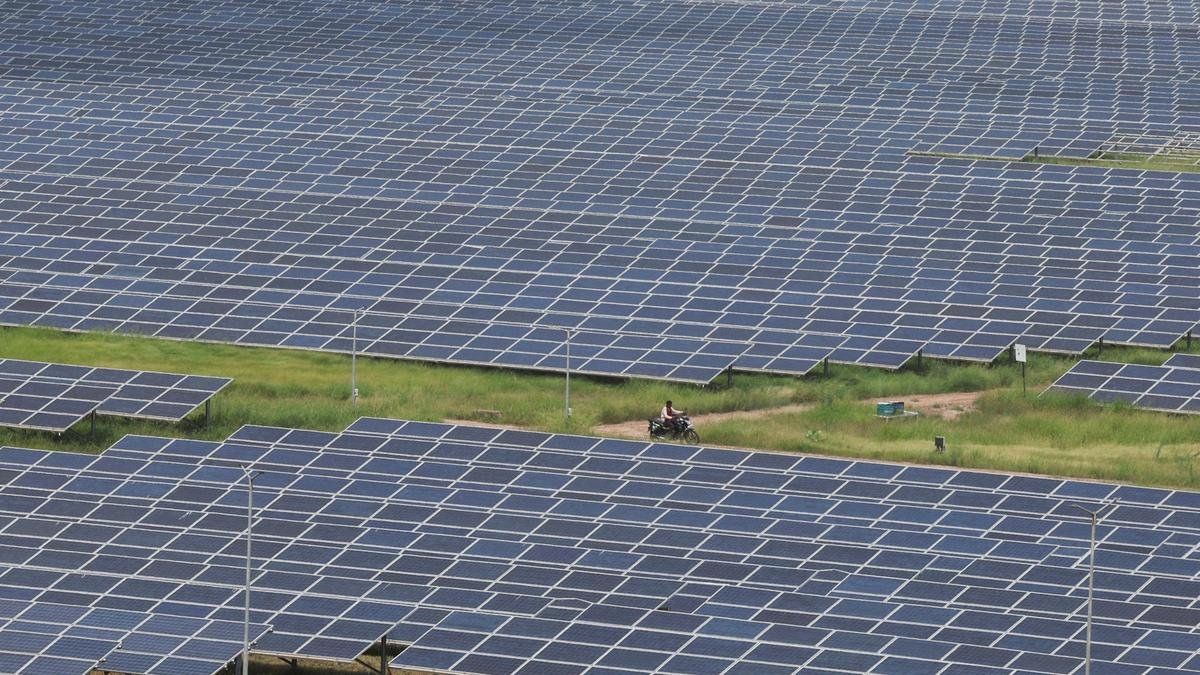
Although renewable energy seems to be the right solution to replace polluting sources, the report cautions that studies are needed to assess the long-term effects of uncontrolled tapping of natural resources.
The story so far:
A Mega Science Vision-2035 report on Climate Research is a roadmap prepared by the Indian climate research community with the Indian Institute of Science (IISc), Bengaluru, as the nodal institution, and submitted to the Office of the Principal Scientific Adviser (PSA) to the Government of India, was made public this week.
What is its central message?
The central message of the report is that India has effectively lost the ability to build its own scientific instruments. “Today, virtually no company in India manufactures quality scientific instruments for climate research,” it states, adding that “billions of rupees have been spent and continue to be spent on procuring instruments manufactured elsewhere.” Worse, imported instruments are often used “without knowing the principle of operation, the built-in assumptions… and their limitations,” and left uncalibrated for years — producing, in the report’s words, “incorrect data being reported in national and international journals, often leading to questions on the credibility of Indian science.”
What is the Mega Science Vision exercise?
The Mega Science Vision exercise, historically used to plan large, long-horizon projects in nuclear and high-energy physics, was for the first time extended to climate research, ecology and astronomy, and facilitated by the PSA’s office under Prof. Ajay K. Sood. A working group chaired by Prof. S.K. Satheesh, with former Indian National Centre for Ocean Information Services (INCOIS) director Dr. S.S.C. Shenoi, as member-secretary, drew on consultations with over 3,000 researchers. Crucially, the document calls itself “a Climate Research community document” of “hopes and aspirations” whose projects are “indicative” — it is neither a mandatory prescription nor a statement of government policy or funding.
Hasn’t India built any of its own climate instruments?
It has built prototypes, but rarely products. The report notes that Indian engineers can design and demonstrate instruments, “some of which have already been demonstrated successfully,” yet “they are not often translated into final industrial products.” Examples include automatic profiling floats developed at the National Institute of Ocean Technology for ocean observation, and automatic weather stations by the India Meteorological Department and ISRO. Although transferred to industry, “most of them have not reached the market yet.” Tellingly, the first phase of the proposed sensor programme is an audit to identify why such technologies fail to scale to production. The suggested remedy — mandating that most instruments be made in India, backed by assured procurement and pricing — sits uneasily with recent experience: the Government e-Marketplace (GeM) portal, made mandatory to support domestic vendors, was rolled back for scientific institutions in June 2025 after scientists found it hindered access to customised, high-quality equipment.
Why study uncontrolled renewables?
Although renewable energy seems to be the right solution to replace polluting sources, the report cautions that studies are needed to assess the long-term effects of uncontrolled tapping of natural resources — even as it insists renewables must remain a priority to sustain recent momentum. India, which has pledged 500 GW of non-fossil capacity by 2030, crossed the halfway mark in installed capacity in 2025. The report also calls for scientific methods to estimate the social cost of carbon, a “polluter pays” mechanism to prevent the atmosphere from becoming a dumping ground, and measures to offset the burden of carbon taxation on the poor.
What else in the report is of importance?
The report proposes a pan-India Climate and Health Observatory under a mega project on adaptation and resilience, reflecting how thinly India tracks climate-related health impacts. It outlines eight mega projects spanning observational networks, indigenous sensors, satellites, two strands of climate modelling, field campaigns, carbon-neutrality research and adaptation science, to be overseen by a high-level apex committee. On science, it enters contested ground, backing a dense Black Carbon observatory network despite disputed claims about its relative role in global warming. It flags India’s thin paleoclimate networks as a gap in understanding the monsoon’s deep past, and the risk of crossing tipping points such as ice-sheet collapse and shifts in ocean circulation. It also warns of limited trained manpower, including in environmental epidemiology.
Published – June 04, 2026 08:30 am IST


