



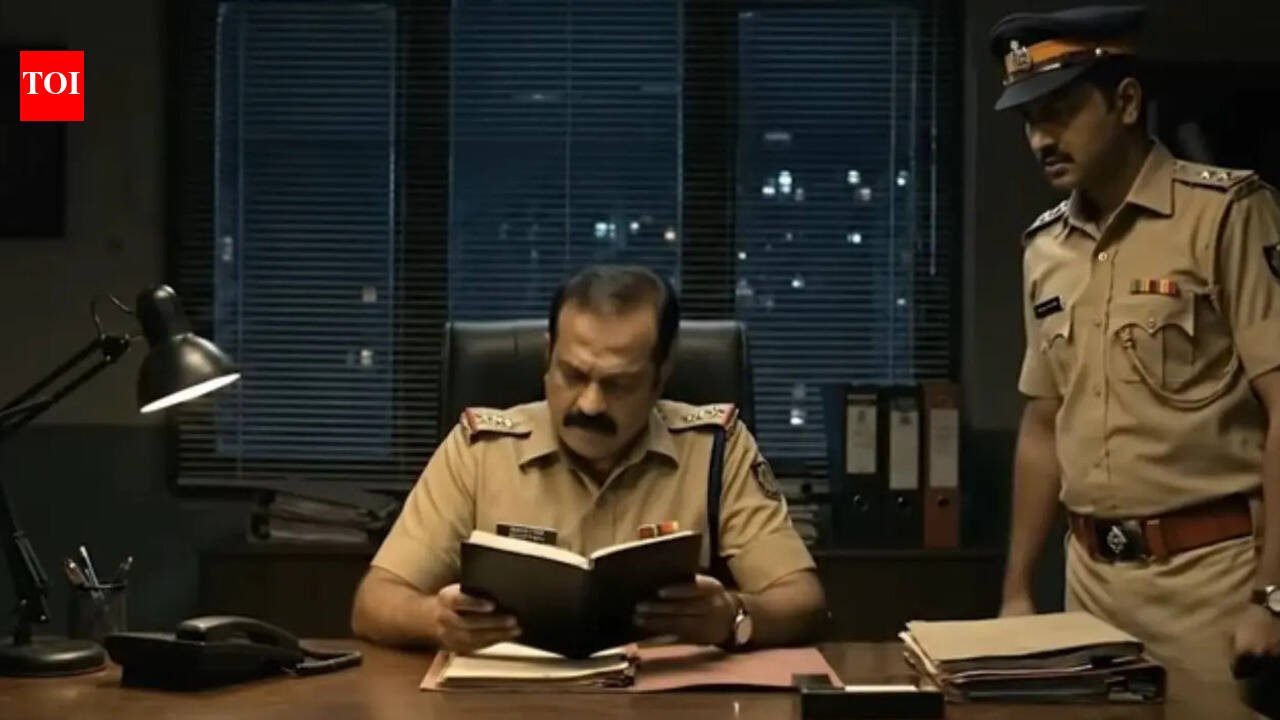
KOLKATA: This year, the world’s first Bengali AI short film was released online, representing an early experiment in the region’s screen industry. Initial audience responses have been mixed. But with further technical refinement, can this format become a disruptive force in Tollywood? ‘Jeyra’ is directed and written by Rohan Roy, with AI engineering by Roy, post-production and AI-based editing by Suman Biswas, assistant AI engineering by Koyel Chakraborty, and concept and mentoring by Oney Seal. Released on January 7 this year, the film is set entirely in a Kolkata police interrogation room. It is fully dialogue-driven, centring on a police officer questioning an accused. On January 25, ‘Chhaya’ premiered online, portraying a middle-class man who discovers his shadow has disappeared, escalating into a psychological mystery that blurs reality and perception. Conceived as a hyper-realistic AI film, it is directed and written by Suman Ghosh. Florida-based Seal pointed out that in the past, a grand cinematic scale required an army of technicians and millions in capital. According to him, AI pushes the “boundaries of filmmaking” by blending “surrealist aesthetics with deep emotional resonance”, proving that algorithms can indeed mirror the soul’s complexity. “We are witnessing a fundamental shift where the technical execution no longer gatekeeps the artistic vision. In the past, a grand cinematic scale required an army of technicians and millions in capital. Today, we are handing those keys to the dreamers. By leveraging these tools, we aren’t just making movies faster; we are making them more personal, more diverse, and more daring. The release of these films is a manifesto for the future: one where the next great masterpiece could come from a lone creator with a laptop and a story to tell. At Databazaar Digital’s AI Film Studio, we aren’t just observing this revolution — we are fueling it,” Seal said. Seal refutes the argument that the synergy of AI and cinematic storytelling is just a technological evolution. “It is a total democratization of the medium. With ‘Jeyra’ and ‘Chhaya’, we have demonstrated that language and local culture are no barriers to innovation. AI allows us to explore the human condition through a digital lens, and we are moving toward a world where the only limit to filmmaking is the depth of one’s imagination, not the size of one’s production budget,” Seal said. With every passing day, the use of AI in various departments of filmmaking in Bengal has generated pleasant surprises. In some cases, it has also drawn criticism for uneven performances and intrusive foley work. But then again, these are limitations common in first-generation productions. As the technology matures and more stakeholders enter the field, qualitative improvement appears likely. In this context, industry bodies, including the Federation of Cine Technicians and Workers of Eastern India (FCTWEI), sometimes criticised for restrictive clauses, may need to reassess their influence and consider whether existing practices support innovation and sustainable growth. Many point out that Tollywood is already witnessing AI’s effectiveness in the case of designing posters and social media content for film promotions. Directors like Atanu Ghosh are looking forward to using AI “only as a partner” in his “thinking process”. “That way, it is easy to explore possibilities more quickly, sharpen structure, and test variations while retaining imagination and emotion strictly to myself. Due to AI’s ability to drastically reduce time for doing routine tasks, I would be able to concentrate more on getting data, analyzing, and experimenting,” Ghosh said.
An experimental frame from ‘Raghu Dakaat’ created with AI by Sugata Guha for discussion with the director
Actor Rayati Bhattacharya, who has directed two short films, is absolutely against the idea of replacing actors with AI. “Since I am an actor myself, I do not warm up to the idea of getting AI to replace actors on screen,” she said. But that doesn’t mean she is absolutely against the use of AI in cinema. “If there is something that I can’t create but can imagine, I will certainly welcome AI to do that for my directorial projects. That would include special effects or scenes that we can’t afford due to our budget or limitations. I wouldn’t mind using AI for creating a character which is not real. I believe AI can amplify creativity, but it can never replace the human imagination behind it,” she said.
A still from ‘Chhaya’
Another important sector where AI’s contribution is being debated is writing scripts which have often been described as the backbone of a film. Scriptwriter Samragnee Bandyopadhyay believes it is futile to resist the invasion of AI into the writers’ room. “It is sad but fact is some will lose their job because a lot of the groundwork will be done by AI in future. The flip side to this is many who didn’t hire good scriptwriters will begin their projects with at least a better script that is drafted by AI. But I feel there is no need to be scared as long as we can continue to upgrade ourselves. There will be no replacement for those who have that X factor and the emotional acumen to add that extra zing to a script drafted by AI prompts,” she said. A big issue that Tollywood is already facing is the increasing dependence on ready-to-paste copies drafted by AI. “Many youngsters are now relying only on AI to write. That is a dangerous trend since their own practice of learning from mistakes is taking a backseat,” Bandyopadhyay added. The intellectual laziness leads to lack of skillset development leaving them incapable of delivering independently. Screenwriter Sugata Guha describes AI as his “favourite assistant”. “It is great for research and brainstorming ideas. It also helps me create frames and storyboards for my scenes, so that I can gauge the visual impact of what I have written. I used AI for visualisation while working on Dhruba Banerjee’s ‘Raghu Dakaat’ and ‘Saptadingar Guptodhon’. That is an interesting tool in the hands of a screenwriter. But at the end, the final word is mine, and that’s the ethical confidence I maintain.”


