



Iran accuses US of ‘barbaric attack’ near children’s cancer hospital
Iran has accused the US of launching a “barbaric attack” near a children’s cancer hospital in Ahvaz south-west of the country.
The Iranian foreign ministry spokesperson, Esmail Baghaei, said the hospital was forced to evacuate, causing “severe suffering and anxiety” for the children being treated there.
In a post on X, he said:
Shahid Baqaei Hospital, a children’s cancer treatment centre in Ahvaz, was evacuated last night after the US attacked a nearby location.
This barbaric attack, reminiscent of Israel’s atrocities against healthcare facilities, caused severe suffering and anxiety upon the hospitalised children, and forced the emergency evacuation of 211 patients undergoing chemotherapy.
This constitutes a cowardly war crime against the most innocent of human beings – children who are bravely fighting for their lives.”
The US did not immediately comment on the allegation. The US military has intensified its strikes and widened its targets in Iran in recent days, with Iranian state media reporting explosions in several cities in the north and south and around the capital Tehran.
Key events
Here are some of the latest images on the newswires from the Middle East:
Aram Roston
The average price of diesel fuel in the US has increased again to more than $5 a gallon, according to the AAA, and the average price of gas is almost $4, returning to their highs before the June memorandum of understanding between the US and Iran.
It’s a reminder to consumers and truckers of the costs of the Iran war and the unpredictable rhetoric from both Washington and Tehran. A year ago today, the AAA says, the average price for a gallon of diesel was $3.72, almost a dollar and a quarter less than it is now.
Earlier this week, Iran declared the strait of Hormuz shut, after both Iran and the US claimed to be the guarantors of safe passage through the strategic waterway. Then the US announced it was imposing a blockade on all ship traffic to or from Iranian ports.
Kuwait says it is responding to new round of incoming fire from Iran
The Kuwaiti army said it was responding to renewed drone attacks from Iran after facing strikes overnight.
“Kuwaiti air defences are currently engaging hostile drone attacks following the Iranian aggression,” the army said in a statement.
“Any explosions that may be heard are the result of air defence systems intercepting hostile targets.”
Iran has launched retaliatory strikes on its regional neighbours including Kuwait, Bahrain and Jordan, saying it is targeting US bases located in those countries.
Drone strikes ship off Iraqi port – reports
AFP and Reuters have reported a drone struck a ship located off the port in Iraq’s southern province of Basra.
Citing oil and security sources, the news agencies said the ship, which was “carrying American-branded cars”, had arrived from the UAE today and was hit near an oil terminal. Crude oil loading has been suspended at all Iraqi terminals as a result of the incident.
It was not immediately clear who launched the drone.
Iraq’s oil ministry said it was verifying reports of an unspecified “object” falling on a tanker.
Syria seize weapons at Iraqi border bound for Hezbollah – report
Syria’s interior ministry said it had seized a shipment of advanced weapons being smuggled across the Iraqi border and destined for Hezbollah in Lebanon, according to the Syrian state-owned Sana news agency.
Sana reported the following:
The ministry said specialised security units carried out the operation after detecting a suspicious vehicle parked near the border. A search uncovered a cache of weapons that included long-range missiles, guided anti-tank missiles and drones.
According to the ministry, preliminary investigations based on evidence collected at the scene indicated that the shipment was intended to transit Syrian territory before being delivered to the Hezbollah terrorist militia in Lebanon.”
Iran accuses US of ‘barbaric attack’ near children’s cancer hospital
Iran has accused the US of launching a “barbaric attack” near a children’s cancer hospital in Ahvaz south-west of the country.
The Iranian foreign ministry spokesperson, Esmail Baghaei, said the hospital was forced to evacuate, causing “severe suffering and anxiety” for the children being treated there.
In a post on X, he said:
Shahid Baqaei Hospital, a children’s cancer treatment centre in Ahvaz, was evacuated last night after the US attacked a nearby location.
This barbaric attack, reminiscent of Israel’s atrocities against healthcare facilities, caused severe suffering and anxiety upon the hospitalised children, and forced the emergency evacuation of 211 patients undergoing chemotherapy.
This constitutes a cowardly war crime against the most innocent of human beings – children who are bravely fighting for their lives.”
The US did not immediately comment on the allegation. The US military has intensified its strikes and widened its targets in Iran in recent days, with Iranian state media reporting explosions in several cities in the north and south and around the capital Tehran.
Lebanon vows to end Hezbollah’s military presence, says foreign minister
The Lebanese foreign minister, Youssef Raggi, said Lebanon has made a decision to “end Hezbollah’s military presence” and that decisions on war and foreign policy are the “exclusive prerogative of the Lebanese state”.
The Lebanese government is pushing to disarm Hezbollah, one of the most heavily armed militias in the Middle East, and it has become a central component of the US-brokered talks between Lebanon and Israel.
The Iran-backed group is the dominant military force in Lebanon and its political arm effectively acts as a government in areas it controls. Hezbollah has rejected calls to disarm and has kept up attacks against Israel.
In a statement posted on X, Raggi said:
Lebanon has made its choice: there will be no return to dual authority, and there is no longer any place for weapons outside the authority of the state or for decisions taken outside its constitutional institutions.
The decision to end Hezbollah’s military presence is a sovereign Lebanese decision. It preceded the Framework Agreement and paved the way for it, affirming that decisions on war and peace, as well as foreign policy, are now the exclusive prerogative of the Lebanese state.”
Images on the newswires show the aftermath of an Israeli airstrike last night at al-Bureij refugee camp in central Gaza. Near daily Israeli attacks have continued in Gaza despite a ceasefire announced in October, killing 1,127 Palestinians and injuring 3,643 since then, according to the Gaza health ministry. In its daily report, the ministry said four people were killed in the past 24 hours, and 28 were wounded.
Netanyahu will not travel to US next week, his office says
Reuters has reported that Benjamin Netanyahu will not travel to the US next week because the funeral of Republican Senator Lindsey Graham has been postponed until the end of the month, the Israeli prime minister’s office said.
Earlier Israeli reports suggested Netanyahu had been set to fly to Washington on Saturday to attend memorial events for Graham, who died on Saturday, and potentially meet Donald Trump.
Israel tells US it will keep troops in occupied ‘security zones’ in Lebanon, Syria and Gaza
In a conversation last night, Israeli defence minister Israel Katz told US defence secretary Pete Hegseth that Israel is determined to keep its forces in occupied “security zones” in Lebanon, Syria and Gaza, according to a statement from Katz’s office reported in Israeli media.
Katz “emphasised Israel’s determination to remain in the security zones in Syria, Gaza, and Lebanon in order to protect Israel’s borders and the communities near the border from the threats posed by jihadist forces”, the statement said.
It appears to contradict an earlier announcement by the US that negotiations held this week in Rome between Israel and Lebanon were “positive” and that the process of implementing “pilot zones”, from which Israeli troops are to withdraw, would begin “in the coming days”. Beirut has demanded the withdrawal of Israeli forces in areas they are occupying in southern Lebanon and for control to be handed over to the Lebanese army.
India orders shipowners to avoid sending Indian crew members on Hormuz routes
India’s government has ordered shipowners not to deploy Indian crew members on vessels that require passing through the strait of Hormuz as violence escalates in the Middle East.
“No deployment of Indian seafarers on vessels undertaking voyages involving passage through the strait of Hormuz until further orders,” India’s directorate general of shipping said in an order issued last night.
The advisory cited recent attacks on two ships in the strait that killed two Indian seafarers, adding that this week’s heightened tensions in the region “have increased the risks faced by seafarers and commercial ships operating in the conflict-afflicted area significantly”.
Reuters reported India is the world’s third-largest supplier of seafarers, with more than 300,000 sailors working across global shipping fleets, according to government data.
Iran’s army spokesperson Mohammad Akraminia said Tehran did not want to confront its regional neighbours, despite an earlier statement by another military official threatening to “crush” infrastructure across the Middle East.
“Iran has no conflict with the neighbouring and Islamic countries of the region and has always emphasised the development of cooperation and brotherly relations with the countries of the region,” he said, according to Iran’s semi-official Fars news agency.
Iran threatens to destroy regional infrastructure if its own is attacked
Iran has warned it would retaliate if its infrastructure is attacked, after Trump threatened that the US military could target Iranian bridges.
In a statement carried by state media, Ebrahim Zolfaghari, a spokesperson for the Iranian military’s Khatam al-Anbiya central headquarters, said “all infrastructure in the region will be crushed”.
He also said Iran would never allow the US to interefere with the strait of Hormuz.
“Under no circumstances and in no way will we allow the United States, as a foreign and extra-regional country, to interfere in the strait of Hormuz. This is Iran’s inviolable red line.”
Pakistan urges US and Iran to return to negotiating table
Pakistan has called on the US and Iran to end the violence and resume negotiations as stipulated in the memorandum of understanding (MoU) signed in June with Islamabad’s mediation.
“While the implementation of the MoU is facing challenges, Pakistan will continue to encourage all sides to end the violence and resume technical level talks in accordance with the MoU,” Tahir Andrabi, spokesperson for the Pakistani foreign ministry, said at a press briefing today.
Jonathan Yerushalmy
The US has fired on an oil tanker attempting to reach Kharg Island in the strait of Hormuz as part of its blockade on Iranian ports, as Tehran came under attack for the first time in this latest round of strikes.
The US said on Thursday morning it had disabled an unladen oil tanker, during a fifth day of strikes, firing Hellfire missiles into the ship’s smokestack after it ignored multiple warnings.
On Wednesday evening, the US targeted coastal defences and missile sites, hours after a separate round of strikes that hit cruise missile storage and launch sites on Iran’s Greater Tunb Island in the morning.
The US also hit targets further north, with state media reporting strikes on the country’s capital, Tehran, and reports of air defences being heard throughout the city early on Thursday.
Read the full report here:
Opening summary: US strikes expand to northern Iran
Welcome to our continuing live coverage of the Middle East crisis.
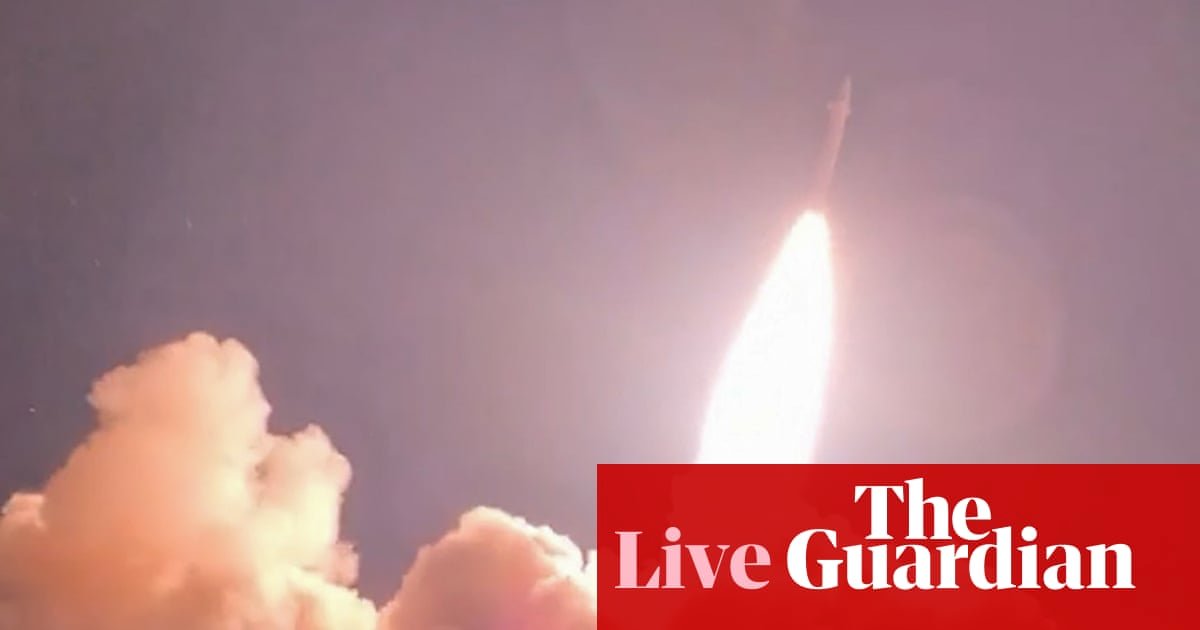
The US military says it carried out a fresh wave of strikes against Iranian targets to degrade the country’s ability to threaten ships transiting the strait of Hormuz, while Iran launched retaliatory attacks on US allies in the region.
US Central Command (Centcom) said targets included the southern port city of Bandar Abbas – home to key facilities belonging to the Iranian navy and Revolutionary Guards – in the strikes overnight to Thursday morning local time. “The US military is holding Iran accountable at the commander in chief’s direction,” it said, referring to president Donald Trump.
Iranian state media said the strikes also hit around Tehran – the first time the capital has been targeted in the latest round of attacks.
Iran targeted US-allied Bahrain, Kuwait and Jordan with missiles and drones in retaliation.
Centcom said US aircraft fired missiles into an oil tanker’s smokestack in the Hormuz strait, disabling the vessel, after it ignored multiple warnings as it tried to violate the US naval blockade of Iran’s ports.
In other key developments:
-
Trump said he did not like giving deadlines when asked by reporters if Tehran had a deadline before the US started attacking Iranian bridges, as he has threatened. “They know the story … They better behave,” he said.
-
Tehran’s top negotiator said that if Iran did not benefit from its memorandum of understanding with the US, “we have no reason to adhere to such an understanding”. Iran had “never welcomed war, nor do we now”, said Mohammad Bagher Ghalibaf, the parliamentary speaker. He called on Iranians to continue with their armed resistance but to also “use the tools of diplomacy and negotiation to achieve and consolidate national interests”.
-
Iranian state media reported explosions in several cities amid the latest US strikes, including Bandar Abbas, Rask, Chabahar and Ahvaz as well as Semnan province, home to the country’s ballistic missile production and space programme. Reports also cited blasts around southern sites including Qeshm and Bandar Imam Khomeini, as well as in Bushehr, home to Iran’s only civilian nuclear plant.
-
The US strikes hit an Iranian army barracks, killed at least seven troops and wounded hundreds of people across the country, according to Iranian officials. There was no immediate word on casualties from Iran’s strikes, but its health ministry said at least 30 people had been killed and 260 injured in southern Iran in US attacks in recent days.
-
Iran’s army said it used kamikaze drones to target US military communication systems and fuel storage facilities in Jordan. The Jordanian military said it shot down eight missiles Iran launched at the kingdom.
-
Trump thanked Iran for allowing an American citizen he says was “wrongfully detained in December of 2024” to leave the country. “She is now safely outside of Iran, and in good condition,” he said, while the woman was named by her lawyer as Dena Karari, a dual American and Iranian citizen.
-
Oil prices continued to rise amid the latest waves of escalation, with Brent crude oil – the international standard – trading above $85 a barrel on Wednesday. That’s more than 15% higher than the price before the war but still well below the nearly $120 reached at the peak of the conflict.


