



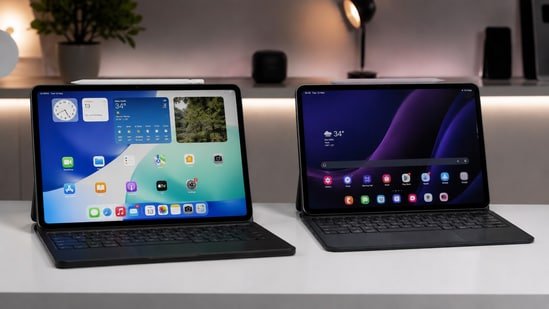
Android tablets vs iPads is a long-running comparison, and it always boils down to this: if you want performance, go for an iPad, and if you want value for money, then go for an Android tablet. But in 2026, most Android tablets like the OnePlus Pad 3 offer flagship-level performance without flagship-level pricing.
Now the real question is experience. The perception has always been that the iPad delivers a better overall experience than an Android tablet. Let’s see if that still holds true in 2026, and if you should go for the more open Android experience or stay inside Apple’s walled garden.
Tablets don’t feel cheap anymore
Most tablets coming out in late 2025 and early 2026 feature premium build quality. Even tablets like Samsung’s Tab S10 and Tab S11 series are IP68 rated, which is something you barely see on tablets. Even budget tablets from Xiaomi, OnePlus and other brands now come with metal builds and super thin designs.
The budget models may not be in the same territory as an iPad, but the mid-range and premium Android tablets can easily offer about the same build quality and in-hand feel as an iPad. So you can remove any doubts about build quality or design while picking an Android tablet in 2026.
The software gap is shrinking
Software is one of the biggest reasons people choose Apple over Android because the iPad experience is more consistent and the software support lasts much longer than most Android tablets in the market. Last year, with the release of iPadOS 26, Apple shrank the gap even further by adding floating window support to iPads, which used to be one of the biggest USPs of Android tablets.
The other side of this debate is app experience because Apple is still doing much better than Android in this segment. The irony is that even some of Google’s own apps work better on iPads than on Android tablets. Apple also has a much bigger library of creative apps that professionals actually use. Final Cut Pro is now available on iPads, and it remains one of the most popular video editing software options out there.
Even though Android tablets can offer floating windows, desktop modes and faster hardware in some cases, they still lack the same level of creative software support as the iPad. So even in 2026, if you want a more refined and productivity-focused tablet with access to a wide range of professional creative apps, the iPad still makes more sense.
The ecosystem advantage
When we talk about ecosystem, Apple still seems to be leading, but brands like Samsung are now offering something very similar. Samsung now has almost the same type of ecosystem Apple offers, including laptops, smartphones, tablets and accessories that work together seamlessly.
During the Galaxy Book6 Pro review and got the chance to properly experience Samsung’s ecosystem. Honestly, I was surprised by how close it feels to Apple’s ecosystem in day-to-day usage.
Now, which ecosystem experience is actually better between Samsung and Apple is still debatable, but the important thing is that Android tablet users now also get access to a proper ecosystem experience. At the same time, your decision mostly depends on which devices you already own because realistically, nobody is going to switch their entire ecosystem overnight. It is expensive on both sides.
Flagship performance is not iPad exclusive anymore
This is probably the biggest change in 2026. For years, iPads dominated this category because Apple Silicon was simply way ahead of Android tablets. But now, tablets like the OnePlus Pad 3, Samsung Galaxy Tab S11 Ultra and other flagship Android tablets are offering performance that is good enough for almost everything.
But again, raw benchmark numbers are no longer the main issue here. The real difference is optimisation. iPads still feel slightly more polished during long-term usage, especially with heavy creative workloads. Apps are better optimised, animations are more consistent and developers still prioritise iPadOS for professional apps.
So if your main focus is just power, Android tablets are finally at the same level. But if you care more about how that performance is utilised through apps and software optimisation, the iPad still has an edge in 2026.
Similar articles for you
Need easy to carry laptop for college? Checkout these budget options from Asus, HP and more
Smartwatch vs. Fitness Band: How to choose the right wearable in 2026
Missing important calls during workouts? Get yourself a smartwatch with Bluetooth calling
Disclaimer: At Hindustan Times, we help you stay up-to-date with the latest trends and products. Hindustan Times has an affiliate partnership, so we may get a part of the revenue when you make a purchase. We shall not be liable for any claim under applicable laws, including but not limited to the Consumer Protection Act, 2019, with respect to the products. The products listed in this article are in no particular order of priority.


