



For most of the last two centuries, we have not had to think much about electricity. At the start of this period, we were just beginning to understand what it was. And towards the end, climate change and renewable energy has rendered it a constant thought in our minds. But for many decades in between, we could take it for granted. Electricity, most of the time, was just something behind a switch. If you flipped the switch, electrons would move through a wire. If you raised the voltage, more current would flow.
But today, there is another way in which some people are thinking about electrons — a way that could, someday, change the future. Scientists have found that inside some materials, in extreme conditions, electricity behaves in highly unusual ways. The electrons stop being independent particles and begin moving together. They flow around edges with uncanny precision. Most of all, the particles seem split up into pieces, each apparently carrying a fraction of an electron’s charge.
From ramp to staircase
Physics has made many weird discoveries — but a real contender for its weirdest find is the fractional quantum Hall effect (FQHE), which is where electrons behave in those strange ways. Recently, physicists were able to make it even stranger by recreating it without one of the conditions they believed to be indispensable for it.
In 1879, the U.S. physicist Edwin Hall found something odd. If electricity flows through a metal plate when a magnetic field is pointing perpendicular to the plate, the current experiences a sideways push. (One reason this was odd was that J.J. Thompson would not discover the electron 18 years later.) Scientists later explained why: the magnetic field pushes moving charges sideways, causing electric charge to pile up on the plate’s edges, creating a voltage across the metal. This came to be called the Hall effect. The compass in your smartphone uses it to point north.
As usual, the rise of quantum mechanics complicated the picture. In the early 1980s, physicists were studying very clean materials at temperatures just a fraction above absolute zero, using magnetic fields. When they increased the strength of the field beyond a point, the resistance the current was experiencing — called the Hall resistance — stopped changing smoothly. Instead, it took discrete values. For example, when before it could change from 1 to 1.1 to 1.2 to 1.3 and so on, now it could change only to 1 or 2 or 3 or so on, like climbing stairs rather than being able to use the ramp. In other words, physicists found the resistance became quantised. And they called it the integer quantum Hall effect.
Once again, they soon found an explanation. Normally, the electrons in a material can have a range of energies. But when there is a strong magnetic field acting on them, the range becomes a set of levels, called Landau levels. And the electrons can occupy only these levels. This is like when before a bunch of people in a room could lie down where they wanted — on one of the four beds or on the floor in between — now they could only occupy the beds. In this condition, the material becomes an insulator on the inside and a very good conductor on its boundaries.
Ocean of electrons
Then, in 1982, physicists found the strangest thing of them all. Sometimes, the Hall resistance occurred only in whole-number steps (1, 2, 3, …) but sometimes it could occur as fractions: 1/3, 2/5, 3/7, etc. This was FQHE.
(The fraction here refers to the multiple of the material’s natural Hall resistance. For example, if the natural resistance is 50 Ω, a fractional Hall resistance of 2/5 implies a measured resistance of 20 Ω.)
At first glance, this should be impossible: electrons are indivisible particles — you cannot break them up into smaller pieces — and each electron carries a fixed amount of electric charge. Yet the Hall resistance seemed to be changing in fractions, as though the current were being carried by objects with only a fraction of an electron’s charge. What then was 1/3?
The answer came from quantum mechanics. When many electrons come together to interact strongly, they form a collective quantum state — a sort of liquid state in which it is impossible to distinguish individual electrons. This is like an ocean: you cannot isolate the single water droplet you dropped in it. And much like waves in the ocean — where no single droplet travels to the shore but the water as a whole has a moving pattern — a part of the collective quantum state can behave as if it possesses only a fraction of an electron’s charge.
Physicists generally call these parts quasiparticles. In this particular case, the quasiparticles were very unusual. They were of a type called anyons. Which meant they would also have a very unusual property: they would be much more robust than other particles (or quasiparticles) at storing information.
‘Faking’ a field
However, there is a big practical problem. The FQHE gives rise to anyonic quasiparticles. But to create the effect, physicists need to apply a very strong magnetic field to the material — sometimes even stronger than the one in a hospital MRI scanner. And the material had to be very clean (i.e. almost entirely free of impurities) and held at close to absolute zero. Try as they might for no less than four decades, physicists found that this was the only way to create the FQHE. Obviously this is not practical.
FQHE — but especially the anyons it gives rise to — could help quantum computers of the future protect information from noise, which is one of the enterprise’s hardest unsolved problems today. In 2025, Microsoft said it had built a quantum computing chip that created anyons using a different technique, and used them to store and manipulate information. (However, many scientists doubt the company’s claims: among other concerns, questions linger about whether the chip really contains anyons and the means by which that can be verified.)
One breakthrough came in 2024. It was based on doing something really clever, if also very sophisticated: if a strong magnetic field organises a material’s electrons in unusual patterns, could the field’s role be ‘faked’ from within the material itself?
A sandwich for electrons
Turns out the answer is ‘yes’ if the material is graphene. Graphene is a sheet of carbon atoms arranged in a honeycomb pattern. Since the 2000s, physicists have found that if you stack one layer of graphene on another and turn it by a small angle — i.e. twisted bilayer graphene — the electrons in the stack behave oddly. The grid of atoms in this structure forms what is called a moiré superlattice, which essentially significantly slows the electrons down. When the electrons slowed down, they formed a (strongly) collective quantum state — the kind of state that gave rise to the FQHE earlier. But this time there was no magnetic field; the moiré superlattice had recreated the field’s requisite effects.
A moiré pattern created by superposing two graphene sheets twisted by 4°.
| Photo Credit:
Ponor (CC BY-SA)
Twisted bilayer graphene has many odd electronic properties. However, it does not slow electrons down enough to create a sufficiently robust collective quantum state. Usually, electrons in a material are zipping around with enough kinetic energy for them to ignore their mutual repulsion. This does not mean they clump together — more like they can zip past each other without also pushing each other apart. On the other hand, the FQHE demands that the electrons’ mutual repulsion must be the stronger force. For that, the electrons need to slow down beyond a specific point, and twisted bilayer graphene was not really creating the conditions for that.
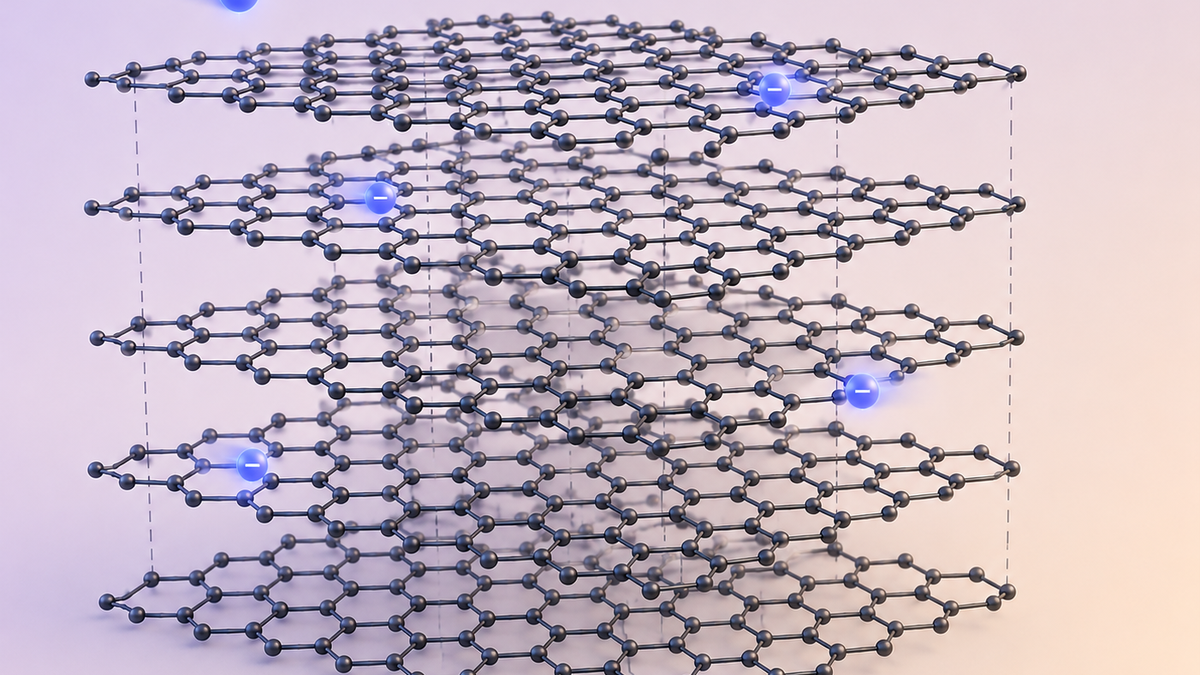
Enter pentalayer graphene. After many experiments, physicists found that when they added more graphene layers to the stack, the electrons slowed down more. With five layers — with each layer turned by a small angle relative to the one below — placed atop a substrate of hexagonal boron nitride, the electrons’ kinetic energy dropped enough for electron-electron interactions to become dominant.
(Aside: If the electrons are repelling each other in this state, how come they form a collective quantum state instead of flying apart? When electrons are repelling each other but are also confined, they do not have the luxury of flying apart. Instead, they organise themselves better, leading to the collective quantum state — sort of like a negotiated settlement where they agree to not antagonise each other.)
Quantum materials
In 2024, a team lead by Long Ju at the Massachusetts Institute of Technology reported that it had detected FQHE in pentalayer graphene. They called it the FQAHE — the ‘A’ stood for anomalous, meaning it had been achieved without using a magnetic field. The team reported observing Hall resistance like 2/3 and 3/5.
They concluded that the moiré superlattice created by five layers of graphene had produced the requisite structural features mimicking the effects of a magnetic field.
The experimental observation of FQAHE does not mean the underlying science is ready for real-world use. With or without magnetic fields, physicists still need the material to be ultra-clean and work with it at very low temperature. They also need to get the angles at which the graphene layers are turned relative to the substrate very close. Even a small deviation can destroy the ideal moiré superlattice properties required to slow and confine the electrons. Finally, the FQAHE also appears only when the material contains the ‘right’ number of electrons, which physicists can control by applying the right amount of voltage.
Since then, by fine-tuning these controls, physicists have found ways to create more robust FQAHE states. Many of them keep going because of the value the anyonic quasiparticles hold for more advanced quantum computers — and indeed a whole world of physics that was previously locked behind powerful yet expensive magnets. But more than that, science also advances when scientists recreate what they find in nature in new conditions. That is how we got air travel, lasers, nuclear power, antibiotics, and semiconductors.
Something similar may be happening now with quantum materials — materials whose properties arise from quantum physics effects.
mukunth.v@thehindu.co.in


