



Sanatana Dharma embraced diversity, never imposed itself
India’s ancient philosophy can guide world towards peace
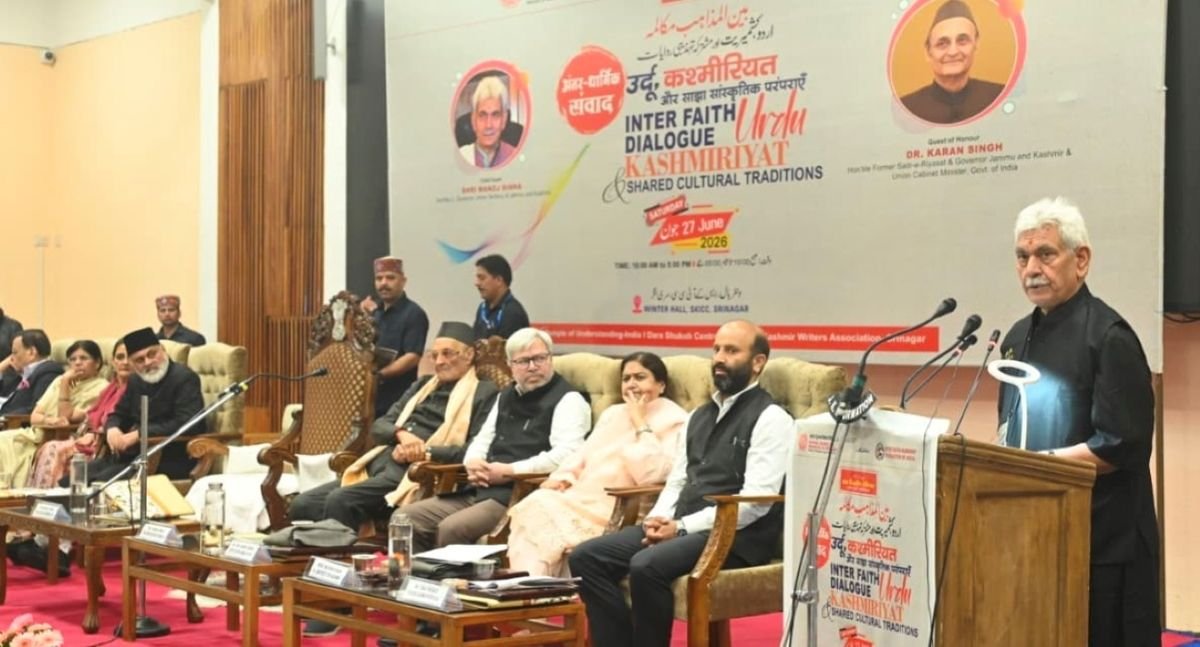
Srinagar, Jun 27: Lieutenant Governor Manoj Sinha on Saturday highlighted India’s legacy as an ancient civilisation rooted in mutual respect where diverse faiths coexist, flourish, and teach the world the wisdom of peace.
“The world recognises that Hinduism-Sanatana Dharma, the world’s oldest living religion, never imposed itself. Instead, it embraced diversity and coexistence. Ancient India built a foundation of respect, giving Christianity, Islam, Judaism, and Zoroastrianism freedom to flourish,” the LG said, addressing an ‘Interfaith Dialogue’ organised by the National Council for Promotion of Urdu Language and Inter-Faith Harmony Foundation of India.
He said that in a world facing conflicts and intolerance, the core spirit of Sanatana Dharma and Indian philosophy can serve as a guiding light.
The Lieutenant Governor said that India is a living idea that declares humanity should live together as one family, and the young generation must carry this vision forward, reminding the world that peace is possible through mutual respect. “In intellectual, spiritual, and cultural vocabulary, I call this ‘Indianness’-‘Bhartiyata’, the ethos that offered the world the vision of equal respect for all religions, the pursuit of truth, unity in diversity, the idea of the world as one family (Vasudhaiva Kutumbakam), and a shared cultural consciousness,” he said.
Sinha said that thousands of years ago, sages said that truth is not confined to a single path and that truth is infinite, with many routes leading to it. “That is why India has always seen diversity not as division but as a blessing. This outlook is reflected in the crown jewel of India, Jammu Kashmir, where for centuries the spirit of harmony and coexistence has been part of life. People often use the word ‘Kashmiriyat’, which actually springs from the philosophy of ‘Indianness’-‘Bhartiyata’,” he said.
The LG said that when Islam came to India in the 12th and 13th centuries, and many Sufi saints and Islamic scholars came here, they found a unique Indian culture rooted in love, spirituality, compassion, and equality. “Sufi saints were inspired by the vision of the Vedas, Upanishads, Buddhism, and Jainism, and they learnt the ideals of co-existence from Indian scriptures. Moreover, numerous repositories of Sanskrit knowledge were translated into Arabic,” he said.
“Our ancestors prayed, ‘Sarve Bhavantu Sukhinaḥ, Sarve Santu Niramayaḥ’ – may all be happy, may all be free from illness. This prayer is not for one religion or sect, but it is a prayer for the welfare of all humanity. I believe this is India’s identity. India and its ancient philosophy have never told anyone to abandon their faith. India has always said to the people to bring your faith with you, bring your traditions, and live with us in harmony. That is India’s distinctiveness. That is the greatness of the Indian spiritual tradition,” the Lieutenant Governor added.
The event was attended by former Union Minister Dr Karan Singh, University of Kashmir Vice Chancellor Prof Nilofer Khan, Inter-Faith Harmony Foundation of India President Dr Khwaja Iftikhar Ahmed, National Council for Promotion of Urdu Language Director Dr Md Shams Equbal, Dara Shikoh Centre Founder Director Dr Jyotsna Singh, Inter-Faith Harmony Foundation of India Director Operations Dr Nasreen Shama, Kashmir Writers Association President Fida Firdous, Inter-Faith Harmony Foundation of India National Coordinator Navaid ul Islam Khan, SSP Srinagar Dr G.V. Sundeep Chakravarthy, Deputy Commissioner Srinagar Akshay Labroo, senior officials, prominent citizens, and literary personalities.


