



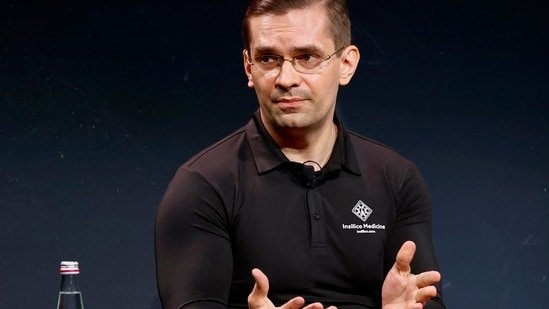
AI drug-discovery firm InSilico has been developing treatments for cancer, Parkinson’s and pulmonary fibrosis. Next up: a “God-like” drug that extends your lifespan.
“My job is to make you live much, much longer,” Chief Executive Alex Zhavoronkov said.
The Hong Kong-listed pharma company, the first to use generative AI to develop a drug that reached clinical trials, is betting longevity treatments will fuel its next phase of growth.
“We are creating the Olympus of drugs,” said Zhavoronkov.
The Latvian-born scientist, who founded InSilico in the U.S., believes his company is able to develop treatments that can let humans live to be 150.
It’s a lofty goal. To get there, Zhavoronkov aims to make InSilico a force in China’s cutthroat pharma industry, and make his business profitable.
InSilico has struck several major deals recently, including one with Eli Lilly worth up to $2.75 billion, but has yet to turn a profit.
Zhavoronkov is confident profitability is close and expects to hit the milestone within the next three years.
The upfront Lilly payment alone is expected to double InSilico’s revenue this year and the CEO said more major deals are in the pipeline.
Earlier this week, it announced a partnership with Korean drugmaker SK Biopharmaceuticals valued at up to $2.5 billion.
Noting that InSilico has a cash runway of five to six years, Zhavoronkov said he has no urgency to fundraise for now.
For the CEO, a self-confessed workaholic, the key to InSilico’s success lies in China.
InSilico’s base may be in Boston, but it has a major presence in China, which has become a powerhouse in biopharmaceutical innovation.
As Chinese companies’ advances in drug development create local powerhouses and draw more foreign firms to the country, Zhavoronkov says it’s imperative to establish a foothold there.
“All of our competitors are [in China] now. If we don’t push hard, we are going to be [beaten],” he said.
The Chinese biotech industry’s ascent has spurred a spate of deals with foreign heavyweights, including one between U.S. pharma giant Bristol Myers Squibb and Hengrui Pharmaceuticals that could be worth over $15 billion.
“Chinese pharma [companies] have done well to bridge the gap in certain niche fields,” said Morningstar analyst Kai Wang, and “have a lot more innovative drugs in their pipeline these days.”
While big pharma companies elsewhere take about four-and-a-half years to move from identifying a novel drug target to preclinical trials, Chinese firms take roughly two-and-a-half years, Zhavoronkov said.
“In some areas [the West] cannot compete anymore,” the CEO said.
Against that backdrop, InSilico’s plan is to double down on a “China for China” strategy.
Using AI to compress drug discovery from years to as little as nine months, it is developing products catering to the local market but that are more novel than what homegrown firms can offer. By gaining a first-mover advantage, InSilico believes it can beat local rivals to the punch.
“The best way to compete with China is to compete in China. Otherwise, you’re going to lose the biggest market that the world will ever see,” Zhavoronkov said.
The strategy seems to be working. InSilico received investigational new drug approvals or clearances in China for 13 drug candidates, 10 of which are in clinical trials. Five are co-developed with or licensed out to local partners
InSilico’s proprietary AI platform is its biggest revenue generator, but betting on AI broadly isn’t a sure thing.
Despite his conviction in AI drug discovery, Zhavoronkov thinks the AI sector is headed for a correction as investors question lofty valuations of companies with little revenue, low productivity and few tangible assets.
“There is clearly a huge bubble. [When it bursts] it could be bigger than 2008,” he said, referring to the U.S. property market crash that triggered a global financial crisis.
“People who are neither drug hunters or AI specialists suddenly want to be valued at several billion dollars with tiny revenue,” Zhavoronkov said. “It’s like a Formula One team made out of people who are horse farmers.”
InSilico won’t be immune to a sectorwide downturn, but it will survive, he said. “We’re ready for battle. For very long-term survival.”
Write to Jason Chau at jason.chau@wsj.com


