



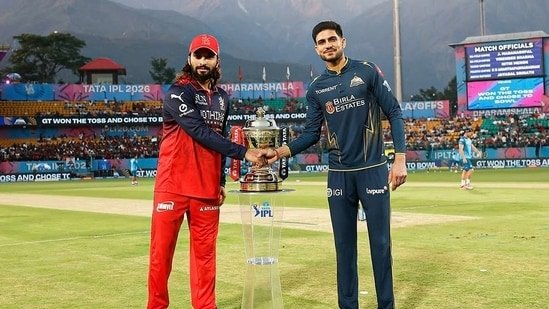
The IPL 2026 final has its obvious cricketing frame. Gujarat Titans against Royal Challengers Bengaluru. One side trying to complete a recovery after being thrashed in Qualifier 1. The other trying to convert its most complete season into a trophy.
But the deeper story sits in the ledger.
Gill enters the final as the season’s most profitable player, with ₹35.14 crore in surplus value. Patidar is almost level at ₹35.06 crore. Together, the two captains have generated more than ₹70 crore in profit before a ball has been bowled in the final. That number gives this match its hook. The cricket gives it its weight.
Gill has been the tournament’s most complete player-captain – volume, consistency, control from the top, match after match. Patidar has been its most violent captaincy-value spike, powering RCB through tempo, middle-overs destruction and leadership returns that turned knockout pressure into scoreboard punishment.
Two captains, two different value systems
Gill’s season is heavier by every volume measure. 722 runs from 441 balls at 163.72. Thirty crossed in 11 of 15 innings, fifty reached seven times, 80 crossed four times, and then, when Gujarat needed him most, 104 off 53 against Rajasthan Royals in Qualifier 2.
That knock mattered beyond the scorecard. Gujarat had just been flattened by RCB in Qualifier 1, bowled out for 162 after Gill made 2 off 7. His century against Rajasthan was not merely a batting performance. It was a damage repair; it put Gujarat back in the final and restored his authority before the rematch.
Rajat Patidar‘s value has come in a different shape entirely. 486 runs from 246 balls at 196.76. Far fewer deliveries, but heavier damage per ball. His dot-ball rate is 22.76 against Gill’s 29.47. He hits a boundary every 3.51 balls; Gill hits one every 4.20. The gap looks small in isolation. Over a full innings, it is the difference between a good total and an impossible one.
That is the split between architecture and detonation. Gill builds innings. Patidar ruptures them.
The phase data makes that contrast exact. Gill has scored 320 powerplay runs at 159.20, 226 in overs 7–11 at 162.58 and 152 in overs 12–16 at 176.74. He gives Gujarat control across every major batting phase, the kind of presence that doesn’t just set totals but shapes them.
Patidar barely exists in the powerplay. Thirty-six runs from 39 balls. His season begins when the field opens. Overs 7–11: 138 off 71 at 194.36. Overs 12–16: 234 off 108 at 216.66. Death overs: 78 off 28 at 278.57.
Gill is Gujarat’s innings spine. Patidar is RCB’s acceleration switch.
The captaincy inversion
In our full impact table, Shubman Gill leads the season at 2556.06 with Patidar third at 2197.55, batting volume, fielding involvement and accumulated leadership all feeding his advantage. But isolate captaincy alone, and the order inverts. Patidar leads the season at 708.3. Gill sits second at 619.2. RCB have not simply benefited from Patidar’s runs. They have extracted major tactical value from his leadership.
Qualifier 1 made that visible. His 93 off 33 against Gujarat, zero dot balls, five fours, nine sixes – turned RCB’s innings into 254/5 and Gujarat’s reply into rubble. The final was effectively shaped in that one innings, before it was officially arranged.
Gill answered in Qualifier 2 with his century. That gives this final its cleanest narrative charge: Patidar broke Gujarat, Gill rebuilt them, and now they meet again with a trophy at stake.
Their three earlier meetings offer no comfortable lean. Game one: Gill 32 off 24, Patidar 8 off 5, RCB win. Game two: Gill 43 off 18, Patidar 19 off 15, Gujarat win. Qualifier 1: Gill 2, Patidar 93, RCB win by 92. The most recent memory belongs completely to Patidar. Tonight is Gill’s one chance to rewrite it.
There is a fielding dimension too. Gill has taken 12 catches at 85.71% efficiency; Patidar has eight without a drop. Gill has handled more volume, and Patidar has been cleaner. In a final between two batting-heavy sides, one spilled chance could shift the entire value ledger within minutes.
That is why the ₹70 crore figure is not decoration. It captures how much of this tournament has run through these two men. Gill is the better season-long asset – more runs, more control, the higher total impact. Patidar is the sharper weapon – better strike rate, lower dot-ball pressure, higher boundary frequency, and the highest captaincy score of the season.
If the final becomes a game of innings construction, Gill is Gujarat’s central axis. If it becomes a game of middle-overs acceleration and tactical violence, Patidar is the most dangerous captain on the field.
One has carried this campaign like a mainframe. The other has attacked it like a live wire.
Only one leaves with the trophy. Both arrive having already beaten their price tag into dust.
Method Note
The monetary values and impact comparisons in this article are based on an IPL 2026 performance valuation model designed exclusively by the author, converting batting, bowling, fielding and captaincy impact into estimated monetary value against each player’s season cost. These are analytical estimates, not official IPL financial valuations.


