



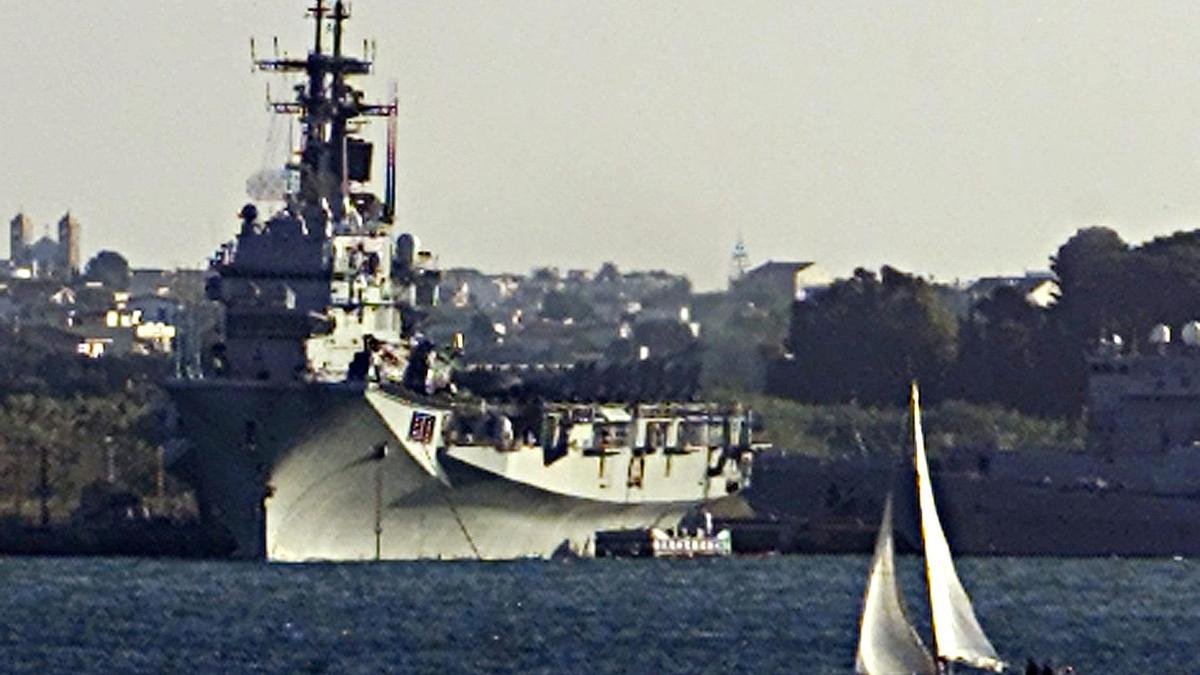
On April 28, the Italian Parliament backed the Georgia Meloni-led government’s plan to donate a decommissioned aircraft carrier, Giuseppe Garibaldi, to Indonesia. If things go as planned, the Indonesian Navy may welcome its first-ever aircraft carrier as early as October 5 this year, as per the Naval Chief, Admiral Muhammad Ali.
With this, Indonesia will become only the second country in Southeast Asia, after Thailand, to operate an aircraft carrier. This purchase is being seen as a part of President Prabowo Subianto’s push to modernise the Indonesian Armed Forces, in an effort to maintain strategic autonomy in the face of growing enmity between the United States and China.
Push for modernisation
“A big nation like us needs a strong military. No nation can be independent without having a strong military,” were the words of President Subianto while addressing Indonesian Military personnel in 2025.
As per Rajiv Bhatia, distinguished fellow at Gateway House and former ambassador, “President Subianto’s modernisation push in defence has been his guiding principle since his time as the Defence Minister.” A former special forces operative and General in the Indonesian Army, Mr. Subianto served as the country’s Defence Minister from 2019 to 2024 in President Joko Widodo’s government before ascending to the Presidency.
As a result, Mr. Subianto has inked and overseen a flurry of defence deals with a host of countries. Major deals included six FREMM-class and two Maestrale-class frigates from Italy; 42 Rafale fighters, 13 long-range radars, and two Scorpène-class submarines from France; and 48 KAAN fighter jets and two Istanbul-class frigates from Türkiye.
Mr. Bhatia added, “President Subianto’s foreign policy has been more independent and resilient than his predecessor Jokowi [Joko Widodo]. He has been favouring better relations with the West, especially the U.S. However, he still prefers a balanced approach with respect to Beijing.”
In 2024, Mr. Subianto stated, “Partnerships are better than conflicts,” when questions on Chinese claims over Indonesian water arose after his visit to Beijing.
Diplomatic and strategic tightrope
Since swearing in, Mr. Subianto has been walking a diplomatic and strategic tightrope to balance China and the U.S., while trying to maintain the Bebas dan Aktif (free and active) policy of non-alignment that has guided Jakarta since independence. But recent times have proved difficult for the archipelagic nation.
China has been using increasingly aggressive postures on the Natuna Islands dispute. The dispute centres on Indonesia’s Exclusive Economic Zone in the North Natuna Sea, roughly 650 nautical miles north of Jakarta, which China claims falls within its so called nine-dash line.
While Indonesia, for long, maintained that it had no territorial dispute with China in the South China Sea, the Natuna Islands have witnessed several confrontations since 2005. In 2020, when President Subianto was the Defence Minister, a major standoff drew warships, jet fighters, and even the then President Joko Widodo to the remote islands.
In 2024, a joint statement by China and Indonesia, after President Subianto’s visit, resulted in Indonesia recognising the dispute officially for the first time. While the Indonesian Foreign Ministry was quick to reiterate that it did not recognise Chinese claims in the South China Sea under the United Nations Convention on the Law of the Sea (UNCLOS), Mr. Subianto had to face intense scrutiny over this controversial development.
On the other hand, in April this year, controversy arose when a leaked U.S. document reportedly detailed a deal which granted the U.S. ‘blanket overflight rights’ over Indonesia, agreed upon by both governments. Essentially, it allowed U.S. aircraft to use Indonesian airspace without permission until the U.S. itself chose to deactivate the rights. The now-stalled deal triggered a massive political storm in Jakarta, putting Mr. Subianto’s government in a spot, yet again.
In such a situation, the news of Giuseppe Garibaldi might be the positive development that President Subianto needs. “It will be interesting to see how China, the U.S., and Indonesia’s internal Opposition react to Garibaldi. It is certainly good news for ASEAN and India, which would want a stronger Indonesia in the Indo-Pacific,” added Mr. Bhatia.
‘Non-war military operations’
“We intend to focus the ship on non-war military operations, but it may also be deployed for other missions related to combat,” said Admiral Ali when he confirmed the plans to acquire the carrier in 2025 and stressed that the vessel may also be used for disaster relief.
But Commodore Deepak Bhatia (retd.), who has served aboard India’s aircraft carrier INS Viraat, states, “You don’t induct an aircraft carrier only for disaster relief missions. The forthcoming carrier will certainly enhance Indonesia’s offensive and power projection capabilities.”
Officially designated as an aircraft-carrying cruiser by the Italian Navy, Garibaldi was built by Fincantieri and decommissioned in 2024 after nearly 40 years of service. Being V/STOL (vertical/short take-off and landing) capable, it operated Harrier II aircraft and a mix of anti-submarine helicopters.
The carrier will undergo a full refurbishment before joining the Indonesian Navy.
Indonesia is reportedly considering including the Harriers in the deal as well since it has limited aircraft options. While the U.S. has rejected Indonesia’s attempts to buy the F-35 Lightning II aircraft, Chinese and French options are notequipped with vertical take-off and landing capabilities. Fincantieri has proposed to convert the carrier into a helicopter and/or drone carrier, ditching the fighters. However, a final decision is yet to be taken.
Though questions on the carrier’s viability and age have been raised by the Opposition parties, Mr. Bhatia said, “The refit route was better suited for Indonesia since it would have been too expensive to buy a new one.” Commodore Deepak Bhatia stated, “This addition to the Indonesian Navy will definitely make it a more potent force.”
However, whether Indonesia can operate a carrier effectively, given its limited defence budget and near-zero experience, remains uncertain. Thailand’s Chakri Narubet offers a cautionary tale: plagued by maintenance failures, rarely deployed, and now better known as a tourist attraction than a warship.
Published – May 06, 2026 08:23 pm IST


