



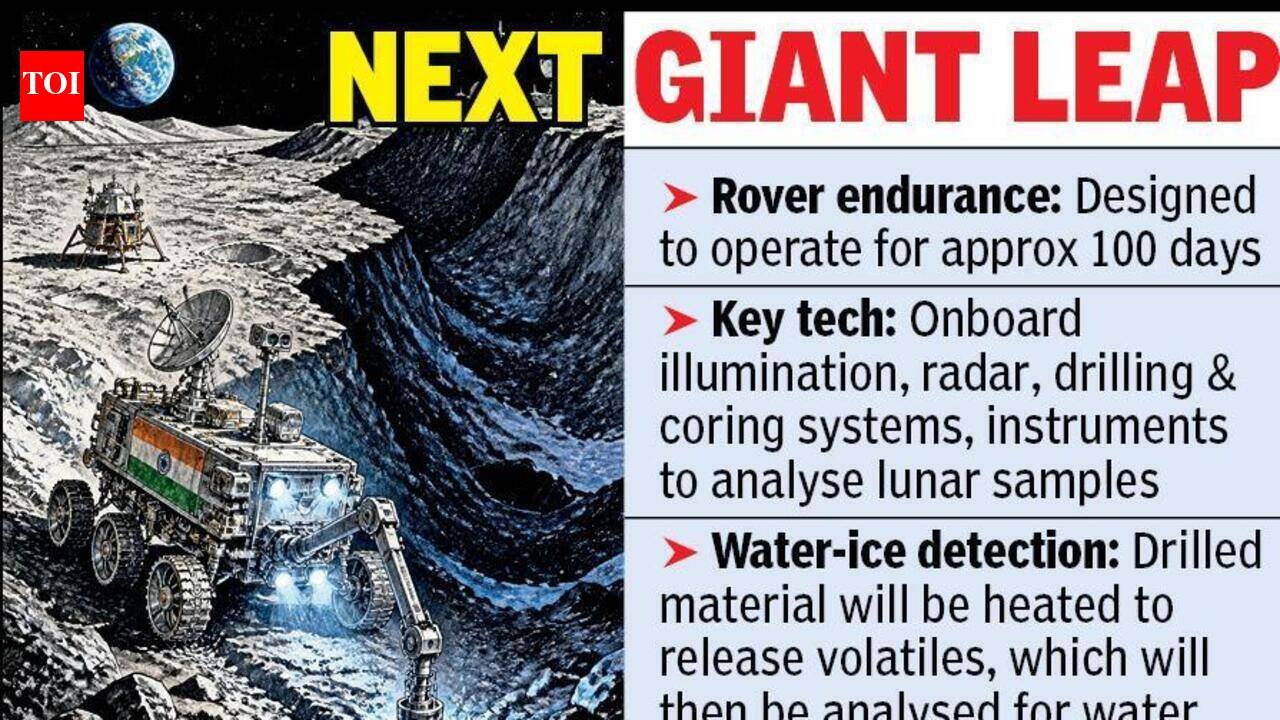
Nagpur: India’s next major lunar exploration mission will take a rover into the Moon’s permanently shadowed regions to search for water ice and other volatile materials, Dr Prakash Chauhan, director, National Remote Sensing Centre (NRSC), ISRO, Hyderabad, said here on Thursday.Delivering the CSIR Foundation Day Lecture on ‘Indian Lunar Exploration Missions and Science’ at CSIR-National Environmental Engineering Research Institute (CSIR-NEERI), Chauhan said the India-Japan Lunar Polar Exploration (LUPEX) mission would deploy a substantially larger rover capable of operating for about 100 days.“The rover will traverse into the permanently shadowed regions on the Moon, which are supposed to have water ice. It will have its own source of illumination, radars and a drilling and coring system,” he said.The rover will drill into the lunar surface and analyse material released after heating. “If there is ice, it will do volatilisation by producing more temperature there. That volatile material then comes out spectroscopically and we will be able to analyse the composition, if there is water or if there are other volatiles,” Chauhan said.The instruments will form part of the Moon Volatile Package, being jointly developed by India and Japan, he said.Chauhan said the mission would target the region around Shackleton Crater, where areas receiving prolonged sunlight can provide the rover with power before it moves towards permanently shadowed terrain.The mission builds on India’s lunar exploration programme that began with Chandrayaan-1 in 2008, followed by Chandrayaan-2 in 2019 and the successful Chandrayaan-3 landing in 2023. Chandrayaan-1 provided crucial evidence of water-related signatures on the Moon, while Chandrayaan-3 demonstrated India’s capability to soft-land and operate a rover on the lunar surface.“Even though we have come to know a lot about our celestial neighbour, many more mysteries have to be solved,” Chauhan said.He cited lunar swirls — striking patterns on the Moon associated with localised magnetic anomalies — as one such mystery. “How these swirls are happening is still a question. There are localised magnetic zones on the Moon. They basically reflect back some of the sunlight. The solar-light interaction in these areas is very different,” he said.Chauhan said India’s lunar programme would ultimately support a larger human exploration roadmap. “By 2040, a human Indian, man or woman, should land on the Moon surface and we should become a permanent member of the lunar exploration club,” he said.Dr S Venkata Mohan, director, CSIR-NEERI, highlighted CSIR’s contribution towards a knowledge-driven and globally competitive India. He outlined CSIR-NEERI’s work on key environmental challenges including water, air quality, climate change, waste management and carbon circularity, with emerging applications of artificial intelligence. He also highlighted initiatives such as NEERI-ZAR for flood-affected areas of Assam, eco-rejuvenation of about 110 hectares of degraded land, and research on emerging contaminants.
