



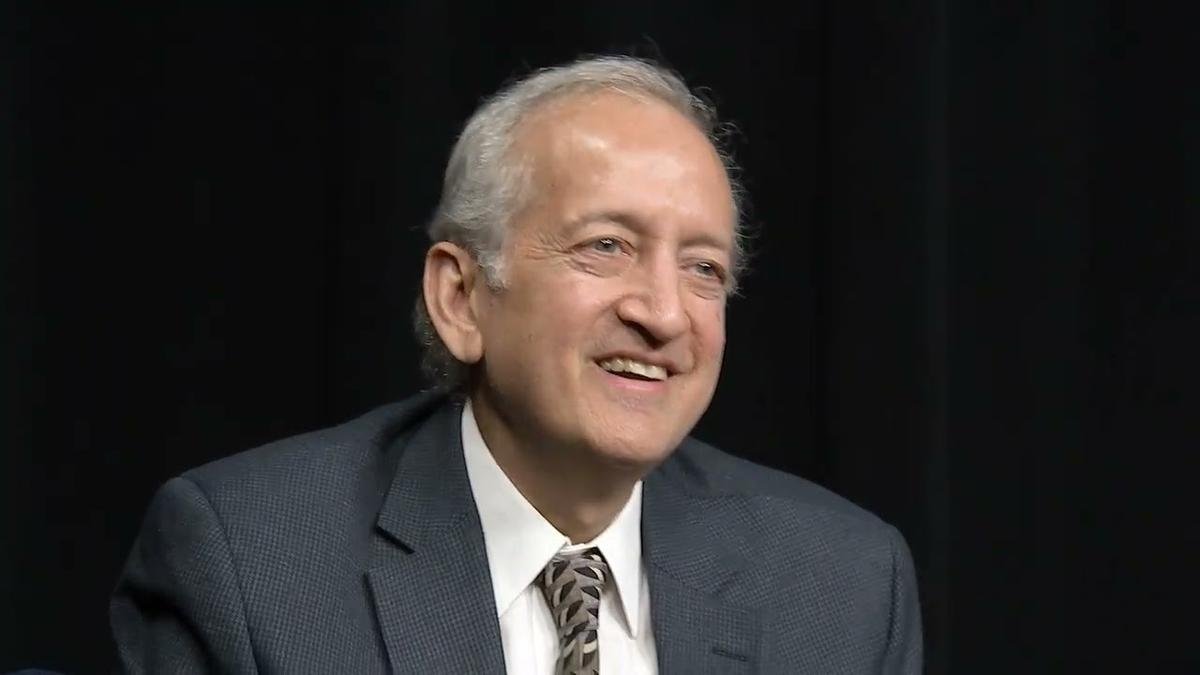
India does not lack respected homes for theoretical physics research. Asked why it needs another, Jainendra K. Jain — founding director of the Lodha Theoretical Physics Institute (LTPI) — answers by describing what the place will not do. It will be “smaller” than the Tata Institute of Fundamental Research (TIFR) , narrower in scope than IISc (Indian Institute of Science) or ICTS (International Centre for Theoretical Sciences) and, funded entirely by private money, spared much of the bureaucracy that comes with the state.
“These other institutes are fantastic,” Jain says of TIFR, ICTS, IISc and Allahabad’s HRI (Harish Chandra Research Institute). “We can all be very proud of them.” What will set LTPI apart, he argues, is focus and freedom. Where TIFR spreads across biology, chemistry, even climate science, LTPI will do one thing — theoretical physics — and stay small: a steady state of about 10 to 12 full-time faculty, some 40 postdoctoral researchers and a rotating cast of visitors.
‘Paradise for theoretical physicists’
The larger difference, he said in an interview, is that private capital lets the institute sidestep the approvals that decelerate public science in India. Making a faculty offer at a government-funded institute can take a year of clearances; at LTPI, he says, a couple of colleagues who agree on a candidate can simply extend one. “There will be no caps on travel or group size, no teaching load, no committee paperwork” — frictions that, he says, can leave a professor barely “five minutes a day” for research.
He anticipates this to be a “paradise for theoretical physicists,” modelled on Princeton’s Institute for Advanced Study (IAS) and Canada’s Perimeter Institute, where people “come, they think about physics, they talk to each other, and push each other to make discoveries.”
One casualty of that design, however, is the doctoral programme. LTPI will not award PhDs, at least initially. “In an institute which has only 10 or 12 faculty members, giving a PhD cannot really be done at this stage, because all the faculty members would just be teaching all the time,” said Prof. Jain. Doctoral students may still pass through as visitors through collaborations, he adds, but the institute will be built around faculty, postdocs and guests.
Jain states
Prof. Jain brings impeccable credentials to the experiment. In June 2025 he became the first scientist of Indian origin to win the Wolf Prize in Physics, shared with James Eisenstein and Mordehai Heiblum, for explaining how electrons behave in two dimensions under strong magnetic fields. His contribution, conceived over a Christmas break in 1988, was the “composite fermion” — an electron bound to quantum vortices — which accounted for the so-called fractional quantum Hall effect and gave rise to what are now called Jain states. The link to computing is real but indirect.
Certain composite-fermion states are predicted to harbour exotic ‘Majorana modes’ — particles that keep a record of how they’ve been moved around one another —, that could in principle store information non-locally and so form unusually robust “topological” qubits. Prof. Jain is quick to clarify he “does not build” quantum computers, and that no such qubit has yet been demonstrated. Microsoft’s much-publicised Majorana work, he notes, draws on the same ideas but uses a different, nanowire-based system.
Philanthropic universities
The financial muscle behind the institute is Abhishek Lodha, chief executive of the listed developer Lodha, whose family pledged close to a fifth of the company — roughly ₹20,000 crore — to the Lodha Foundation in 2024. The foundation, which describes its giving as a “philanthropy of excellence,” runs the Lodha Genius Programme for gifted students and has now seeded two research institutes: the Lodha Mathematical Sciences Institute, launched in 2025, and LTPI. Each is to receive about $100 million over eight to ten years.
Private money seeding Indian science is not new. Jamsetji Tata pledged half his personal wealth to found IISc, which opened in 1909; the Tatas went on to establish TIFR and TISS (Tata Institute of Social Sciences), and the Birlas built BITS Pilani. More recent philanthropic universities — Ashoka, Azim Premji, Krea — continue that line. The perennial question, put to Jain during the interview, is endurance: C.V. Raman built the Raman Research Institute with his own funds partly to keep the government at arm’s length, yet such ventures often come to lean on the state over time. Jain’s answer is an endowment large enough to sustain the institute from its returns in perpetuity, and he says he intends to study the charters of the IAS and Perimeter — the latter founded by BlackBerry’s Mike Lazaridis and still running after 25 years — to see how they endured.
Measure of success
He resists the idea that publicly funded science is fading. Even nominally, private US universities such as Harvard, and public ones such as his own Penn State, run on substantial government funding and have world-class facilities, he points out. A private institute is meant to “complement” the public system and offer a proof of concept, not replace it. The gap is stark at home: India spends about 0.64% of GDP on research, against the 2% to 5% of the United States, China, Israel and South Korea, with private industry contributing a far smaller share.
The measure of success, Jain suggests, will not be citation counts — metrics he considers increasingly hollow in an age when AI can draft a passable paper — but discoveries. “We want people from abroad to come to India and provide a proof of principle, which shows that great, stimulating research and discoveries can be made in India,” said Prof. Jain.
jacob.koshy@thehindu.co.in
Published – July 30, 2026 09:15 am IST


