






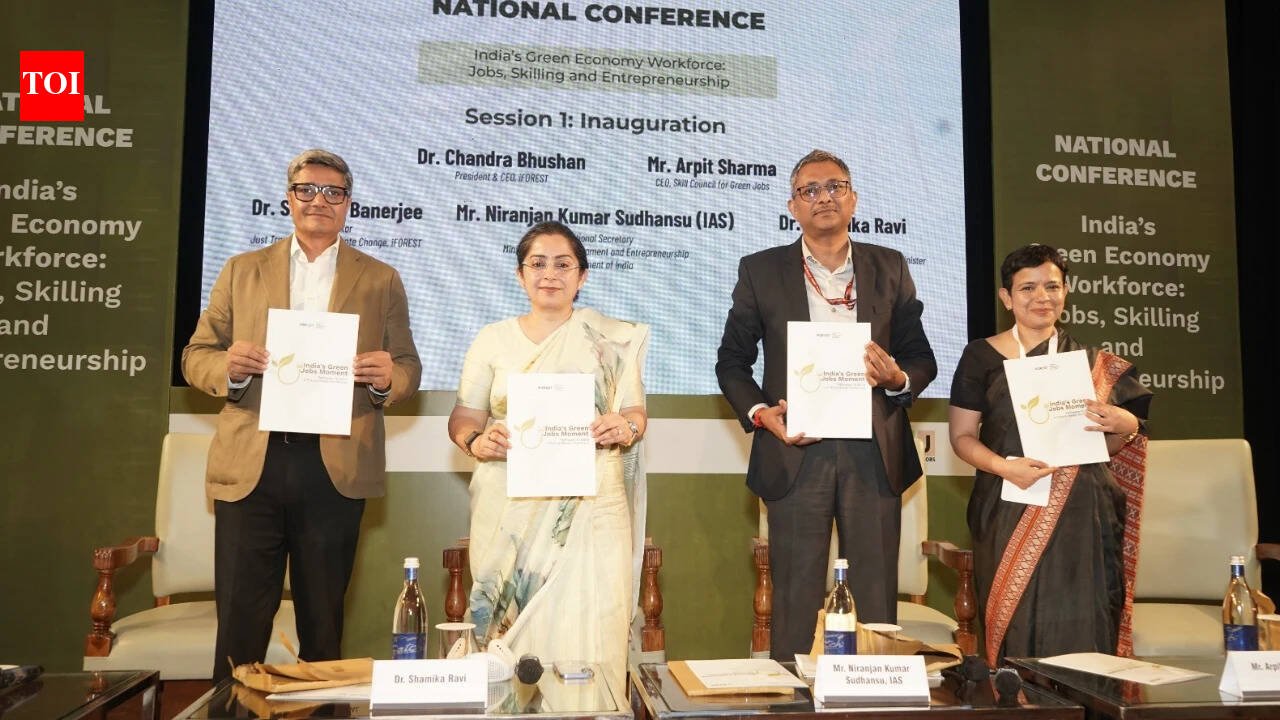
KOLKATA: India’s transition to a greener economy could support nearly 1.3 crore jobs by 2035, but a persistent gap between education, vocational training and industry requirements could prevent the country from fully tapping the opportunity, a new iFOREST report has warned.The report, India’s Green Jobs Moment: Pathways to Build a Future-Ready Workforce, estimates that green sectors could support 98.5 lakh jobs by 2030, rising to nearly 1.3 crore five years later. It has called for a National Green Jobs and Skilling Mission to align education and workforce training with emerging employment demand.Released Wednesday at a national conference organised by the International Forum for Environment, Sustainability and Technology (iFOREST) with the Skill Council for Green Jobs, the report identifies renewable energy, green hydrogen, electric mobility, circular economy and nature-based solutions among the major employment-generating sectors.Significantly, nature-based solutions — including agroforestry, forest restoration and mangrove restoration — could account for around 41.5 lakh jobs, the report said. Waste management, pollution control and the circular economy could generate substantial additional employment.The opportunity, however, comes with a major skills challenge. Indians aged 15-29 make up around 27% of the population, but just 5.3% have technical education and about 5% formal vocational training, according to the report.“Today, the biggest constraint to the growth of every business is finding skilled manpower. We have degrees, but we don’t have skills, and the market is now saying it will reward only skill,” said Shamika Ravi, member of the Economic Advisory Council to the Prime Minister.She stressed that skilling policies would need to respond to local labour markets rather than merely chase training targets. “Skilling is not an end in itself; job creation is the outcome we must keep in sight,” Ravi said.The report also suggests that workers in conventional sectors may not always need to start from scratch as the economy changes. It found around 89% of assessed coal-mining roles highly transferable to metal mining, while 90% of automobile-sector roles and 71% of thermal-power roles had high or medium transferability to emerging occupations.iFOREST president and CEO Chandra Bhushan said India already had the institutions, policy momentum and demographic advantage needed to create a future-ready green workforce. “The priority now is to connect these capabilities to emerging demand,” he said.Niranjan Kumar Sudhansu, additional secretary in the ministry of skill development and entrepreneurship, said green jobs and skills were expected to be incorporated into the ongoing revision of the National Policy for Skill Development and Entrepreneurship.iFOREST has proposed national and state-level Green Jobs and Skilling Missions, supported by district cells that would map local employment demand, connect employers with training institutions and promote apprenticeships and recognition of prior learning.The report also recommends introducing project-based learning on clean energy, waste, water and climate resilience in schools and moving beyond short-duration training. It noted that around 43% of formal training courses currently last less than six months, while many emerging green occupations require deeper technical and practical skills.The report argues that linking education, skills and employment will be crucial if India is to turn its demographic dividend into a workforce capable of supporting both its Viksit Bharat 2047 ambitions and its 2070 net-zero target.


