



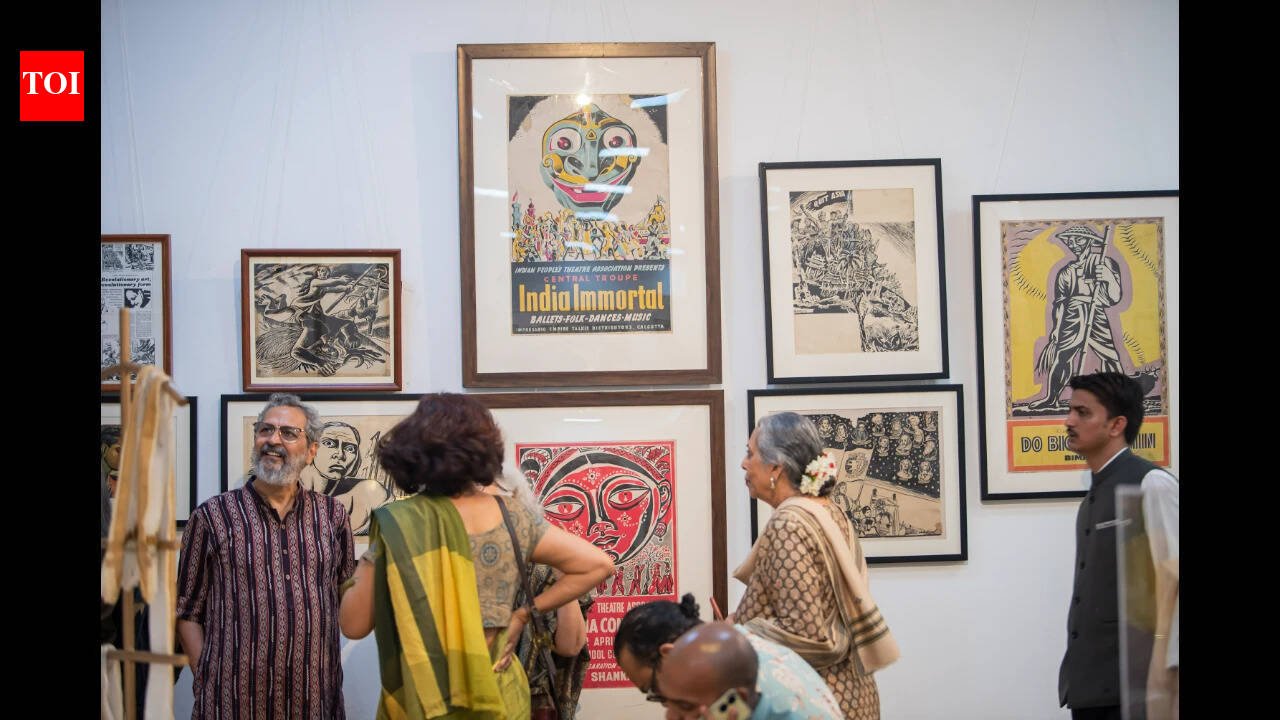
It’s the second week of August, the patriotic fervour has already got to you, and then you walk into the Visual Arts Gallery at India Habitat Centre, with Ae Mere Watan Ke Logon and Bharat Humko Jaan Se Pyaara Hai playing in the background and a lot of history to take in.
The exhibition moves through several such moments of change. There is a section on cinema, highlighting films that captured the political moods of its time
Swaraj: India’s Political History, an exhibition of archival material by the Tuli Research Centre for Indian Studies, takes you through critical moments in India’s history, from colonial rule and the freedom struggle to the making of a new nation and its evolving identity.
At the heart of SWARAJ is the conviction that history is a living force that continues to shape the present and speak to the future.
‘India can be described as an eternal sponge’For curator Neville Tuli, swaraj is not merely a political idea. It is something he has been thinking about for much of his life. “Swaraj has been the only thought for nearly 45 years of my life. Freedom as also an inner process – the ability to question oneself, laugh at oneself, look inward and still retain faith in oneself,” he noted.
Neville Tuli
His idea of India is similarly one of constant absorption and reinvention. He described the country as an “eternal sponge”, taking in influences, making them her own and continuing to evolve. “There’s nothing in the world that she has not absorbed, made her own, resolved it, dissolved it and tried to create,” he said, likening India to a mixed pickle, where different flavours come together and continue to change.
Jatin Das
Nasir Abdullah
There’s nothing in the world that she (India) has not absorbed, made her own, resolved it, dissolved it and tried to create
Neville Tuli, exhibition curator
Dilip Cherian
Lithuanian ambassador Diana Mickeviciene
‘History is cyclical’The exhibition moves through several such moments of change. There is a section on cinema, highlighting films that captured the political moods of its time – Chetan Anand’s Haqeeqat on the Indo-China war, Leader featuring Dilip Kumar, and Manoj Kumar, who became almost synonymous with patriotic cinema. Among the archives are images of student protests from the 1960s, 70s and 80s. There is something familiar about the energy in these pictures. The restlessness, the questioning and the demands being made of the state still resonate today. Sukhpreet Kahlon from the Tuli Research Centre for Indian Studies observed, “The fights have changed. Form has changed. The protagonists have changed. You can see a reflection of contemporary times in all of these moments in history that are very important.”
The exhibition features posters of various films that captured colonial rule and the freedom struggle
Alka Pande, Gunjan Goela and Dr Gita Prakash


