






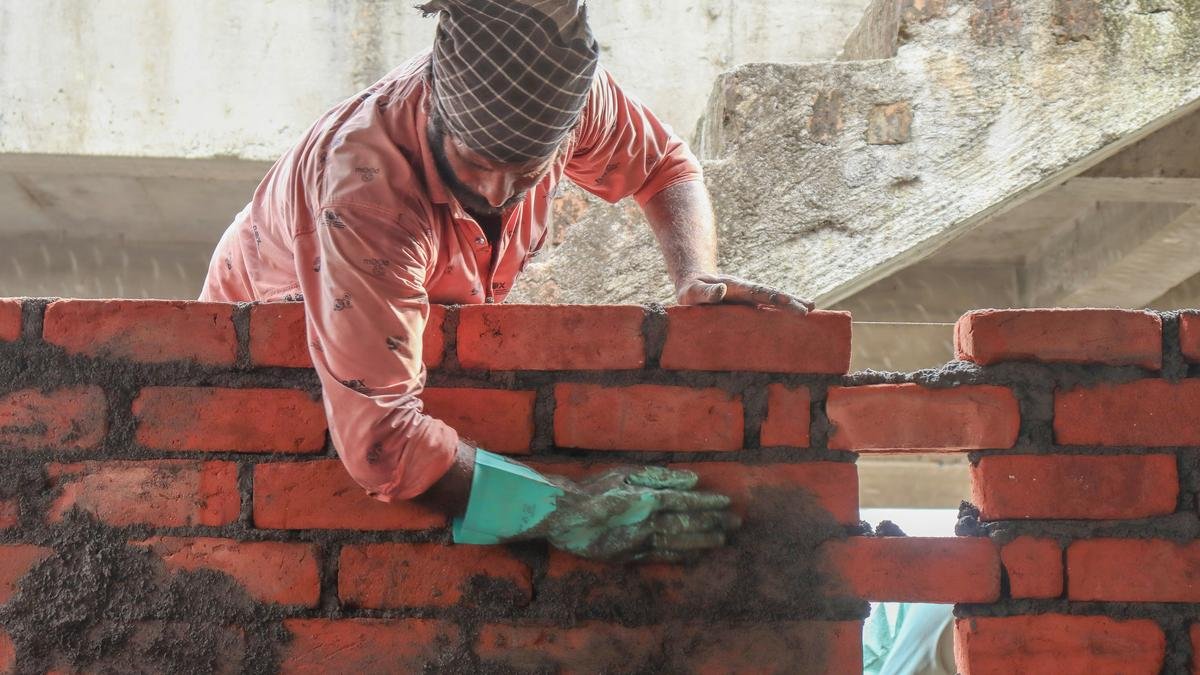
By 2047, India plans to become an economically developed country. By 2070, it aims to become a net-zero emissions economy. Achieving both of these targets requires the Indian government to deal with one of the most important sources of emissions: construction. This sector consumes steel and cement, among other materials, and its footprint contributes 35% to 40% of all greenhouse gas emissions around the world.
Most of these emissions are because of the energy that the steel and cement sectors need to reach extremely high temperatures required for industrial processes. But even between the two, the cement sector also emits carbon when calcinating limestone — a chemical reaction that makes cement one of the few hard-to-abate sectors, and which contributes 7 to 11% of emissions, almost double that of the aviation sector.
Need for cement
Construction activities have been part of human civilisation for many centuries now. Cement became the standard binding agent only in the 19th century, with the development of Portland cement in Britain in the 1820s, when builders were trying to meet the demands of rapid industrialisation. Before that, people used mineral-based binders, the material that holds bricks, sand, and stone together.
“Traditionally, India and many other parts of the world used a much wider range of binders and construction systems than Portland cement,” Nandini Haldar, assistant professor at the School of Architecture and Planning, Vishwakarma University, Pune, said. “These included lime-based mortars, lime-surkhi mortars, mud/clay mortars, gypsum-based materials, and, in some contexts, naturally pozzolanic materials.”
(A pozzolanic material reacts with calcium hydroxide in water to form cementitious compounds, thus strengthening concrete without itself being cement.)
Researchers have suggested that meeting India’s infrastructure and housing demands may not be realistic without cement. However, that does not mean there are no alternatives. The Taj Mahal, which was completed in the mid-17th century, is testimony to the efficacy of lime mortar. Many Roman buildings until the 4th century AD that used lime-based binders with volcanic pozzolanic materials also still stand.
“The issue is less about the technologies having disappeared and more about the construction industry having developed an enormous ecosystem around cement,” Dr. Haldar noted.
“One of the challenges is that cement has become deeply embedded in the construction industry through standardisation, commercial availability, established supply chains, building practices and extensive marketing. Traditional materials often lack the same level of commercial infrastructure and standardised supply.”
Science of cement
“Not just cement production … [The] wider life cycle of cement and concrete has an environmental impact. From extraction and processing of raw materials, subsequent manufacturing, and transportation to construction sites,” Dr. Haldar added.
Limestone — the raw material for cement — is formed when calcium-rich marine life, such as oysters and corals, is fossilised and compressed over millions of years.
Accessing it requires miners to first clear forests and all layers of fertile soil in specific areas to expose the sedimentary rock layer. Depending on the geography, limestone can be found 30-60 m under the topsoil in Karnataka, Chhattisgarh, and Andhra Pradesh and at more shallow depths in Rajasthan.
A view of a rotary lime kiln in Wyoming, the U.S., in 2010. These kilns heat calcium carbonate, commonly found in limestone, to 800° C or more to produce calcium oxide (quicklime) and carbon dioxide.
| Photo Credit:
Greg Goebel (CC BY-SA)
Once that limestone is brought to a factory, it is mixed with clay and heated to around 1,450° C. This heating process alone accounts for 35% to 40% of emissions from cement-making; the rest comes from the chemical breakdown of limestone.
When limestone is heated in the calcination process, it releases carbon dioxide as a by-product along with small stone-like balls called clinkers. These clinkers, responsible for 53% to 65% of emissions, are made of calcium silicates, calcium aluminates, and calcium aluminoferrites. They are crushed into powder and mixed in several ratios with gypsum and fly ash and sold as the various cement types available on the market.
India’s cement industry currently emits 0.62 tonnes (or 620 kg) of carbon dioxide per tonne of cement. In a decarbonisation roadmap prepared with the Global Cement and Concrete Association, experts from The Energy and Resources Institute, New Delhi, said India should aim to reduce the emission rate to 0.56 tonnes of carbon dioxide tonne of cement made by 2030 and to 0.51 tonnes of carbon dioxide by 2047.
The same report also estimated cement production in India is expected to rise from 334 million tonnes in 2019- 20 to 1,546 million tonnes in 2070.
But “carbon dioxide is not the only environmental concern associated with industrial activity,” Dr. Haldar said. “Cement manufacturing can also be associated with air pollutants such as nitrogen oxides, sulphur dioxide and particulate matter. These should be distinguished from greenhouse gases, which are assessed using their global warming potential.”
There are also many ‘hidden’ sources of carbon. Some examples are the carbon cost of cutting down hills to secure the limestone, emissions due to long distance transport, and the long-term effects of the loss of vegetation and the corresponding loss of carbon sequestration. And these effects are not typically considered in discussions around the cement industry.
“The dialogue on the effects before and after the cement production units are under-emphasised in current climate debates” in India, Kaveri Ashok, a researcher at the Center for Study of Science, Technology and Policy, Bengaluru, said.
Existing and proposed solutions
Since the dawn of the first industrial revolution, engineers and manufacturers have used coal, petroleum coke or natural gas to heat kilns. Today, with the focus on renewable sources of energy, electrification and the use of solid municipal waste to produce refuse-derived fuel (RDF) — to replace coal as a heat source for kilns — are at the forefront, according to a decarbonisation roadmap that NITI Aayog, the Indian government’s topmost think-tank, released earlier this year.
RDF is processed waste, typically shredded and sorted, with combustible materials concentrated into a fuel suitable for industrial boilers and cement kilns.
The idea is especially attractive because it also creates an incentive to improve waste management.
The NITI Aayog roadmap recommends that India “increase the use of RDF from municipal solid waste to achieve a 20% thermal substitution rate by 2030”, resulting in “a cumulative emission reduction of approximately 80 million tonnes of carbon-dioxide-equivalent”. But this requires India to do a better job of segregating waste at the source.
Another option focuses on reducing the amount of clinker: by mixing it with waste or by-products like slag from heavy industries like power plants and steelmaking. The less clinker cement contains, the greener it is. According to the International Energy Agency, replacing one tonne of clinker can avoid 0.83 tonnes of carbon dioxide emissions.
This said, cement cannot be fully decarbonised, so attaining net-zero emissions makes carbon capture inevitable.
The substitution also presents another limit: “While there are options where substitution goes as high as 50-70%, [in practice] the average substitution cannot be more than 40%,” Ms. Ashok added, or a building’s integrity could suffer. This is why cement “is called hard-to-abate”.
Traditional ordinary Portland cement (OPC) consists of over 95% clinker mixed with gypsum. Portland pozzolana cement has 65-80% of clinker with fly ash and gypsum. Portland slag cement consists of 35-64% of clinker, with the rest a mixture of gypsum and granulated slag from a blast furnace. But per Ms. Ashok, real-estate developers and builders generally prefer OPC. One reason is that while all three types have a similar setting time of around 30 minutes, OPC gains strength in one week while the other two could take twice as long.
“To push the demand for green cement in the initial few years, maybe the government can do more public procurement of green cement,” she suggested.
Since green cement replaces clinker with waste from other industries, it is less expensive. Per NITI Aayog, clinker-to-cement ratio — around 67.5% — in India is already lower than the global average of 77% and can be further reduced.
Some researchers are also working on complementary solutions like using traditional materials to make binders and to design buildings better.
Then there is also the challenge of changing people’s perceptions about the alternatives.
“Cement is easy to use, relatively fast-setting, versatile and widely understood by the construction industry. It can be used in a very wide range of structural and architectural applications, and the existing construction ecosystem is built around it,” Dr. Haldar said. “These factors make cement very difficult to replace at scale, even when we recognise its environmental impact.”
Looking beyond cement
In her research, Arpita Mathur, assistant professor at the National Institute of Construction Management and Research, Pune, has been studying indigenous construction practices. She said that depending on the requirements, there are several examples of alternatives to conventional cement-based construction around India, each of which evolved in response to the local geography and weather. For example, in South India, compressed earth blocks and rammed earth have been used with soil and sand and relatively small amounts of cement or lime.
Dr. Mathur has also identified binding agents such as cactus juice — a thick water-repellant fluid derived from cactus plants and mixed with lime and mud — and marble powder, a by-product of the marble industry.
Traditional Kath Kuni construction in Himachal Pradesh uses dry masonry and alternating layers of wooden beams without cement, with the structure using a raised stone plinth for better strength. In parts of North and Northeast India, houses are raised above the ground using lightweight wood and bamboo to better survive flooding and earthquakes.
But these options are also not silver bullets. Dr. Haldar said a material or construction method that works well in one region or for one type of building may not be appropriate elsewhere. Traditional practices may also have to be modified to meet contemporary requirements.
“Cement and concrete are extremely difficult to eliminate from contemporary construction. I cannot realistically tell a client constructing a ten-storey building to simply replace reinforced-concrete construction with soil,” Dr. Haldar said. “The more realistic approach is to reduce dependence where appropriate and design the building and surrounding urban environment to minimise heat gain and heat storage.”
There are contemporary practitioners using lime, earth, mud, lime-surkhi, and other traditional or natural systems, she added. “The issue is less about the technologies having disappeared and more about the construction industry having developed an enormous ecosystem around cement.”
Monika Mondal is a freelance science and environment journalist.


