






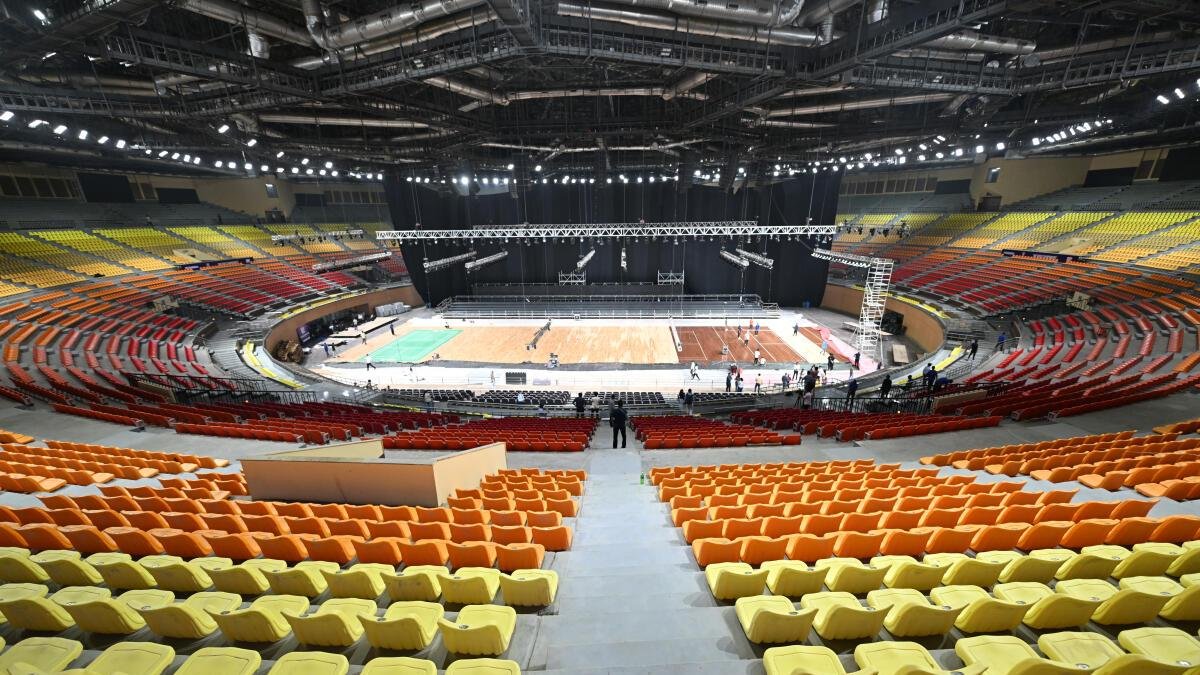
The year was 2009. Denmark and Macau walked away from their bids to host the BWF World championships. The opportunity fell into India’s lap. Hyderabad had no clue at the time that it was about to stage the opening scene of a story that would take 17 years to finish telling.
In 2009, the country did not have the cast of characters to make a home World championships a triumph. Badminton had only flickered across the Indian imagination during Prakash Padukone’s All England title in 1980 and P. Gopi Chand’s echoing of it 21 years later — stray flares in a long darkness.
Humble beginnings
Saina Nehwal was the closest thing to a rising star. Aged 19 then, she had just become the first Indian woman to win the World junior championship and the first Indian to claim a Super Series title. The Olympic medal and No. 1 ranking were still years away. P.V. Sindhu was 14.
There was no Target Olympic Podium Scheme (TOPS) funding. Corporate India didn’t see a reason to cut a cheque. Olympic Gold Quest (OGQ) was in its early stages.
ALSO READ | P.V. Sindhu: “Winning it on home soil, for the country, is all I could ask for”
Saina’s quarterfinal finish at the 2008 Beijing Olympics caught the nation’s attention but the machinery beneath the sport hadn’t caught up to the moment. When the Worlds came to Hyderabad in 2009, the money just wasn’t there.
Gopi Chand himself went door to door, hat in hand, trying to talk India Inc. into caring. Yonex’s entire sponsorship contribution was around 200 boxes of shuttlecocks. Government support was barely a whisper. The multi-purpose Gachibowli indoor stadium became the stage, and the crew running it were young players — and sometimes their parents — pressed into service.
“We hosted a bunch of events in that period. Nationals [2004], Asian championships [2005], India Open [2008 and 2009], and the World championships, after which the Commonwealth Games infrastructure was created in Delhi. We had our challenges, but we hosted a grand event. People still talk about it in Hyderabad,” Gopi Chand recalled.
A champion’s arc: P.V. Sindhu, who was 14 the last time India hosted the Worlds, has gone on to have an incredible career. She says the support system she had access to played a huge role.
| Photo Credit:
Getty Images
H.S. Prannoy, a volunteer in 2009, put the improbability of it more bluntly.
“Badminton wasn’t popular then, so people were hesitant to sponsor it. I remember hearing a lot about Gopi sir doing the rounds to ask for sponsorships. But I don’t think there was even one complaint about the event. To pull it off the way they did was spectacular,” he said.
“We were all there at that time as volunteers, helping arrange small things. But the one thing we all remember is that we got a chance to watch guys like Lin Dan and Lee Chong Wei up close — which, back then, was almost impossible! The confidence and motivation you get from seeing them live propelled me for the next couple of years.”
ALSO READ | Gopi Chand: “Horizons much bigger for the present players”
The tournament came off without a hitch. And yet India finished empty-handed, still stuck on the single bronze Padukone won in 1983.
Seventeen years later, the Worlds return to a country that no longer merely makes up the numbers. It now expects to be standing on the podium, and usually is. Fourteen medals have arrived in the years since, spread across every discipline but mixed doubles, crowned by Sindhu’s gold in 2019.
Ask what lit the fuse on all of it, Saina’s run at the 2008 Olympics and her bronze four years later in London take centre stage for many.
The spark
“Saina’s performance in 2008 was probably the spark, but the 2012 medal was what really changed things from a funding perspective. Before that, we used to think it was only the Indonesians and Chinese who could medal at these big events. When Saina won, everyone had hope that if she could win one, maybe we could too,” Prannoy said.
“I don’t think there’s been one singular turning point, honestly,” Gopi Chand differed. “My winning the All England was big. Without it, the idea of the academy and the belief that Indians could win at the highest stage wouldn’t have come. Then Saina’s win was the moment Indian women started to believe they could win.”
ALSO READ | Ayush Shetty: “I would like to set my own benchmark”
Jwala Gutta and Ashwini Ponnappa took the Worlds bronze in 2011, snapping a 28-year drought. A year later, Saina clinched India’s maiden Olympic medal in badminton. By 2015, she had topped the world rankings — the first Indian woman to do so — and claimed the country’s first Worlds silver. Sindhu then walked through the door that had been kicked open, and Indian badminton never looked back.
Lighting the fuse: Saina Nehwal inspired a generation, clinching India’s maiden Olympic badminton medal, topping the rankings and claiming the country’s first Worlds silver.
| Photo Credit:
Getty Images
But medals aren’t the only measure of evolution.
“In 2008, I remember tournaments being cancelled for lack of entries. Today, we hosted an Under-17 event with 4,200 entries at the national level. The sport now needs — and has — a much larger official setup,” Gopi Chand explained.
Ayush Shetty, one of India’s most promising young talents, has seen the winds change at the grassroots. “I didn’t have the support system a 14-year-old has now when I was that age. You have physios, trainers, and everything else now. Back in my day, I didn’t know much about recovery, it was all about working hard only.”
Corporate India slowly began embracing the sport. Money came, infrastructure followed.
Sindhu, now the face of badminton rather than a kid running around in the stands, points to a support system that simply didn’t exist for her predecessors. “OGQ has been backing me since I was 14, when I was still a junior and not even on the senior circuit. That kind of support in the starting stages is very important!”
“Now BAI has its own academy in Guwahati,” BAI general secretary Sanjay Mishra noted. “We have sponsors like Yonex [title sponsor of the 2026 edition]. In 2009, we had just four to five senior ranking tournaments. Now we have 30 to 32 tournaments a year across different levels. It’s a clear reflection of the sport’s popularity.”
Not every experiment survived the journey, though.
ALSO READ | “I’m not ready to give up the torch” – Prannoy isn’t planning to fade away just yet
The Indian Badminton League, later rebranded the Premier Badminton League, briefly turned the sport into a televised, commercial entity, only to buckle under the pressures of the COVID-19 pandemic, undone less by the lack of appetite than by a pile-up of logistics, an overcrowded international calendar, and commercial disagreements behind the scenes.
Fringe benefits: H.S. Prannoy cherishes his time as a volunteer at the 2009 Worlds. ‘Watching Lin Dan and Lee Chong Wei up close propelled me for the next couple of years,’ he says.
| Photo Credit:
Getty Images
Government investment, however, firmed up and brought Indian badminton something 2009 never had: depth. Where the country once staked everything on a single Padukone- or Gopi Chand-shaped miracle, it now walks into a World championships with waves of match-winners. If the singles medal doesn’t come, the doubles might deliver instead.
The scale of change
That, more than anything, is the real distance between 2009 and 2026, and it has demanded 17 years of quiet, unglamorous institution-building. Real academies now stand where one man’s mortgaged house once did. A queue of contenders has replaced the single name carrying an entire nation’s hopes.
The real ambition now isn’t one champion every generation but ten players in contention at once, so that whoever wins, India wins.
Hyderabad asked the country to believe. Delhi is proof that it was right to.


