




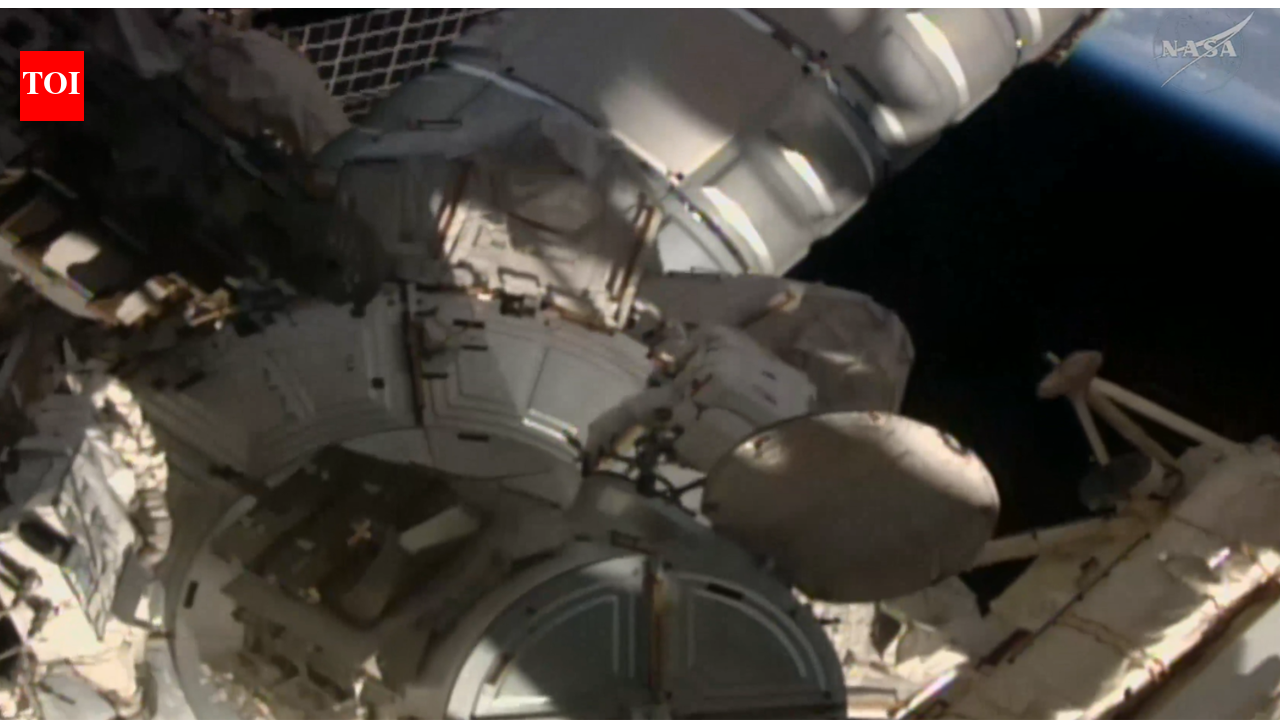
India’s growing footprint in space exploration reached another landmark on Thursday as Indian-origin Nasa astronaut Anil Menon stepped outside the International Space Station (ISS) for the very first time.For Menon, it will be more than just a routine maintenance mission.It will mark his maiden spacewalk — one of the most demanding tasks any astronaut can undertake — as he ventures into the vacuum of space to help upgrade the orbiting laboratory’s power system.The six-and-a-half-hour Extravehicular Activity (EVA) will see Menon team up with veteran Nasa astronaut Jessica Meir, who is embarking on her sixth spacewalk. Together, the duo will carry out critical work that will help keep the ISS powered for years to come.
Preparing the ISS for its next chapter
The astronauts’ primary objective is to install hardware on the station’s 3B power channel to pave the way for another International Space Station Roll-Out Solar Array (IROSA), scheduled to be installed later this year.The new panel will become the seventh IROSA attached to the ISS. These advanced solar arrays significantly boost the station’s electricity generation, ensuring a stable power supply for hundreds of scientific experiments, life-support systems and future missions aboard the orbiting laboratory.The upgrades are also part of Nasa’s long-term strategy to maximise the ISS’s operational life while preparing for its eventual controlled de-orbit later in the next decade.
A career-defining milestone
For Anil Menon, Thursday’s mission represents years of preparation culminating in one defining moment.Selected by Nasa as part of the 2021 astronaut class, Menon brought an unusual mix of expertise to the space programme. A physician, mechanical engineer and former emergency medicine specialist, he also served as SpaceX’s first flight surgeon, helping develop medical support systems for commercial human spaceflight.Born in the United States to an Indian father from Kerala and a Ukrainian mother, Menon has become one of the most prominent Indian-origin astronauts representing Nasa.Ahead of the mission, Menon shared his excitement on social media, posting on X.For first-time astronauts, spacewalks are considered among the toughest assignments in human spaceflight.Every movement must be carefully rehearsed, every tool securely tethered and every action coordinated with mission controllers on Earth. Outside the station, astronauts work in the harsh vacuum of space, exposed to extreme temperature swings and travelling around Earth at nearly 28,000 km/h.
The science behind the mission
The ISS has relied on solar power for more than two decades, but many of its original solar arrays have gradually degraded after years of exposure to the harsh space environment.Nasa’s newer Roll-Out Solar Arrays are lighter, more efficient and capable of generating substantially more electricity than the ageing panels they supplement. By installing additional mounting hardware now, astronauts are laying the groundwork for future upgrades without disrupting ongoing operations aboard the station.The enhanced power capacity will support a growing number of scientific investigations in microgravity while ensuring reliable electricity for critical station systems.
One of three August spacewalks
Thursday’s mission, designated US Spacewalk 96, will be the 281st spacewalk conducted in support of the assembly, maintenance and continued expansion of the International Space Station.It is also the first of three Nasa spacewalks planned this month.A second EVA is scheduled for August 13, during which astronauts will replace a space-to-ground communications antenna. Another mission on August 25 will focus on connecting power-channel cables and upgrading the station’s data relay systems.
Safety first in the vacuum of space
Throughout the operation, Menon and Meir will wear Nasa’s Extravehicular Mobility Unit (EMU) spacesuits—essentially miniature spacecraft that provide oxygen, temperature regulation, communication and protection against radiation and micrometeoroids.Both astronauts will remain securely attached to the ISS using multiple safety tethers while carefully navigating the station’s exterior.Nasa will broadcast the entire mission live, allowing viewers around the world to witness Menon’s historic first venture outside the International Space Station.For India, the moment carries added significance. As the country prepares for its own human spaceflight ambitions through the Gaganyaan programme, Menon’s maiden spacewalk stands as another reminder of the growing global presence of astronauts with Indian roots—continuing a legacy that stretches from Kalpana Chawla and Sunita Williams to a new generation helping shape the future of human space exploration.


