



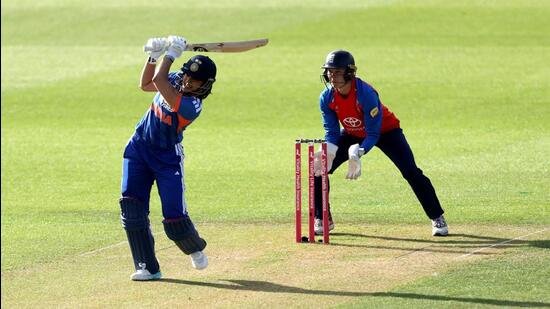
New Delhi: India has often arrived at global tournaments as contenders. They moved from contenders to challengers gradually but this year, at the 2026 Women’s T20 World Cup, they are carrying something different – expectation. For years, they were viewed as a talented side capable of upsetting the favourites. Today, they are looked at as one capable of going all the way — the favourites.
After the ODI World Cup win last year, India produced some of their most convincing cricket overseas while continuing to build depth through domestic structures such as the Women’s Premier League.
The success of Indian captains — namely Harmanpreet Kaur and Smriti Mandhana — has reflected a broader shift. This is no longer a team searching for belief, but one learning how to handle the burden of it. After the ODI title triumph at home last year, players spoke about making it a habit. A double this year would make it a historic achievement.
Yet their path into the tournament has been far from smooth. Successive series defeats to South Africa and England have exposed vulnerabilities at a time when most contenders would prefer stability.
Injuries to key pace-bowling all-rounders Amanjot Kaur and Kashvee Gautam have disrupted the team’s balance. Combinations remain unsettled and several senior players are still searching for their best form. As a result, India entered the tournament with questions surrounding them rather than certainty.
The challenge becomes even greater considering the composition of Group A – India are grouped with Australia, Bangladesh, Netherlands, Pakistan and South Africa. There is no room for a slow start and momentum can quickly swing in a competition where one defeat often alters the complexion of qualification scenarios, which had become a concern during the ODI World Cup after India lost three matches in a row.
The ability to peak when it matters could prove decisive in this tournament. India’s recent World Cup campaigns have repeatedly demonstrated that tournaments are often shaped less by pre-event narratives and more by composure under pressure.
For Harmanpreet Kaur, this World Cup represents another opportunity to convert potential into silverware. At the captains’ meet, the India captain reflected on the significance of ending long waits for major titles, saying the team’s previous triumphs were the reward for years of hard work. That experience and the confidence gained from winning in challenging overseas conditions, could become invaluable over the coming weeks.
Among the key decisions facing the team management is the batting order. The return of Yastika Bhatia after nearly nine months on the sidelines has provided a welcome boost. Her promotion to No. 3 against England underlined the faith the team has in her ability. Bharti Fulmali will also add some firepower to the lower middle order.
Richa Ghosh’s recent struggles have left India searching for greater consistency, particularly in the finishing phase. However, she remains one of the biggest match-winners for India with the bat. With limited lower-order power available, contributions from the top and middle order become even more critical.
The encouraging aspect for India is that their ceiling remains extremely high. They possess match-winners with both bat and ball, experience in pressure situations and a captain who has seen the highs and lows of World Cup cricket.
The six-time champions Australia remain the benchmark in women’s T20 cricket and their biggest challenge but India no longer enters tournaments hoping merely to compete with the best. In fact, they are among them.
The ODI final between England and India at the iconic Lord’s Cricket Ground is considered one of the most thrilling matches in cricket history. India returned with heartbreak then but the question now is whether they can bring their best cricket to England at exactly the right time.


