



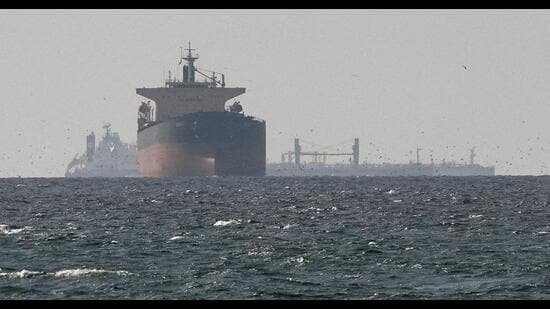
India on Saturday said it is in touch with all key stakeholders in West Asia to ensure the safe passage of Indian-flagged merchant vessels through the Strait of Hormuz to ensure the country’s energy security, even as two LPG tankers sailed through the crucial waterway and headed towards Indian ports.


A total of 22 Indian-flagged merchant vessels, including six LPG carriers, an LNG carrier, and four crude oil tankers, are in the Persian Gulf and awaiting safe passage, officials told a media briefing on the situation in West Asia. Shivalik and Nanda Devi, two carriers with 92,700 metric tonnes of LPG, transited the Strait of Hormuz early on Saturday and are expected to dock at Mundra and Kandla next week, they said.
Since the start of the Iran-US conflict on February 28, India has called for de-escalation, emphasised the need to ensure the unimpeded transit of goods and energy, and urged all sides to avoid the targeting of civilian infrastructure, including energy infrastructure, across the region, said external affairs ministry spokesperson Randhir Jaiswal.
India’s leadership reached out to all key interlocutors, including members of the Gulf Cooperation Council (GCC), Iran, Israel, and the US, and underlined the country’s focus on energy security. “As a result of these multiple contacts with all concerned, some ships destined for India have been able to cross through the Strait of Hormuz,” Jaiswal said.
Separately, Iranian ambassador Mohammad Fathali said at the India Today Conclave that Tehran has allowed some Indian-flagged vessels to transit the Strait of Hormuz following contacts between President Masoud Pezeshkian and Prime Minister Narendra, and foreign ministers S Jaishankar and Seyed Abbas Araghchi.
“Yes, we have allowed [the vessels] but let me not tell you how many,” Fathali said. He declined to go into details and said he would continue following this issue so that more vessels could cross the strait. “As the ambassador, I did my best, of course, there was some delay, but it happened,” he said.
Iran and India have common interests and “any rift or gap” between them can be taken advantage of by “enemies”, Fathali said. “Both sides have the maturity to handle political and social issues together and solve everything,” he added.
Rajesh Kumar Sinha, special secretary in the shipping ministry, said the Shivalik is expected to dock at Mundra port on March 16 and the Nanda Devi at Kandla port on March 17. Authorities have issued instructions for priority berthing of LPG carriers at Indian ports to maintain energy supplies, and six LPG carriers arrived at ports from different parts of the world in the past three days, he said.
“Several of our ships remain on standby in the Gulf region. We propose to continue to remain in touch and coordinate with all concerned countries to ensure a safe and unimpeded transit for them in an effort to ensure our energy security,” Jaiswal said.
All Indian seafarers in the Persian Gulf, including 611 sailors on 22 Indian-flagged vessels in the region, are safe, Sinha said. Since Friday, 30 Indian sailors have been brought back to India from the Gulf region, taking the total number of sailors repatriated to 253, he said.
The 22 Indian-flagged vessels currently located to the west of the Strait of Hormuz also include a chemical products tanker, three container ships, two bulk carriers, a dredger, a merchant vessel with no cargo, and three that are in dry dock for repairs or maintenance.
When Jaiswal was asked about the Iranian leadership’s call for Brics, currently led by India, to play a constructive role in supporting security and stability in the region, he said that efforts to forge consensus on a common Brics position on the conflict had been “obviously impacted” as some members of the grouping are “directly involved” in the current situation.
India has facilitated discussions among Brics members through the Sherpa channel, and the latest meeting of Sherpas was held virtually on March 12. “We are trying our best to develop a position, but because of differing positions, it has been difficult…We will continue to remain engaged with Brics member countries so that we can arrive at a position on this particular conflict,” Jaiswal said.
Jaiswal responded to another question on the conflict’s impact on fertiliser supplies by saying that India has “more than adequate stocks” of the commodity, especially for the kharif season of 2026.
“Our stocks of urea are more than what they were at this point last year; our DAP stocks are double what they were last year; our NPK stock position is similarly much higher today in comparison to last year. Insofar as our domestic production of urea is concerned, our current production will be more than our nominal consumption, especially as the rabi season is coming to an end,” he said.
Authorities had advanced the scheduled annual maintenance of some fertiliser plants, and were able to maximise production with available gas. The department of fertilisers issued global tenders “well in advance in anticipation of the current situation”, and it expects to receive the bulk of quantities ordered from different sources by the end of March, he said.
The department also decided to procure spot gas on a competitive basis, and the first phase purchase will be made by March 17. “All our international partners have assured us of uninterrupted supplies, and we hope to attain and maintain comfortable stocks of fertilisers by the time kharif demand peaks by May 15,” Jaiswal said.
Aseem Mahajan, additional secretary (Gulf) in the external affairs ministry, said 172,000 Indians had returned home from West Asia since February 28 as air connectivity had steadily improved. In countries such as Bahrain, Kuwait, and Iraq, where no direct flights are available, officials are assisting stranded Indians with transit visas or visa extensions, he said.
Indian officials are focused on assisting 10 Indian nationals who were injured in a drone strike at Sohar in Oman on Friday and facilitating the early return of the bodies of two Indians who were killed in the same incident. Officials are also working to ensure the early return of 15 Indian crew members of the merchant vessel Safesea Vishnu, which was attacked near Basra in Iraq, and the repatriation of the body of an Indian killed in the same incident, Mahajan said.


