






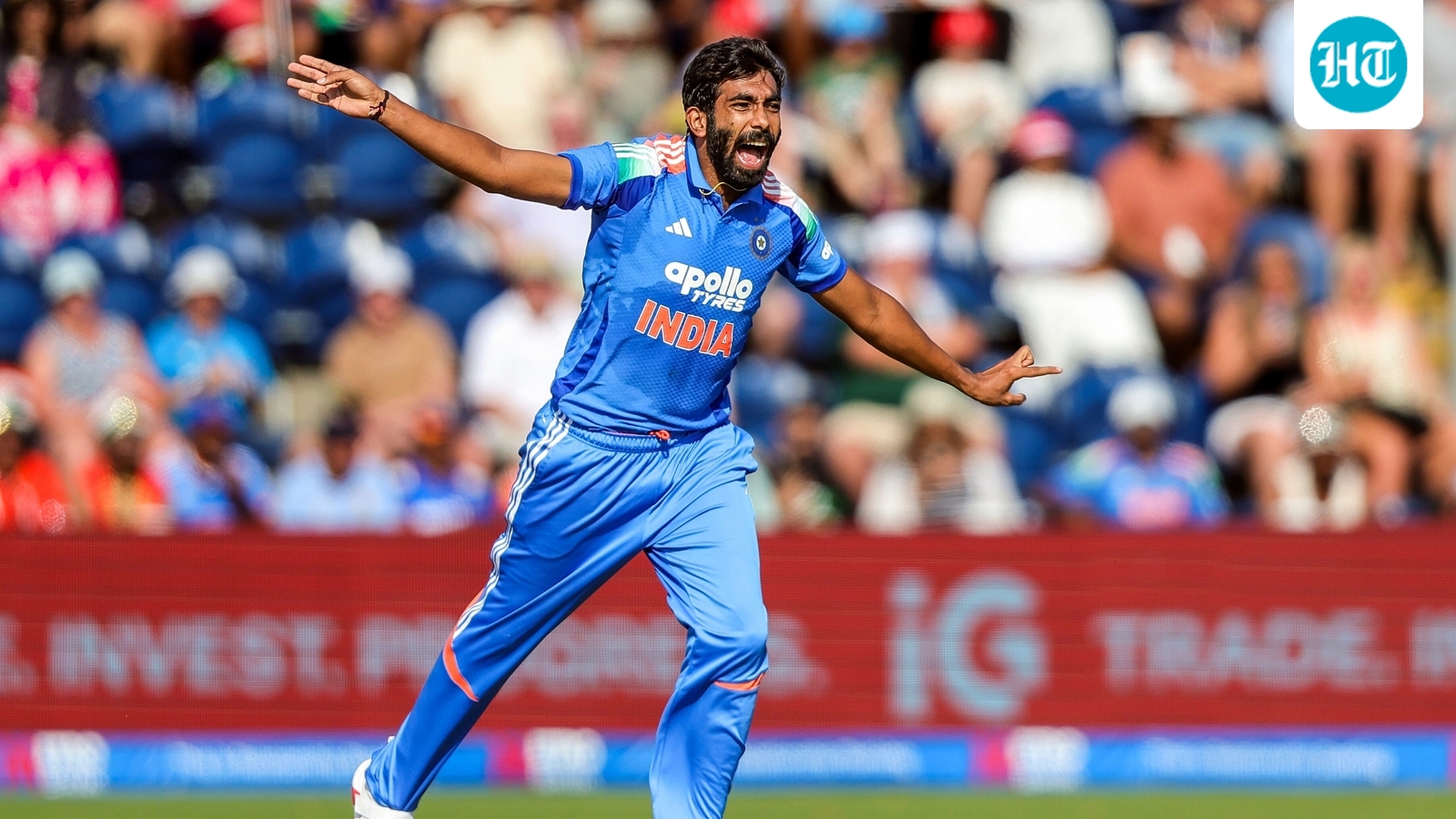
Of the 15 players picked for the upcoming T20I series against Afghanistan, starting next week in New Delhi, four have an asterisk next to their names in the BCCI press release, signifying that their selection is “subject to fitness clearance”. Of those four, one is likely to miss out, while Jasprit Bumrah’s long-awaited return appears on track.
According to a report by news agency PTI, Harshit Rana is unlikely to be fit in time for the three-match series against Afghanistan, beginning on September 13. The India pacer last featured in the T20I series against England in July, after which he suffered a hamstring injury.
Rana was picked for both the Afghanistan T20Is and the Asian Games, for which India are scheduled to depart on September 20, but he is unlikely to make the cut just yet.
“He has not yet fully recovered from his hamstring injury. He will need more time,” a BCCI source said.
Meanwhile, Bumrah, who sustained a knee injury during the ODI series in England in July, is all set to feature in the upcoming T20Is against Afghanistan, with his comeback on track. He had earlier missed India’s Test tour of Sri Lanka after failing to recover in time, which led to criticism of the Centre of Excellence (CoE).
Along with Bumrah, all-rounder Nitish Kumar Reddy, who is recovering from a quadriceps injury, is also set to return. “Both Bumrah and Reddy are on track for their comeback,” the source added.
After the Afghanistan series, India will play a one-off game against Japan in Tokyo on September 22 before opening their Asian Games campaign on September 28.
While the CoE has faced criticism amid India’s latest injury concerns, the facility has been operating without a head of sports science since Nitin Patel left 18 months ago. However, CoE head VVS Laxman has stressed that the facility is not merely a rehabilitation centre for injured players.
Explaining the process, Laxman said players go through a structured assessment involving the sports science and medical teams before progressing through rehabilitation, strength and conditioning, and skills work.
“The whole idea is that when he goes back to the Indian team, men and women, or wherever, including the state teams, he has to be up and running and from the first match, he has been able to perform to the best of his potential,” Laxman said.
He also stressed that recovery timelines cannot always be predicted precisely.
“It’s an objective way of assessing the player to move from one stage to the next stage,” Laxman said. “The guidelines and the timelines are given based on what you expect. But it’s the human body. It is not a machine where the timelines will always be met.”


