



India on Thursday highlighted its concerns related to the West Asia conflict, including disruptions to energy infrastructure and the security of the Strait of Hormuz, at a crucial Brics meeting, even as it urged members of the bloc to stand against the increasing use of unilateral coercive measures and sanctions.


The foreign ministers’ meeting of Brics, which includes India, Brazil, China, Russia, South Africa, Egypt, Ethiopia, Indonesia, Iran and the United Arab Emirates (UAE), is being hosted by New Delhi at a time when the country has been hit by disruptions in global commerce and energy supplies due to the closure of the Strait of Hormuz by Iran.
External affairs minister S Jaishankar, who is chairing the two-day meeting, specifically referred to the West Asia conflict in his address to the gathering and said: “Continuing tensions, risks to maritime traffic and disruptions to energy infrastructure highlight the fragility of the situation.” Safe and unimpeded maritime flows through the Strait of Hormuz and Red Sea are “vital for global economic well-being,” he said.
In a bid to address concerns within the bloc about the situation in Gaza and Palestine, Jaishankar said the wider region too is a cause of serious concern. “The conflict in Gaza has grave humanitarian implications. A sustained ceasefire, humanitarian access and a credible pathway towards a durable and peaceful resolution remain essential,” he said, reiterating India’s support for a two-state solution to the Palestine issue but without referring to Israel.
While referring to the situation in Lebanon, Libya, Syria and Sudan and humanitarian concerns and maritime risks related to Yemen, Jaishankar backed sustained and coordinated global efforts to find solutions. “Taken together, they underline a clear reality: stability cannot be selective, and peace cannot be piecemeal,” he said.
Jaishankar emphasised the need to uphold international law, protect civilians and avoid targeting public infrastructure, and said India will constructively contribute to de-escalation efforts and support initiatives for restoring stability.
Without naming any specific countries, Jaishankar said members of Brics must “address the increasing resort to unilateral coercive measures and sanctions inconsistent with international law and the UN Charter.” His remarks came against the backdrop of US sanctions that have hit India’s purchases of cheaper Russian energy and participation in the development of Iran’s strategic Chabahar port.
“Such measures disproportionately affect developing countries. These unjustifiable measures cannot substitute dialogue, nor can pressure replace diplomacy,” he said. Such challenges will widen disparities and constrain development at a time when many developing countries are trying to manage vulnerabilities under increasingly difficult global conditions, he noted.
The Brics foreign ministers’ meeting has been hit by sharp differences between Iran and the UAE over the West Asia conflict, raising doubts as to whether the bloc, which works by consensus, will be able to agree on a joint statement.
The Indian side has had to strike a balance between the UAE, with which economic, energy and security cooperation has grown rapidly in recent years, and Iran, with which the country has long-standing friendly ties. India, the world’s third-largest oil importer, has also been hit hard by Iran’s closure of the Strait of Hormuz.
Jaishankar pointed to the geopolitical churn and economic uncertainty triggered by the climate crisis, the Covid-19 pandemic and conflicts, as well as the “rebalancing and democratisation of the global order”, and underscored the need for Brics member states to come together to cope with “challenges testing the resilience of multilateral systems”.
Brics solidarity has become more significant at a time when these issues are impacting developing countries through pressures on energy, food and fertiliser security and supply chain disruptions, he said. “Collective action and resolve are essential to promote stability, sustainability and prosperity…Respect for sovereignty and territorial integrity must remain the foundation of international relations. Dialogue and diplomacy are the only sustainable means of resolving conflicts,” he added.
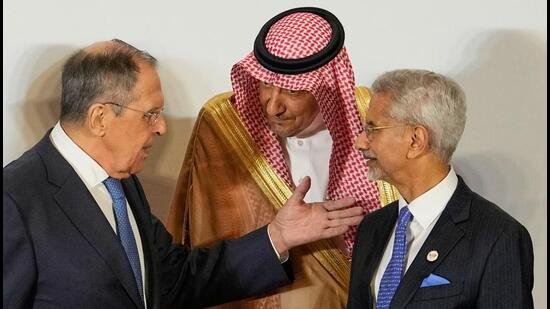
Iran’s Seyed Abbas Araghchi, Russia’s Sergey Lavrov, Brazil’s Mauro Vieira, Indonesia’s Sugiono and South Africa’s Ronald Lamola are among the foreign ministers attending the meeting. China’s Wang Yi was conspicuous by his absence, having stayed on in Beijing for a visit by US President Donald Trump, and the Chinese side was represented by ambassador Xu Feihong.
Jaishankar also described terrorism as a “continuing threat” and said there can be no justification for any form of terror. “Cross-border terrorism violates the basic principles of international relations. Zero tolerance must remain an uncompromising and universal norm,” he said.
With technological advancements reshaping the global landscape, Jaishankar pointed to the need to bridge the digital divide and to address concerns related to trust, transparency and equitable access to emerging technologies. He also called for the reform of the UN Security Council while noting the weakening of the multilateral system.
“The state of the UN, which is at its core, is particularly worrisome. With each passing day, the case for reformed multilateralism only gets stronger,” he said. “The message from our times is clear: cooperation is essential, dialogue is necessary, and reform is overdue. We must work together to shape a more stable, equitable, and inclusive international order.”
The Brics foreign ministers’ meeting is crucial for preparations for the bloc’s summit to be held in September. The deliberations during the two-day meet will set the stage for the summit at a time when many members of the bloc, which represents 49.5% of the global population, 40% of global GDP and 26% of global trade, have been hit by the trade and tariff policies of the US.
The Brics foreign ministers and other senior officials also met Prime Minister Narendra Modi, who said the bloc has become an “important platform for advancing cooperation among emerging economies and giving voice to the aspirations of the Global South.” Under India’s presidency, Brics will strengthen multilateralism, enhance economic resilience and build a “more inclusive world order,” Modi said on social media.


