



India’s two-match T20I series against Ireland did not merely expose a batting failure. It exposed a phase-specific weakness. The problem was not that India were blown away in the powerplay, nor that the lower order had no fight. The issue was sharper: once the field spread and the game entered overs 7 to 15, India did not have a batter who could take ownership of the innings.


That is why Rajat Patidar enters the discussion.
Not as a fashionable name. Not as another IPL performer being forced into an India debate. But as a batter whose recent data directly answers the weakness Ireland dragged into the open – India’s inability to control, accelerate and break the game open in the middle overs.
Across the two T20Is against Ireland, India scored 124 runs in overs 7 to 15 at 6.89 runs per over. Ireland, in the same phase across their two innings, scored 152 runs at 8.44 runs per over. The 28-run difference in that period was not cosmetic. It was the difference between Ireland building defendable totals and India repeatedly entering the death overs under pressure.
In the first T20I, India were 68/3 after six overs while chasing 183. That was not a hopeless position. The asking rate was manageable, and the innings had enough time to settle. But between overs 7 and 15, India managed only 61 runs and lost three wickets. Even more damaging was the stretch from overs 7 to 12, where they scored just 32 runs for three wickets. By the end of the 12th over, India were 100/6. The chase had not been lost at the start. It had been squeezed to death in the middle.
The second T20I was different in shape but similar in diagnosis. India were 41/4 after six overs chasing 155. This time, they did not collapse immediately in the middle overs. They moved from 41/4 to 104/5 after 15. On paper, 63/1 in nine overs looks like recovery. In reality, it was passive repair. India still needed 51 off the last five overs. The wicket column looked healthier, but the match situation had not been seized.
That is the key distinction. India had batters who could survive. They did not have a batter who could survive and then hurt Ireland before the death overs.
Why Patidar fits the exact vacancy
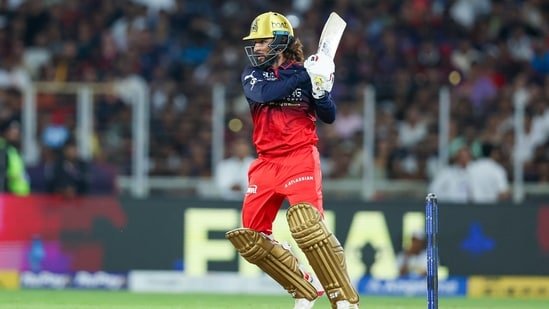
Rajat Patidar’s middle-overs numbers from IPL 2026 make the discussion impossible to ignore. In overs 7 to 15, he has scored 322 runs off 159 balls at a strike rate of 202.52. That scoring rate translates to more than 12 runs per over.
Place that against India’s Ireland middle-over rate of 6.89, and the relevance becomes obvious. Patidar is not merely slightly better in that phase. His profile is almost the opposite of what India produced in Ireland. India drifted. Patidar disrupts.
The volume also matters. This is not a 40-ball sample where one cameo has inflated the numbers. Patidar has faced 159 balls in that phase and scored 322 runs. He has hit 16 fours and 28 sixes between overs 7 and 15 alone. A boundary every 3.61 balls in the middle overs is not conventional anchoring. It is sustained pressure. Yes, the conditions might be different, but it is Patidar’s intent that is the centre of discussion.
India’s batting in Ireland often looked overloaded with “options” but underpowered in terms of defined middle-order skill. There were all-rounders, floaters and stabilisers. But the middle overs demand a particular type of specialist: someone who can enter after the powerplay, play spin and pace-off bowling, rotate enough to avoid stagnation, and still have the power to create a 14-run or 16-run over before the death phase begins.
Patidar’s data says he can do exactly that.
The split inside the middle overs is even more revealing. From overs 7 to 11, he has scored 152 off 80 balls at a strike rate of 190.00. From overs 12 to 15, he has been even more dangerous: 170 off 79 balls at 215.19. That second number is crucial because India’s Ireland problem was not only the immediate post-powerplay phase. It was the inability to shift gears before the final five overs.
In the second T20I, India’s over-by-over sequence from the seventh to the 15th over read 7, 6, 7, 5, 5, 6, 8, 10 and 9. There was no true release over. No 15-run over. No moment where Ireland were forced to retreat. Patidar’s record suggests he is built precisely for that missing moment.
Also Read: Inside India’s dressing room after Ireland shock: Disbelief, acceptance and lessons for England
Not matchup-dependent, not just a spin hitter
The strongest part of the Patidar argument is that his middle-overs success has not been locked to one bowling type. In overs 7 to 15, he has scored 161 off 78 balls against fast bowling at 206.41, 84 off 40 against spin at 210.00, and 77 off 41 against medium pace at 187.80.
That range matters. Ireland’s bowlers did not beat India with mystery alone. They beat India with discipline, pace variation, hard lengths and smart field use. A batter who only attacks spin would not fully solve that. Patidar’s middle-over scoring has come against different bowling profiles, which makes his case stronger as a proper No. 4 or No. 5 candidate rather than a conditional matchup pick.
His shot distribution also explains why he is different from the type of batting India showed in Ireland. He has 102 runs off 47 balls through drives, 71 off 17 through slog sweeps, and 66 off 26 through pulls in the middle overs. That is a powerful combination: straight scoring, square-leg aggression and back-foot punishment. He does not need the final five overs to start accessing the boundary.
That is what India missed. Not merely boundaries, but boundary threat at the right time.
The risk India must accept
There is a caveat. Patidar is not a risk-free fix. He has been dismissed six times in overs 7 to 15, and an attacking middle-over method naturally brings catches into play. He is not a pure insurance batter. He is a tempo batter.
But that may be exactly why his case has value.
India already had enough insurance against Ireland. They had batters who could hold shape, bat deep and extend the innings. What they lacked was a player who could change the tempo while the innings was still being shaped. Tilak Varma offered stability. Shivam Dube offered bursts. Axar Patel and Washington Sundar offered depth and utility. But India did not have one pure middle-order batter who could claim the phase and say: This is where the match changes.
Patidar’s evidence goes a long way toward solving that weakness because it is not a generic batting case. It is a phase-specific answer. India’s problem was overs 7 to 15. Patidar’s strongest body of work is overs 7 to 15. India struggled to find release overs. Patidar’s middle-over record is built on release shots. India became passive under pressure. Patidar’s numbers show aggression without being trapped by bowling type.
That does not mean he must walk into every XI, and it does not mean IPL numbers automatically transfer to international cricket. But selection is about identifying a problem and finding the closest available solution. After Ireland, India’s problem is clear: the middle order has too many flexible pieces and not enough middle-over authority.
Rajat Patidar gives them that authority.
In a format where one quiet phase can decide the match, India cannot keep treating overs 7 to 15 as a passage to be managed. They need to win it. Patidar’s evidence says he is one of the few Indian batters currently making that phase his own.


