



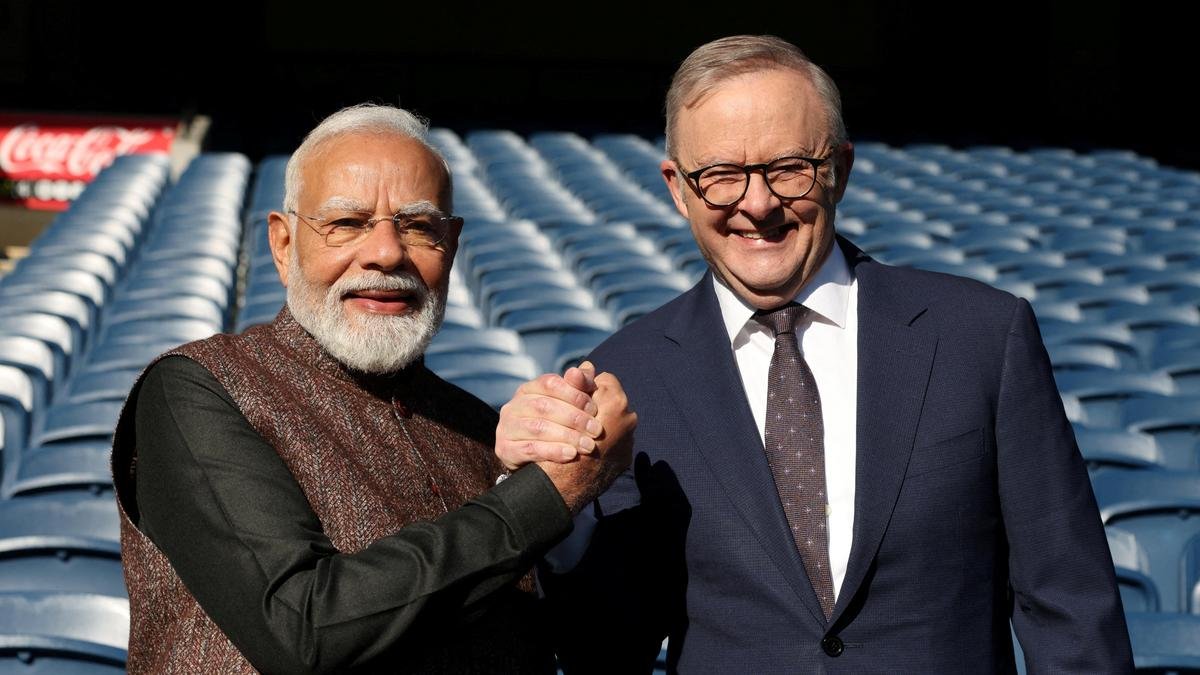
The story so far: During Prime Minister Narendra Modi’s visit to Australia last week, India and Australia “finalised the administrative arrangements” required to enable export of uranium from Australia to India. These exports will be “exclusively for peaceful purposes and under International Atomic Energy Agency (IAEA) watch” under the Australia-India Nuclear Cooperation Agreement, 2015.
What does the latest development mean?
The finalisation of the “administrative arrangement” means that private Australian mining entities involved in uranium extraction will be able to conclude commercial contracts with Indian private sector companies and other organisations. The participation of private Indian entities in uranium exports from Australia adds a new chapter to India’s energy journey, which was recently boosted by the SHANTI Act passed in Parliament in December 2025, opening the nuclear sector to private players.
The timing of the agreement is significant, as it has come at a time when India’s energy sector is under severe stress due to the U.S.-Israel attack on Iran. India is being forced to diversify and explore options to cope with short-term requirements by buying hydrocarbons from Russia, the United States, and Venezuela, while also planning for the future. The India-Australia “administrative arrangements” for uranium export are expected to help India meet its energy requirements in the future.
Comment | Beyond three Cs, the new lexicon of India-Australia ties
Why is this significant?
Australia holds more than a quarter of the global uranium reserves and has traditionally maintained a strict policy regarding the supply or export of uranium to non-NPT member countries. The countries that have received Australia’s uranium include the United States, Japan, South Korea, France, Sweden, Belgium, Finland, the United Kingdom, and Germany. India is among the non-signatories, which are countries that chose not to sign the Nuclear Non-Proliferation Treaty.
Australia has been exporting uranium to countries with which it has “bilateral safeguards agreements”, as it maintains that support for nuclear non-proliferation is among its “paramount” considerations. The “administrative arrangement” is equivalent to the “bilateral safeguards” that Australia has established with India to allow its private mining companies to export uranium to India’s expanding energy portfolio.
Comment | Building a durable India-Australia partnership
India is a non-signatory to the NPT. So how is Australia entering into administrative arrangement with India?
India has an unblemished nuclear supply chain record and an ambitious nuclear energy programme. Though it is not a signatory to the NPT, it signed a safeguards agreement with the IAEA in 2008 after India and the United States signed the nuclear deal, which was presided over by Prime Minister Manmohan Singh and President George W. Bush. Subsequently, the 48-member Nuclear Suppliers Group made a major move by exempting India from the list of countries with which they are prohibited from engaging in nuclear-energy-related business, thereby opening the gates for nuclear-energy-related supplies to India. This exemption has been the basis of several civil nuclear agreements that India has signed with partner countries. According to World Nuclear News, Australia is currently the fourth-largest uranium producer, after Kazakhstan, Canada, and Namibia.
What kind of negotiations have taken place on uranium supplies in the previous two decades to make this arrangement possible in 2026?
While Canberra and New Delhi have finalised the “administrative arrangement” now, negotiations between the two sides have been ongoing for nearly two decades. On November 12, 2009, during Prime Minister Kevin Rudd’s visit to India, the two issues were addressed.”
A joint statement issued during this visit said, “Mr. Rudd noted India’s plans to meet its future energy requirements by exploring and developing all sources of energy, including nuclear, renewable and non-conventional resources. Both sides recognised the benefits of enhancing bilateral commercial exchanges of renewable and non-renewable energy resources. The two Prime Ministers also agreed that energy security concerns are best met by reconciling the long-term interests of both energy-producing and energy-consuming countries through a truly open and competitive energy market. Both sides also expressed their willingness to join efforts which promote a cooperative response to any global energy crisis, noting the important role of open and transparent energy trade and investment markets.”
The same joint statement also mentioned mutual commitment to oppose nuclear weapons. These negotiations led to the Australia-India Nuclear Cooperation Agreement, which was signed in 2014 and came into force in 2015.
Why has Australia agreed to the “administrative arrangement” now?
India has set a target of 1,000 gigawatts of nuclear energy capacity by 2047. During his tour of Australia, Prime Minister Modi outlined that Australia could play a role in helping India attain 500 gigawatts of clean energy, which will include nuclear energy and infrastructure, by 2030. These projections have generated necessary commercial momentum for the supply of uranium exports to India. Following the civil nuclear agreement between India and Australia, Australia’s Joint Standing Committee on Treaties observed that Australian suppliers could begin exporting only after India fulfills conditions regarding its nuclear regulatory regime, routine inspections, and reactor decommissioning plans being verified.
Earlier this year, Cameco of Canada agreed to supply uranium ore concentrate to the Department of Atomic Energy (DAE) for use in India’s 24 functional nuclear reactors. This $1.9-billion long-term contract also boosted international confidence in India’s nuclear energy programme as an attractive area for investment. India is expected to build several nuclear reactors in the coming years to meet the goal of 1,000 GW of nuclear energy by 2047.
From uranium supply deal to economic cooperation, what did PM Modi, PM Albanese discuss?
| Video Credit:
The Hindu
Published – July 13, 2026 01:18 pm IST


