



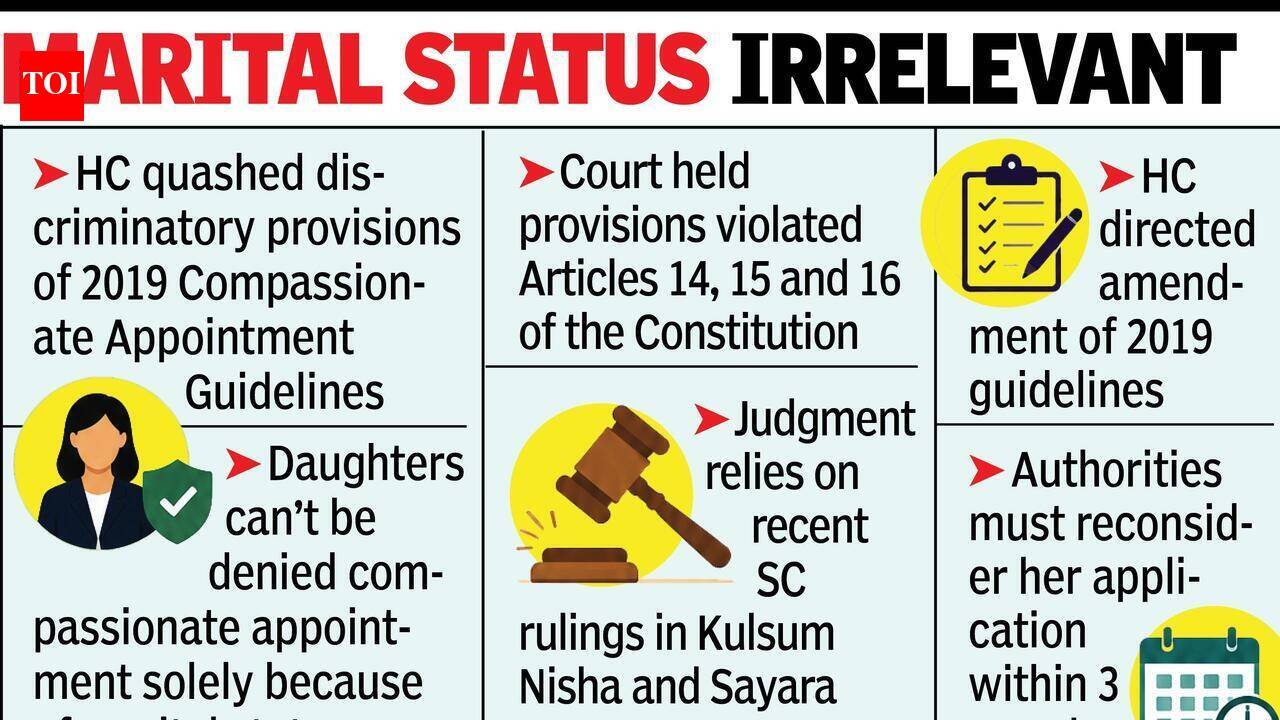
Nagpur: In a ruling reinforcing gender equality in public employment, Nagpur bench of Bombay High Court declared recently that provisions of high court’s ‘2019 Compassionate Appointment Guidelines’ that excluded married daughters from compassionate appointment, except in limited circumstances, is unconstitutional.A division bench comprising Justices YG Khobragade and SM Ghodeswar allowed a petition filed by a Gadchiroli woman, whose application for compassionate appointment was rejected solely because she was a married daughter of a deceased district court employee.The 27-year-old’s father, a stenographer at Gadchiroli district court, died of cancer while in service on May 7, 2022. Although her mother, brother and sister supported her claim and consented to her appointment, the court administration rejected her application under 2019 guidelines, which restricted eligibility of married daughters.The bench held the distinction between married and unmarried daughters violates constitutional guarantees of equality and non-discrimination under Articles 14, 15 and 16.Relying extensively on recent Supreme Court judgments in Sayara Khatoon versus State of Bihar and Kulsum Nisha versus State of Uttar Pradesh, the bench observed that “marital status cannot constitute a valid ground for denying the benefit of a welfare measure to an otherwise eligible daughter”. It further noted that “classification restricting eligibility only to a divorced or deserted daughter cannot be sustained in eyes of law.”The court said the 2019 guidelines discriminated against married daughters by presuming that marriage automatically severed their dependence on their parental family. It ruled such classification was based on gender stereotypes and is constitutionally impermissible.Declaring clauses 4(I)(c) and 4(I)(e) of 2019 rules unconstitutional to the extent they excluded married daughters except in exceptional situations, the judges directed the court administration to amend the guidelines in accordance with the law laid down by the apex court.The court also quashed the communication rejecting the woman’s application and directed the authorities to reconsider her claim for a suitable post within three months.As a safeguard, the bench directed the petitioner’s counsel Rahul Tajne to furnish undertakings from the woman’s mother, brother and sister stating they had no objection to her appointment. She must also undertake to financially support her mother and siblings until their marriages and during her mother’s lifetime.


