



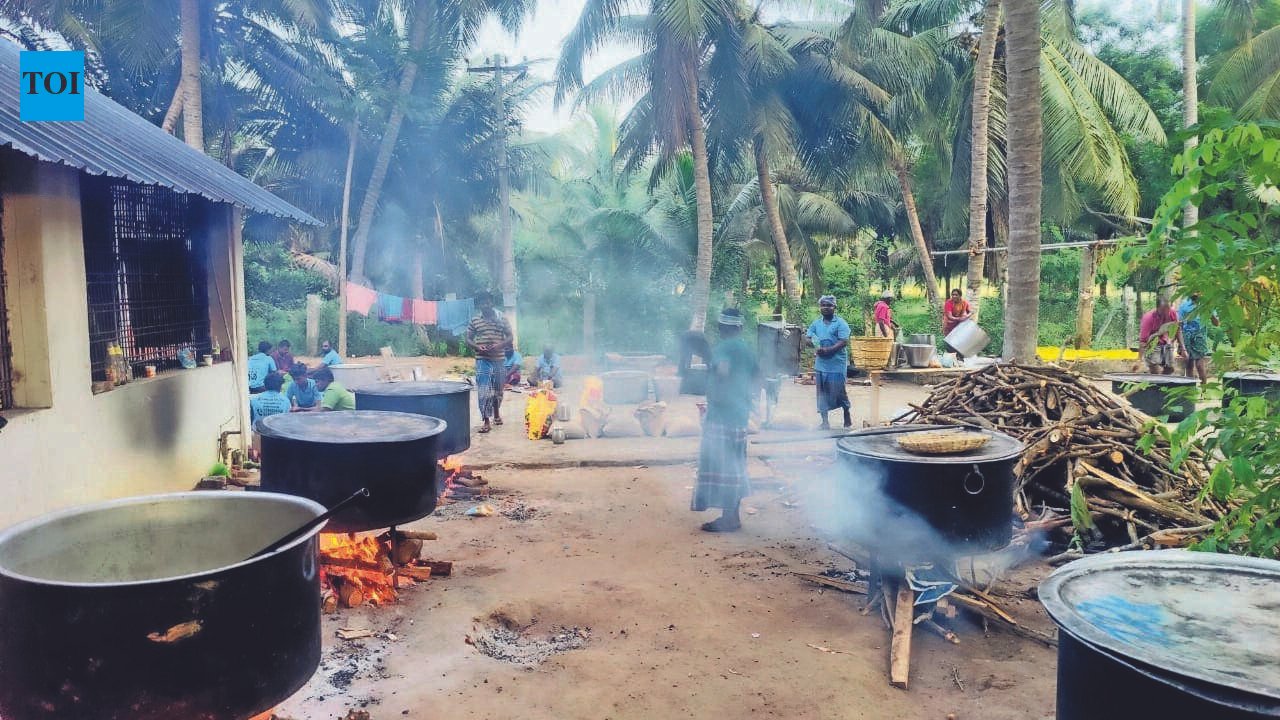
Before sunrise, the clearing outside a house on Madurai’s outskirts has become a kitchen. Goat meat simmers in broad aluminium vessels. Ginger and garlic are pounded in stone mortars. Men squat beside baskets of onions, peeling and chopping them. Others tend the fire, wash vessels or carry water. Curry leaves crackle in hot sesame oil as the smell of pepper, coriander and mutton spreads through the neighbourhood.At the centre of it all is P Nandakumar, directing preparations for a keda vettu — a village ritual in which a goat is sacrificed and cooked for relatives and guests as part of a community feast.The men working beside him are not employees recruited through an agency. They are his neighbours, cousins and relatives. Some lead their own catering teams. On another day, Nandakumar may be working under one of them.This is how Manapatti cooks.Around 75 years after a cook from the Melur region first taught a handful of villagers, wedding catering has become Manapatti’s livelihood, inheritance and calling. Every household in this village has someone connected to a kitchen — as a cook, helper, server, vegetable cutter, vessel washer or organiser.When a wedding serving thousands is booked, Manapatti does not simply dispatch a catering company. It mobilises a village.Nandakumar is often the first link in that chain. Once a customer calls, he estimates the crowd, menu, labour and cooking time before distributing the work among 15 teams in the village. Each team can draw from a pool of about 200 workers. For events requiring more hands, cooks and helpers from neighbouring villages are brought in.Teams may compete for bookings, but not for labour. If one group is short of ten cooks or 20 servers, another sends them across. A man supervising biryani for his own team one day may wash rice or cut meat for another the next.“Members of one group help another without hesitation,” says Nandakumar. “That is the only way we can accept more orders. When we work together, everyone gets work.”The arrangement allows Manapatti’s cooks to move from a family ceremony feeding a few hundred to a wedding or temple festival serving several thousand. A single assignment can begin days before the guests arrive, with purchases, spice preparation, vessel transport and labour allocation completed in advance.The working month is often longer than the resting one. Nandakumar says cooks are occupied for nearly 25 days a month. “Over the past 15 years, I have worked at close to 5,000 weddings, temple festivals, keda vettu feasts and family functions.”The story began in 1950, says M Murugesan, one of the village’s senior cooks. Vairavan, a cook from Melur, trained Murugesan’s father and a Manapatti resident named Mandaiyan. They travelled through nearby villages preparing vegetarian and meat dishes before passing what they had learned to others.“Vairavan is our god,” says Murugesan. “Everything we have today began with him. Since then, each generation has taught the trade to the next.”There are no recipe books documenting that inheritance. No one measures the village’s cooking in written formulas or distributes notes listing the quantity of chilli required for 500 people.The recipes travel through hands, tongues and memory.A young helper watches the colour of roasting coriander seeds, learns when a mutton dish has released enough water and tastes rasam until the balance of pepper, tamarind and salt feels right. Years later, he stands beside the vessel and teaches another boy the same way.“Nothing is written down,” says Murugesan. “We learn through experience, taste and word of mouth.”Manapatti built its reputation around rasam and mutton sukka. Its cooks later added biryani, ghee sukka, onion roast, chicken fry and other dishes as wedding menus changed. But they say their methods have not moved towards the shortcuts common in bulk cooking.Chillies, turmeric, cumin and coriander are bought separately. They are cleaned, dried and ground by the teams. Ginger and garlic are crushed in mortars or on grinding stones. Sesame oil and ghee are used for flavour and cooking.“We do not use ready-made masalas, artificial colours or flavour enhancers,” says Murugesan. “The taste has to come from the ingredients and the way they are handled.”G Karthiyayini, among the regular customers, says her family continues to hire Murugesan’s team because the taste has remained consistent over the years and across functions.“The taste I had 10 years ago is still there,” she says. “It does not leave you feeling heavy. It tastes like food made at home by my mother.”The trade has also reversed migration from the village. Many graduates and engineers leave Manapatti after completing their studies, hoping to find salaried employment in cities. Some return after finding that entry-level jobs pay around `10,000 a month despite long working hours.A catering worker can earn about `2,000 a day, according to Nandakumar. At 25 days of work, that can mean about `50,000 a month. Those who master cooking, build teams and secure bookings can earn more.The entry barrier is also low. A young villager does not need to buy land, open a shop or invest in machinery. He can begin as a helper with an existing team, earn from the first assignment and learn while working.“There is no capital needed,” says M Balan, another cook. “Youngsters realise that they can earn here, learn the recipes and later lead a team themselves.”Manapatti is now an identity that travels beyond Madurai, following its teams to marriage halls in Chennai and to functions in other states.


