






With the hallowed Headingley Cricket Ground serving as a backdrop, England’s Test team ushered in a new era last week. It was brought upon the Englishmen after Ben Stokes’ retirement at the end of a chaos-ridden series defeat to New Zealand in June. Brendon McCullum also had to relinquish his role as Test coach in the aftermath, curtailing his authority to just the white-ball set-up. Joe Root, certainly older and hopefully wiser to the perils of captaincy after his first stint, is back in the hot seat for a second time. The 35-year-old will have another Kiwi coach, Stephen Fleming, by his side when England embarks on a tour of South Africa for three Tests over the winter.
If Root & Co. intended to start with a clean slate and not let the previous regime’s ideological inclinations linger, there were encouraging signs against Pakistan in Leeds. The result — victory by an innings and 103 runs inside three days — was just as the doctor ordered for England, but the willingness to change tack was most apparent in how Harry Brook went about his business during his two hours and 22 minutes at the crease.
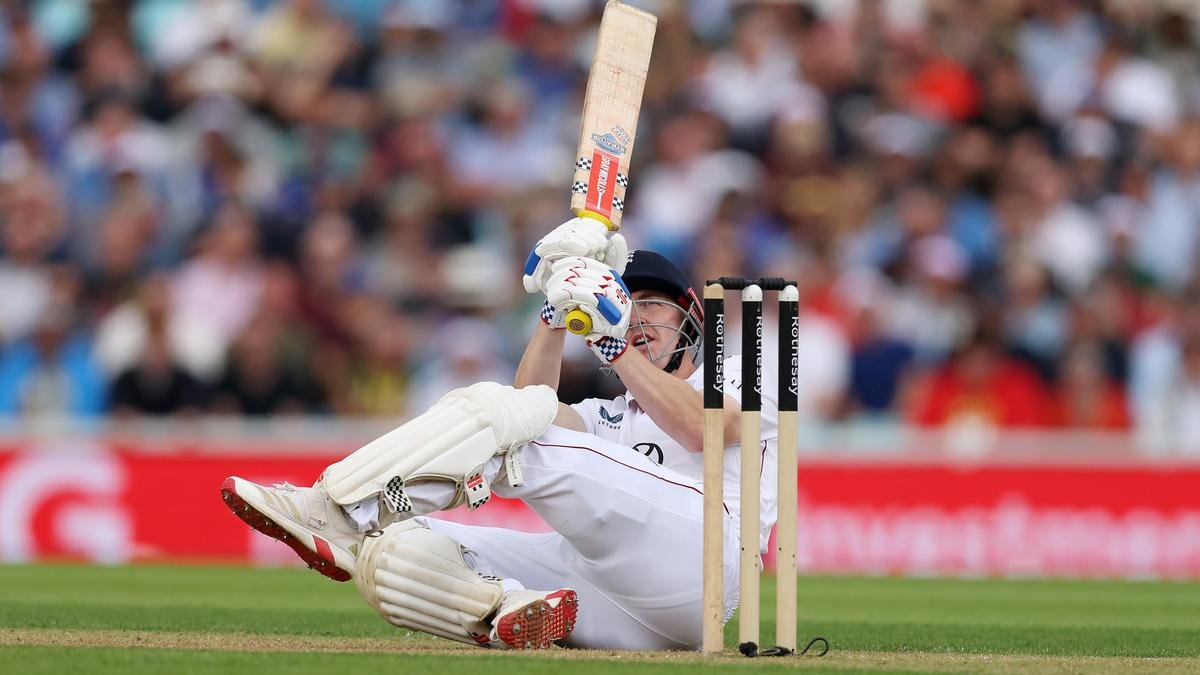
At a venue he knows like the back of his hand, Brook simply batted, without resorting to any of the gimmicks that entertain and exasperate onlookers in equal measure. Not once did he dance down the track to wallop the ball over extra cover. The shuffle across the stumps for the scoop to fine-leg, another trademark of the Yorkshireman, was also concealed.
Yet, the 27-year-old raced to 91 off 93 deliveries before walking off to a rousing ovation from his home crowd. Even his dismissal was unusually soft — bowled by left-arm spinner Ali Usman while looking to nudge the ball square on the leg-side.
It raises a pertinent question: was Brook’s very first innings in the post-Bazball era a pointer to the tweak in approach that Root and Fleming desire from him?
It may appear absurd to quibble about a method that has only yielded outstanding results so far. A bit like nitpicking the song-writing structure of the Beatles. After all, Brook averages 53.63 after 39 Tests. He is one of only three batters since the start of 2020 to average more than 50 in this format. He is currently No. 1 in the International Cricket Council’s rankings for Test batters.
More to offer
If there is a sense then that he still isn’t optimising his ability to the fullest, it is a testament to his supremely high ceiling as a batter. Such was his incandescent start to life at the highest level that he was actually averaging a remarkable 61.62 after his first 23 Tests. Granted that it is natural for the average to plateau as one plays more Tests, but Brook could have sustained that initial surge if only he had applied himself more. Too often in his Test career, the middle-order dasher, driven by an impetuous streak to unleash his eclectic range of shots, has succumbed to his impulsiveness. It has been the difference between victory and defeat on some occasions.
The most glaring example came against India at The Oval a year ago. Chasing 374 in the fifth and final Test of a series that had oscillated like a pendulum all through, Brook hammered the Indian attack with nonchalance to take England to the cusp of a storied win. With another 73 runs required and seven wickets in hand, however, Brook committed the schoolboy blunder of assuming that the contest was done and dusted. Instead of aiming to stay through to the end, he swung wildly at a length ball by Akash Deep and holed out at mid-off after a sublime 111 off 98 deliveries. Mohammed Siraj & Co. sensed the narrowest of openings, and seized the initiative to clinch an epic six-run win and level the series 2-2.
If not for that error in judgment, England may have entered the Ashes later in the year with greater impetus and avoided a 1-4 rout. As it turned out, the legacy of Stokes and McCullum as captain and coach was tarnished by the end by their inability to win a series against either India or Australia.
Another nadir in Brook’s collection of forgettable dismissals came in the final Test of the last series against New Zealand at Trent Bridge. With Stokes, whose retirement became public midway through the fourth day’s play, promoting himself to open in the fourth innings and bowing out with a burst of attacking shots in pursuit of a target of 373, Brook decided to follow his captain’s command without hesitation.
He produced a frenetic and frankly bewildering 9-ball 21, and was caught at fine-leg while trying to loft Zak Foulkes into the stands. The hysterical reaction of the New Zealanders — the stump mic picked up Rachin Ravindra chuckling as he muttered, ‘what are they doing?’ — summed up the imprudence of the stroke.
During the Test against Pakistan, Stuart Broad, who has turned into a shrewd commentator after a stellar playing career, delved into the conundrum facing Brook.
“He can play in any way that his captain and coach require for the team. McCullum and Stokes wanted him to play in a certain style, and that did play into his strengths. But if we look for improvements in Brook, I feel he could average 60 in Tests. England needs him to get the team over the line in big games. If he had got the job done against India, the narrative would have been different for England going into the Ashes,” Broad commented on Sky Sports Cricket.
“If he can get through little periods and win those moments, he can be averaging closer to 60. Averages won’t matter to him, but it is more about being the guy who wins Test matches at important times. There are some instances when he hasn’t done that. Because he is so talented, we expect much more from him,” the former fast bowler continued.
Brook’s knock against Pakistan may be a sign that he is coming of age. The relatively measured tempo may have also had to do with the sheer incompetence of the Pakistan attack, for he knew that he did not have to manufacture boundary-scoring opportunities when a rank bad ball was on offer in every over. Even then, it is a step in the right direction for Brook to have had that situational awareness.
The trigger
When he has displayed daredevilry on previous occasions, he has done so to usually counter either a tricky surface or a formidable bowling attack that has homed in on a stifling channel.
While there is some cricketing logic to such an outlook, there is a fine line between being proactive and plain foolish. In Brook’s case, he has tended to veer towards the latter.
The recklessness has extended beyond the field too. Think of the nightclub incident in Wellington on the eve of an ODI against New Zealand last October, when Brook was at the centre of an altercation with a bouncer. It was far from adhering to the standards of professionalism expected of an elite cricketer in the 2020s, not least because he was also white-ball captain.
Even if the top honchos of the England & Wales Cricket Board (ECB) don’t concede, it would have had a bearing on the decision to not let Brook take charge of the Test team at this point. It may be to England’s detriment, for he has shown a flair for leadership in helping the ODI and T20I teams regain their mojo under his watch. He led the two-time champion to the semifinals of the T20 World Cup in March, and also spearheaded T20I and ODI series wins against India at home in July.
“Harry makes a really good captain. He has a good presence and a very good cricket brain. I personally would have preferred England going with Brook as Test captain. It would have been a forward-looking step.
There is obviously the issue of what Harry has done off the field,” former England skipper Nasser Hussain observed in the discussion with Broad. Some of Brook’s indiscretions shouldn’t give the impression that he doesn’t quite care. If that was the case, he wouldn’t have pulled out of the IPL in 2025 and invited a two-year ban from the T20 league because he wanted to wholeheartedly focus on his commitments with England. “It is a really important time for England cricket, and I want to fully commit to preparing for the upcoming series. In order to do this, I need time to recharge after the busiest period in my career to date,” Brook said at the time of his decision.
Now, the time is ripe for Brook, approaching the prime of his career, to show that his template last week wasn’t a one-off. If he can buckle down and become ruthless, England’s new era under Root and Fleming can strive to accomplish series wins against elite opponents. Something that Bazball never managed.


