






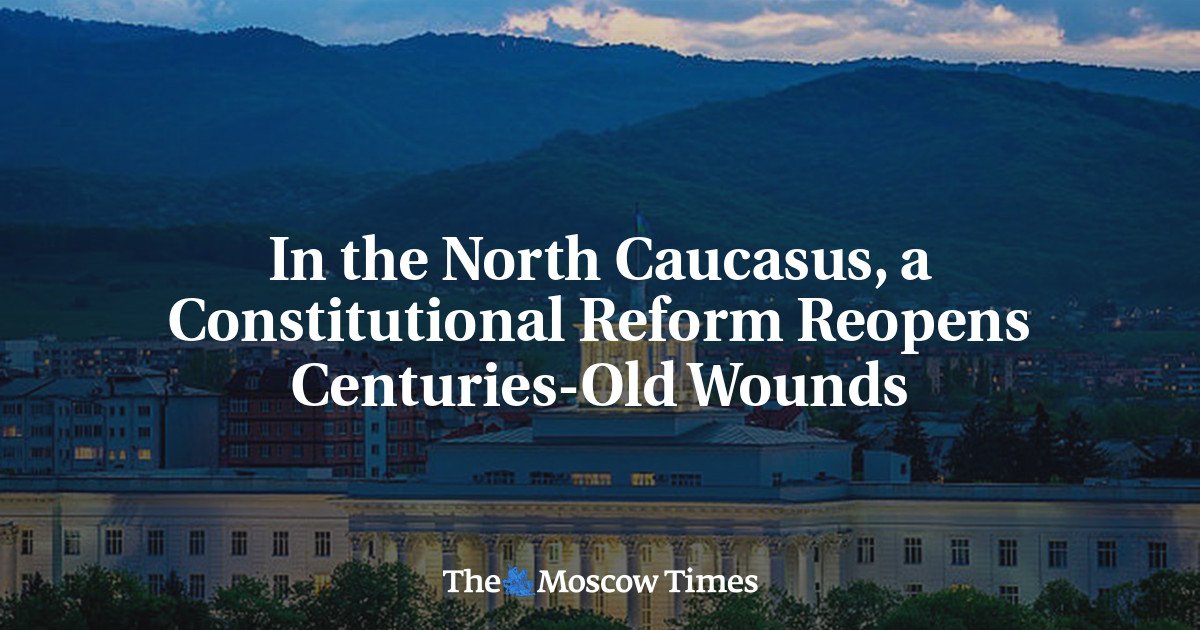
Tensions between the authorities and civil society are rising in Russia’s North Caucasus republic of Kabardino-Balkaria after the regional parliament agreed last month to consider amendments to the republic’s constitution.
Proposed by Kremlin-appointed regional prosecutor Nikolai Khabarov, the amendments would remove guarantees of Kabardino-Balkaria’s “statehood” and “territorial integrity and inviolability” from the republic’s supreme legal document.
If adopted, the changes would also strip the republic’s head of the formal status of “head of state” and remove their mandate to ensure Kabardino-Balkaria’s “security and territorial integrity.”
“The powers of Russia’s federal subjects are not sovereign powers, but part of a unified system of state power,” Khabarov told lawmakers when presenting the amendments to the region’s parliament last month, stressing that the amendments would merely bring Kabardino-Balkaria’s constitution into line with Russia’s supreme law.
But prominent civil society actors in Kabardino-Balkaria and members of the Circassian diaspora believe the changes would further erode the republic’s autonomy and set the region on a sure path to demise.
Opponents of the reform fear that, if adopted, the amendments could equip the federal government in Moscow with the legal basis to redraw the small, mountainous republic’s borders, transfer parts of its territory to neighboring regions or — in the worst-case scenario — merge it with one of them.
“When the constitution of the Kabardino-Balkarian Republic was initially adopted in 1992, Kabardino-Balkaria was declared a state with its own constitutional court, its own president, its own parliament and so on,” said Martin Kochesoko, a native of the republic and head of the Circassian political alliance Khabze.
“The powers of the republic have been taken away year after year,” Kochesoko told The Moscow Times. “It is obvious that everything is being prepared for the complete elimination of the republics [of Russia] and unitarization of the state.”
JukoFF
A mountainous republic roughly the size of Montenegro with a population of fewer than 1 million, Kabardino-Balkaria is best known as the home of Mount Elbrus, Europe’s highest peak located along the region’s 130-kilometer (80-mile) border with Georgia.
The republic’s name is derived from its two largest ethnic groups: the Kabardians, who make up nearly 60% of the republic’s population, and the Turkic-speaking Balkars, who account for around 13%.
The former consider themselves part of the larger Circassian ethnic group, while the latter share a language and cultural traditions with the Karachays, the majority ethnic group of the neighboring republic of Karachay-Cherkessia.
This name reflects the complicated history that preceded its founding by the Bolsheviks in the 1920s and the divide-and-rule strategy that guided the Soviets’ nationality policies.
Indigenous to the northwest Caucasus, the Circassians were conquered by the Russian Empire in 1864 after the century-long Russo-Circassian War. Historians estimate that up to 2 million Circassians were killed during the conflict, while the Russian Empire deported millions of survivors to the Ottoman Empire.
Today, fewer than 1 million of the more than 5 million Circassians worldwide live in Russia, scattered across the republics of Adygea, Kabardino-Balkaria, Karachay-Cherkessia and North Ossetia-Alania, as well as the Krasnodar and Stavropol regions.
“The North Caucasus is the native land of Circassians living all across the globe,” Kochesoko explained. “The fact that the republics there have at least some autonomy gives Circassians hope for defending their rights, preserving their culture and language and the hope for returning to the motherland.”
Last month, more than 40 organizations from across the North Caucasus and the Circassian diaspora appealed in an open letter for regional head Kazbek Kokov and the local parliament to preserve the constitutional provisions protecting Kabardino-Balkaria’s territorial integrity.
And Faruk Arslandok, chairman of Turkey’s Pluralist Democracy Party, also known as the Circassian Solidarity Party, called on President Vladimir Putin to consider the “social and psychological” impacts that the constitutional changes could have on both the republic’s population and the vast Circassian diaspora.
But for the Kremlin, revising the constitutions of Russia’s 21 ethnic republics is a routine part of a long-running centralization drive that is unlikely to be derailed by public appeals or by the pressures of the invasion of Ukraine, comparative federalism expert Irina Busygina said.
“We know that Kabardino-Balkaria is not the first republic in the queue. It’s just that the Kremlin has now got round to the republic,” said Busygina, a researcher at Harvard University’s Davis Center for Russian and Eurasian Studies.
tanci-kavkaza.ru
Last year, lawmakers in the Siberian republic of Altai removed references to the region’s “territorial integrity” from the constitution, reigniting long-standing fears that Moscow could merge it with the neighboring Altai region — and triggering large-scale protests that swept the republic last June.
Though changes to local constitutions are often seen as existential by civil society in Russia’s republics, including Kabardino-Balkaria, Busygina said they are unlikely to alter the balance of power between Moscow and Russia’s regions.
While Russia’s regions and republics have some degree of economic and social authority, political powers are “categorically” withheld, Busygina said.
She added that she did not believe that Moscow currently intended to redraw internal borders or merge regions. Even if it did, she argued, Kabardino-Balkaria’s existing constitutional protections would hardly be an obstacle.
“The provision on ‘territorial integrity’ in the republic’s basic law lacks a mechanism for enforcement,” she said. “If Moscow suddenly decided to redraw the borders, what could the region do? Declare war on Moscow and defend its territory? How exactly?”
And though many in Kabardino-Balkaria acknowledge they are powerless to resist Moscow, knowing any public expression of dissent would be put down with force, frustration among the republic’s Indigenous population will only continue to build, Circassian activist Kochesoko said.
“For now, people are trying to express grievances through letters and other such formats, but… it all accumulates and people keep all this anger to themselves,” said Kochesoko. “It’s a shame that the authorities don’t take all this into account and ignore it, because they can use fear to control them only for so long.”
A Message from The Moscow Times:
Dear readers,
We are facing unprecedented challenges. Russia’s Prosecutor General’s Office has designated The Moscow Times as an “undesirable” organization, criminalizing our work and putting our staff at risk of prosecution. This follows our earlier unjust labeling as a “foreign agent.”
These actions are direct attempts to silence independent journalism in Russia. The authorities claim our work “discredits the decisions of the Russian leadership.” We see things differently: we strive to provide accurate, unbiased reporting on Russia.
We, the journalists of The Moscow Times, refuse to be silenced. But to continue our work, we need your help.
Your support, no matter how small, makes a world of difference. If you can, please support us monthly starting from just $2. It’s quick to set up, and every contribution makes a significant impact.
By supporting The Moscow Times, you’re defending open, independent journalism in the face of repression. Thank you for standing with us.
Continue
Not ready to support today?
Remind me later.
×
Remind me next month
Thank you! Your reminder is set.


