



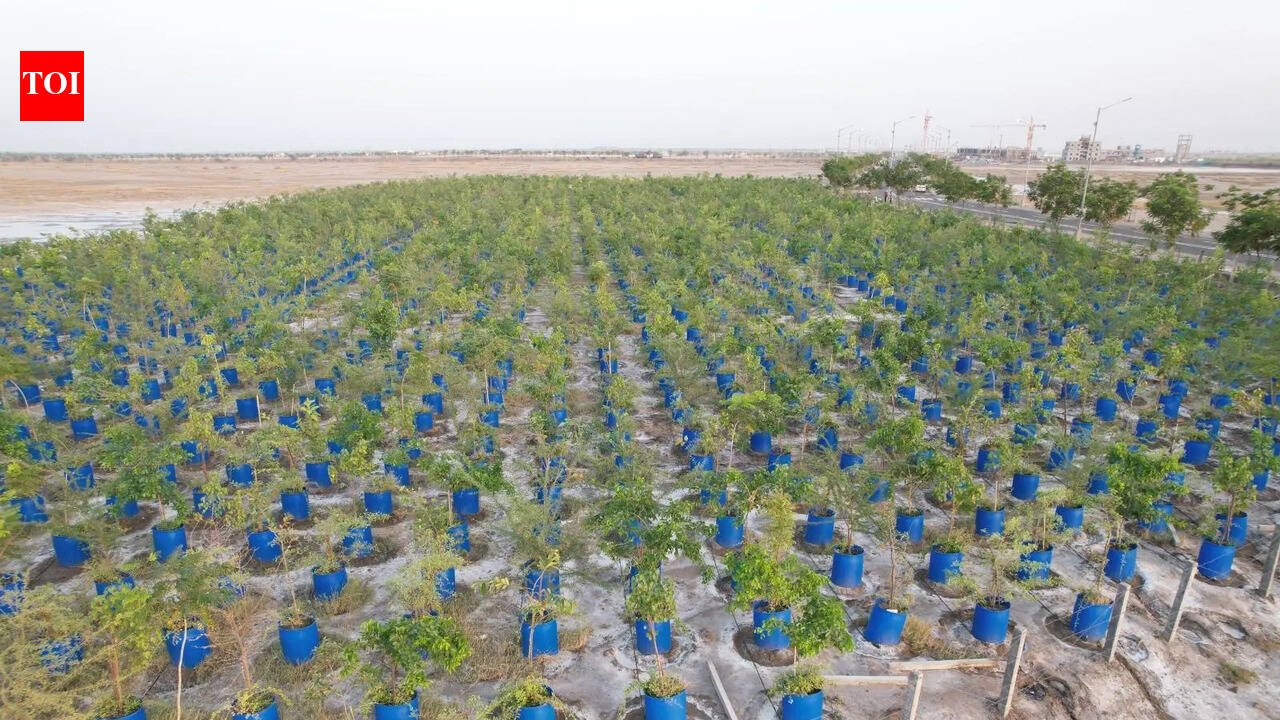
Gandhinagar: A lush green patch of trees in the semi-arid and saline landscape of the Dholera Special Investment Region (Dholera-SIR) stands out like an oasis in the emerging semiconductor hub. In the saline coastal belt of Ahmedabad district, an experiment of drum plantation has emerged as an example of ecological innovation. Rows of drums hold trees that add greenery to this barren landscape.More than 3,200 trees of 15 different species have been planted by the social forestry division of the Ahmedabad forest department next to Block 29 of the SIR as part of the project funded by the Dholera Special Investment Region Development Authority (DSIRDA).According to the state govt, saplings were planted last Aug in plastic drums to shield their roots from excessive salinity in a region that is hostile even for grass. In less than a year, many of the saplings have grown up to 12 feet tall, the govt said.“There were major challenges before us. The soil had extremely high electro-conductivity, low carbon content, and excessive salinity, and waterlogging lasts for weeks, making plant growth nearly impossible. To overcome this, we adopted the drum plantation technique, where saplings are elevated and planted in drums filled with layers of sand, nutrient-rich soil, vermicompost, stubble, and cocopeat,” said Minal Jani, deputy conservator of forests, Ahmedabad social forestry division.The department created ventilation holes on both sides of the drums and embedded them about one foot deep in the ground. DSIRDA provided fresh water, and a drip irrigation system was installed for all saplings. “Today, nearly all the trees have survived, and some have even started bearing fruits, attracting pollinators and birds,” the official added.On the eve of World Environment Day, observed on June 5, the govt said that the ecological impact of the experiment is already visible. “In areas where even grass could not grow earlier, we are now witnessing the presence of pollinators, birds, and naturally growing grass due to improving soil conditions,” Jani said.Officials said that the plastic drums used would eventually be removed and recycled, ensuring the project remains environmentally sustainable.With the success of this greening project, DSIRDA has allotted another 20 hectares for expanding the drive. In the next phase, authorities plan to plant around 50,000 more saplings in drums.


