




A fishing trip that began with a long drive from California ended with an extraordinary catch in an unnamed Idaho reservoir. Matteo Bonales, 23, was using forward-facing sonar with his father, Mark, when he spotted an unusually large fish holding near a rocky structure deep beneath the surface. The fish was holding in about 54 feet of water, and at first Bonales did not even think it was a bass.
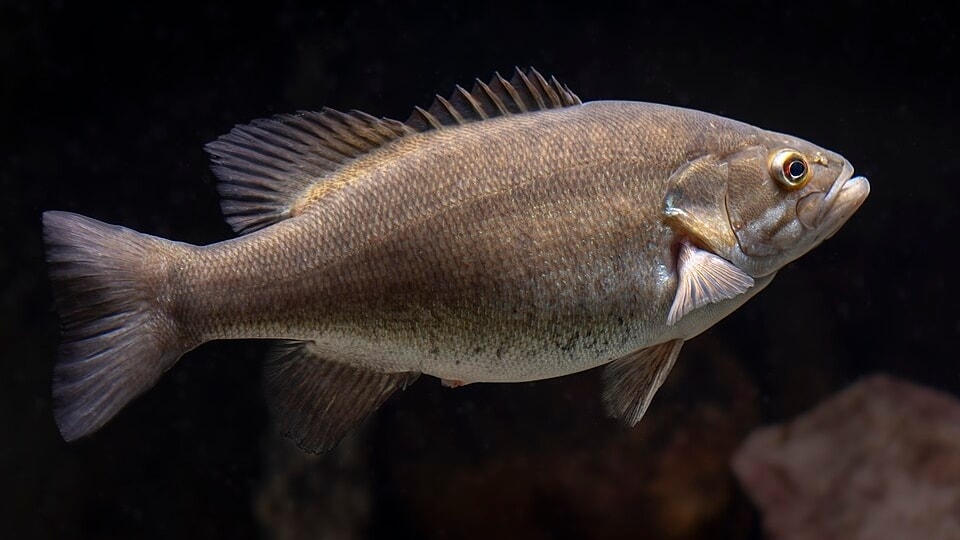
The father-and-son pair drove about 16 hours from their home in Ceres, California, to reach the remote Idaho reservoir. They had already spent several days learning the lake and catching smallmouth bass before Bonales located the unusually large mark on October 16. The fish eventually proved to be a 9.41-pound smallmouth, which the angler chose to release rather than keep for an official record attempt.
A giant hiding 54 feet below the surface
Bonales and his father spent five days fishing the rocky, cold-water reservoir, using forward-facing sonar to locate bass. During the first two days, the fish were difficult to find, but the pair gradually learned where the larger bass were holding. They caught several impressive fish, including a seven-pound smallmouth on each of two days. Then, around 1 p.m. on October 16, Bonales saw what appeared to be an enormous fish near a deep rock pile. The structure was in about 55 feet of water, and the fish was roughly 54 feet below the surface.
He eased past the area and let a jig with a lead head sink slowly to the bottom. The jig carried a soft-plastic grub colored like a baitfish. When it came close to the rocks, the fish started moving up towards it. Two more fishappeared on the sonar, but the first one reached the lure first. Bonales was using 10-pound braid and a 6-pound fluorocarbon leader.
The discovery of a large bass at such a depth is not as unusual as it might initially sound. Smallmouth bass can use considerably deeper and cooler parts of lakes, particularly larger individuals. A study in Ecology of Freshwater Fish found that smallmouth bass occupied deeper sections of stratified lakes, with larger fish tending to occur at deeper, cooler sites.
A 9.41-pound fish that went back into the lake
The size of the bass became apparent only when it reached the boat. Mark netted the fish, and the pair initially weighed it on their own Bubba scale, which showed about 9.7 pounds. It measured approximately 23.5 inches. Rather than kill the fish to pursue a conventional weight record, the anglers placed it temporarily in an aerated livewell and stopped fishing. They then drove to a nearby grocery store, where the bass was weighed on a certified meat scale.
The official reading came in at 9.41 pounds. Bonales then returned to the reservoir with his father and released the fish. The decision meant the catch could not be submitted as a conventional certified weight record in the usual manner. It nevertheless raised another possibility: a catch-and-release length record. Idaho already has a formidable smallmouth record from the same reservoir. According to the Idaho Fish and Game record listings, Joey Walton holds the state’s catch-and-release smallmouth record at 23.75 inches, caught at Dworshak Reservoir in December 2022. Idaho’s certified weight record is 9.72 pounds, also from Dworshak Reservoir, caught by Dan Steigers in 2006.
Why the catch could become a world record
The bigger claim is about length rather than weight. Bonales’ fish was reportedly 23.5 inches long, which would put it above the current International Game Fish Association catch-and-release world record of 20.86 inches. However, that does not automatically make it a world record. According to the International Game Fish Association (IGFA), all fish submitted for All-Tackle Length World Records must be measured at the site of capture using an official IGFA measuring device and released alive in good condition. The organization also requires photographs documenting the fish’s full length, the measuring position, the angler and the equipment used. Bonales, however, released the bass after weighing it rather than documenting it on an official IGFA measuring device. That could make an official record claim more difficult, even before the strength of the fishing line is considered.
The line he used was marked as 10-pound braid, but braided lines can have a breaking strength considerably higher than their stated rating. This is important because IGFA line-class records are determined by the line’s actual breaking strength, rather than simply the number printed on the packaging. Bonales had said he was considering submitting the catch to the IGFA, but the fish had not been officially certified as a record. Regardless of whether the catch ultimately qualified, the trip had already given Bonales a remarkable fishing story: he had travelled hundreds of miles with his father, landed a huge bass nearly 54 feet underwater and released it alive.
