






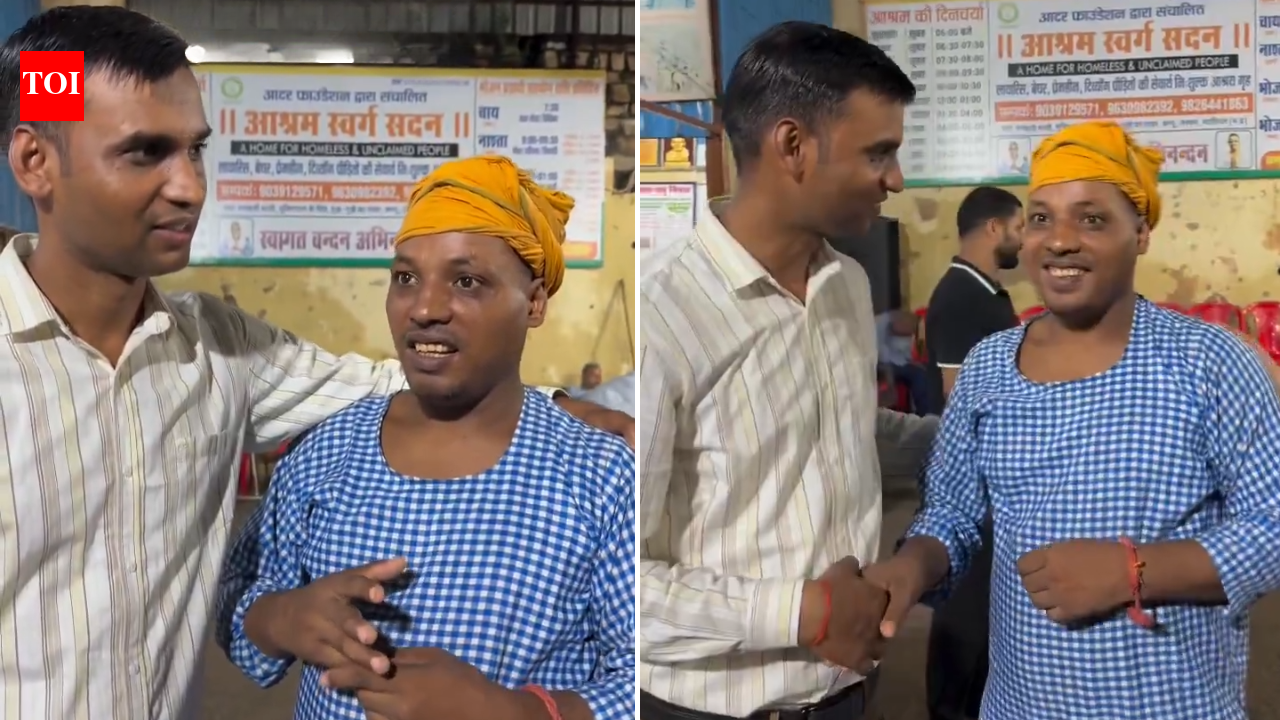
When Ram Shanker Kushwaha boarded a train from his village in Bihar at the age of 15, he had no idea that the journey would keep him away from his family for the next 21 years. He had no spare clothes and no identity proof. For years, his parents waited for him to return. On September 7, 2026, 36-year-old Shanker finally came home to Maheshpura village in Madhubani district. His family traced him after he appeared in a Facebook video posted by Gwalior Deputy Superintendent of Police Santosh Patel. The video was recorded at Ashram Swarg Sadan, a state-run shelter where Shanker had been living for eight years. The reunion came after more than two decades of uncertainty and a social media post that happened to catch the attention of Shanker’s brother.
A boy who loved trains
Shanker’s fascination with trains had started long before he disappeared. His home was barely 400 metres from Mahrail railway station, a small station on the Sakri-Jhanjharpur-Laukaha Bazar line. As reported by the Indian Express, his father Rajendra Kushwaha said Shanker would often board a local train simply for the experience and return an hour or two later. But on December 6, 2005, his usual fascination with trains took him much farther.It was Vivah Panchami, when Maheshpura was celebrating the symbolic wedding of Lord Ram and Sita. Sadhus and ascetics had arrived in the area from different parts of the country. “A sadhu from Ayodhya asked if I wanted to go with him. I asked how he was travelling, and he said, ‘by train’,” Shanker told The Indian Express. He decided to go to Ayodhya. What happened after that remains unclear even to Shanker. His memories of those years are fragmented, and the police and his family believe he moved from place to place without knowing where he was or how to get back. “He kept confusing ‘Jhanjharpur’ and ‘Jharkhand’, unaware that the former was a block in Madhubani, while the latter was an entire state to the south of Bihar,” his elder brother Lalit Shastri told The Indian Express.
From Ayodhya to Gwalior
Shanker remembers spending time at a temple in Patna after leaving Ayodhya. He cleaned floors in exchange for food, participated in kirtans and continued moving. “I have no clear memory of how or when I reached Gwalior,” he said. He does remember spending years around Gwalior railway station, sleeping on platforms or outdoors. “I didn’t like begging, so I survived on food given by passersby or shopkeepers, and did odd jobs at roadside dhabas,” Shanker said.In 2018, the Gwalior-based Ashram Swarg Sadan found him at the railway station and brought him to the shelter.
The Facebook video that changed everything
The breakthrough came in 2026. Gwalior DSP Santosh Patel visited Ashram Swarg Sadan and recorded a video in which Shanker, wearing a ‘muretha,’ the traditional headgear worn by North Indian farmers introduced himself as “Shanker Kushwaha from Anand Nagar, Bihar”. Patel posted the video on Facebook. “I was drawn to his smile and mentioned it in the post that ultimately helped find him. I’m thrilled that my post eventually reunited a man with his family,” Patel told The Indian Express. On September 4, during Janmashtami, Shanker’s oldest brother Lalit saw the Facebook post. “I dialled the number listed on DSP Santosh Patel’s post,” Lalit said. The family had spent years looking for Shanker, but their search had never gone beyond Bihar. They had also never registered a formal missing-person complaint because they continued to hope that he would eventually return. When Lalit saw the photograph and details in the post, the possibility that the missing boy from Maheshpura had finally been found became real.
“Arre, ye to Shankerba hai, mera bachcha”
Shanker reunited with his parents. (Photo credit: The Indian Express)
The family’s first reaction came when they saw Shanker on the video. “I said: ‘Arre, ye to Shankerba hai, mera bachcha (Oh, this is Shanker, my child),’” his 70-year-old mother Lakshmi Devi recalled to the Indian Express. For her, the timing of the reunion carried a special meaning. “My son went missing on Vivah Panchami and was found on Janmashtami, the birth date of Lord Krishna. For us, it is as if my Shanker has been born again today,” she said. Shanker had never attended school and had no identity documents. His family knew him as Ram Shanker, but there was little paperwork to establish his identity. It took hours of persuasion by villagers and verification by officials before the local Jhanjharpur police station issued the necessary identity certificate. Once the paperwork was completed, Shanker’s older brother Lallan and cousin Sanjeev Kumar travelled to Gwalior. Shanker recognised them immediately.
A homecoming after 21 years
Shanker returned by train but this time, he was travelling towards home. During the journey, his brother stopped in Patna to buy him a pair of trousers and a shirt. At Kanhauli Chowk in Madhubani, around 500 people gathered to welcome him. He was presented with a Mithila paag and a yellow cloth before being accompanied on the walk back to Maheshpura. At home, his parents were waiting, along with one of his favourite dishes. The family had changed dramatically during the 21 years Shanker was away. For Shanker, however, the years in between remain largely blank. His mother remembers him as the youngest and most pampered of her children. He had refused to attend school, and after two unsuccessful attempts to enroll him, the family stopped trying.Back in Maheshpura, Shanker is slowly settling into a life that changed without him. His father, 75-year-old Rajendra Kushwaha, summed up what his return means to the family. “For years, I had stopped counting past two. Now I can say we have three sons, Lalit, Lallan and Shanker,” he said.


