









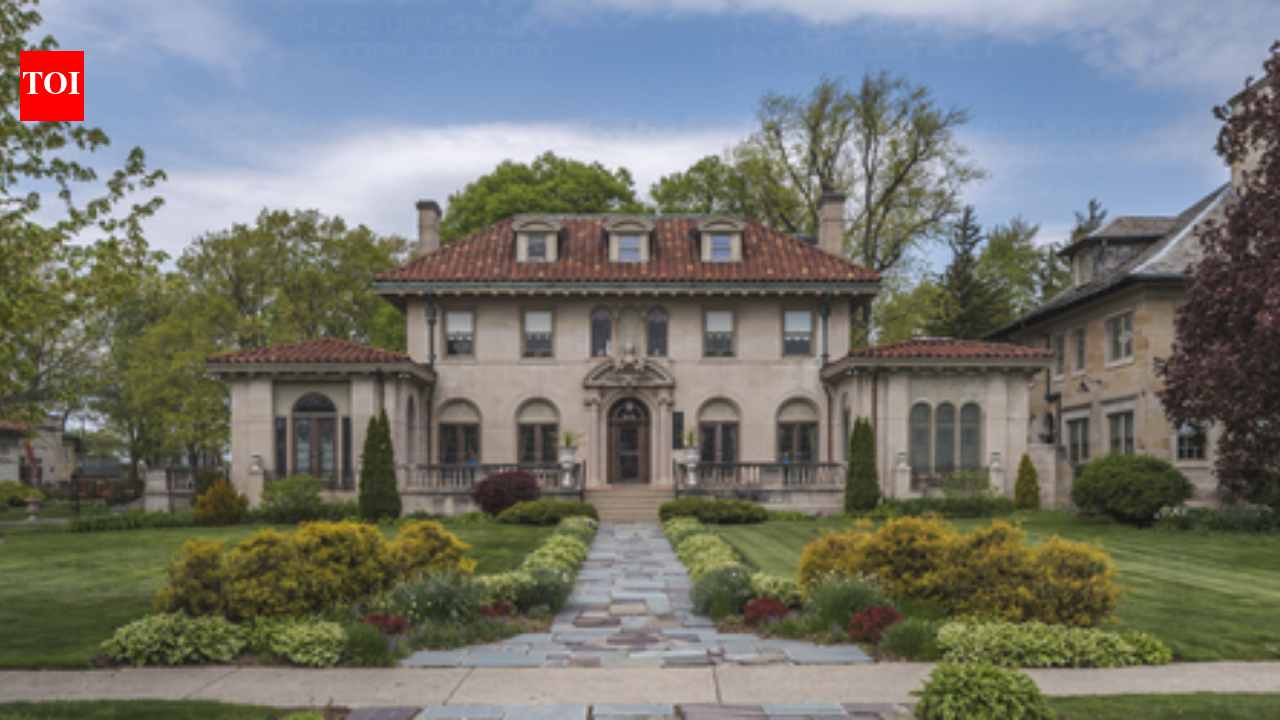
A century-old Detroit mansion with deep ties to the city’s music and industrial history once changed hands for just $250,000 before a painstaking restoration helped it sell for $1.65 million. Known as the Motown Mansion, the 10,500-square-foot residence at 918 W. Boston Blvd. was built in 1916-17 for lumberman Nels Michelson and later became the home of Motown Records founder Berry Gordy Jr. Historic Detroit identifies the property as the Nels Michelson Mansion and documents its origins, architecture and notable owners. Gordy bought the house in 1967 and lived there during a pivotal period for Motown before eventually selling it to Detroit attorney Cynthia F. Reaves, who restored the landmark and later sold it in 2017.
A mansion built for a Detroit lumber baron
The story of the property began long before Motown. Nels Michelson, who was born in Denmark in 1840, immigrated to the United States in 1866 and built a successful career in the lumber industry. He established the Grayling Lumber Company in 1906 and later entered the real-estate business through the Michelson Land and Home Company. Michelson commissioned architect John W. Case to design the grand residence, which was completed in 1917. The house was created in an Italian Renaissance style and featured the elaborate craftsmanship associated with Detroit’s grand early-20th-century residences.Historic Detroit notes that Michelson lived at the Boston Boulevard property until the 1920s. The mansion subsequently passed to Leonard A. Young, owner of the L. A. Young Spring & Wire Company, who expanded the estate significantly.
The additions that transformed the estate
Young added a large Athletic Building to the property in 1926. The approximately 4,000-square-foot structure included an Olympic-sized swimming pool, a gymnasium, billiard room and two bowling alleys. The additions made the property more than a formal residence. It became an expansive entertainment compound, with passageways connecting different sections of the estate. The main house itself featured marble, elaborate woodwork, carved mantels, stained and beveled glass and other decorative details. The estate eventually became associated with one of Detroit’s most influential cultural figures.
Berry Gordy brings Motown history to the mansion
Berry Gordy Jr., the founder of Motown Records, purchased the mansion in 1967. He lived there from 1967 to 1969, during a period when Motown was producing music from artists including The Supremes, The Four Tops, Smokey Robinson and Stevie Wonder. The mansion became a setting for parties and gatherings connected with the Motown world. The Washington Post reported that Diana Ross and Aretha Franklin sang at Gordy’s parties, while Stevie Wonder played the grand piano. The Jackson 5 also had connections to the property during its Motown years.Gordy eventually moved his music operation to Los Angeles but retained ownership of the Detroit mansion for decades. The property continued to carry the Motown association long after he stopped living there.
A $250,000 purchase and four-year restoration
When Cynthia Reaves returned to Detroit from Washington, D.C., she became interested in the house. She had grown up across the street from the mansion and remembered seeing celebrities arrive for parties. The Washington Post reported that Reaves bought the property from Gordy in 2002 for $250,000. Rather than treating it simply as a real-estate investment, she undertook a major rehabilitation designed to preserve its historic character.A Michigan State Historic Preservation Office record says Reaves used state historic-preservation tax credits and spent four years rehabilitating the house. The work included restoring wood surfaces, decorative painting and plaster, updating mechanical systems, restoring the landscape and rehabilitating much of the carriage house and Athletic Building. The restoration later received a Michigan historic-preservation award. The Washington Post reported that Reaves retained as much of the mansion’s original architecture as possible while bringing the property back into use.
From $250,000 to a $1.65 million sale
After more than a decade under Reaves’ ownership, the restored mansion went on the market in 2015 for $1.295 million. The property included the 10,500-square-foot main house, the adjoining pool house and a carriage house, set across approximately 2.2 acres. It ultimately remained on the market for about two years. In August 2017, the property sold for $1.65 million, exceeding its $1.595 million asking price at the time. CBS Detroit reported that the buyer was a Detroit native returning from San Francisco. The sale was followed by an estate auction featuring furniture, antiques and memorabilia associated with Gordy and Motown. Among the items offered were Gordy’s Steinway piano, photographs, Motown records and other pieces connected to the mansion’s musical past.Today, the property remains known as the Motown Mansion, but its story extends well beyond Berry Gordy. From Michelson’s lumber fortune to Young’s expansion, Gordy’s Motown years and Reaves’ preservation work, the Boston Boulevard residence reflects several chapters of Detroit’s architectural, industrial and musical history.


