



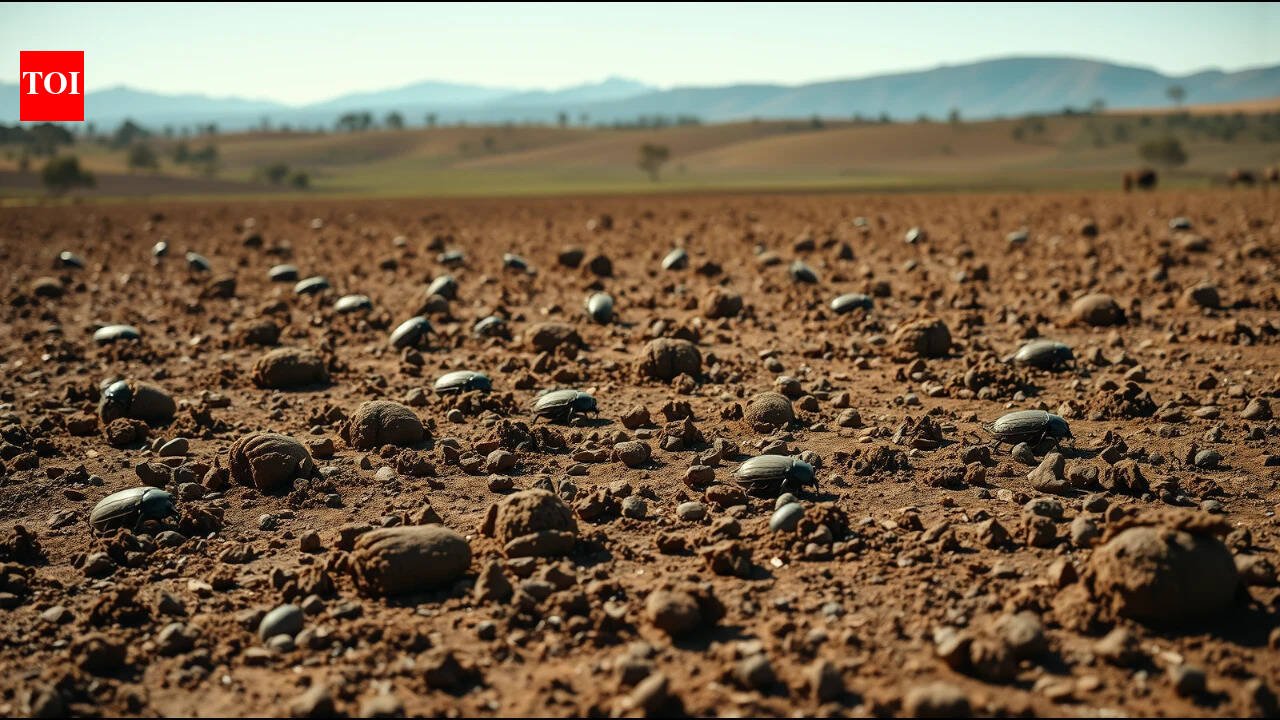
Australia’s dung beetle problem began almost two centuries before scientists found a solution, when European settlers introduced cattle whose droppings were unlike anything most native Australian dung beetles had evolved to process. The First Fleet brought five cows and two bulls in 1788, and as cattle numbers grew, their large, moist dung pads accumulated across grazing land because Australia’s native beetles were adapted primarily to the smaller, drier droppings of marsupials. By the middle of the 20th century, the buildup had become a serious agricultural problem, with cattle dung covering large areas of pasture and providing breeding sites for bush flies. Entomologist George Bornemisza recognised the problem during his early work in Australia and proposed importing dung beetles from overseas that were better suited to cattle manure. After years of research and testing, CSIRO began releasing selected species. A small trial in 1967 was followed by a much larger programme from 1968 to 1970, when approximately 275,000 beetles from four species were released across cattle country.
Why George Bornemisza realised Australia was missing the right dung beetles
According to CSIROpedia’s history of the dung beetle programme, Bornemisza noticed the unusual accumulation of cattle dung while studying insects in Australia during the early 1950s. He had previously encountered European dung beetles that rapidly buried cattle manure, making the sight of cattle paddocks covered with old dung pads particularly striking. The difference reflected Australia’s evolutionary history. Native dung beetles had developed alongside marsupials for millions of years, and the droppings of kangaroos, wallabies and other native animals were generally much smaller and drier than the large pads produced by cattle. Most of Australia’s existing beetles therefore had little ability or incentive to break down cattle dung efficiently. Bornemissza continued developing the idea that Australia needed to import specialised beetles capable of exploiting the new food source. The proposal eventually gained institutional backing, with CSIRO researchers beginning systematic work on finding, importing and testing suitable species under quarantine before releasing them into the Australian environment.
How scientists tested imported beetles before releasing 275,000 of them
The first large-scale solution was not an immediate mass release. Researchers initially tested different species to determine whether they could survive Australia’s climate, reproduce successfully and effectively remove cattle dung. Bornemissza travelled to Hawaii, where imported dung beetles had already demonstrated their usefulness in cattle-producing areas, and selected species that appeared promising for Australian conditions. After quarantine and breeding work in Canberra, researchers conducted an initial release in Townsville in 1967, involving five species. Three of those species proved successful enough to justify expanding the programme. From 1968 to 1970, CSIRO researchers then approached cattle farmers across a huge area stretching roughly from Broome in Western Australia to Townsville in Queensland, releasing approximately 275,000 beetles from four species. One of the most successful was Onthophagus gazella, which spread rapidly after release and established itself across a large area of Queensland. The experiment demonstrated that carefully selected foreign species could occupy an ecological role that Australia’s native beetles had largely been unable to fill.
Why Australia continued importing dung beetles for decades
The success of the early releases encouraged researchers to continue searching for species suited to Australia’s enormous range of climates rather than relying on only the initial introductions. In 1970, Bornemissza travelled to South Africa and established a research base in Pretoria, giving scientists access to dung beetles adapted to environmental conditions that could resemble those found in different parts of Australia. The programme subsequently continued for many years, with CSIRO’s historical accounts documenting the importation and release of numerous additional species. The exact totals vary between CSIRO-associated historical sources depending on the period and definition being used, so the safest description is that dozens of species were imported and many were tested or released over the following decades. The beetles worked by rapidly burying cattle dung underground, where it became food for the insects and their larvae while returning nutrients to the soil. Removing manure from the surface also reduced breeding habitat for bush flies and could improve nutrient cycling, soil structure and water infiltration. What began as a puzzling accumulation of cow pats therefore became one of Australia’s best-known examples of biological control: instead of trying to remove the waste manually, scientists introduced insects capable of turning an agricultural problem back into part of the ecosystem.


