


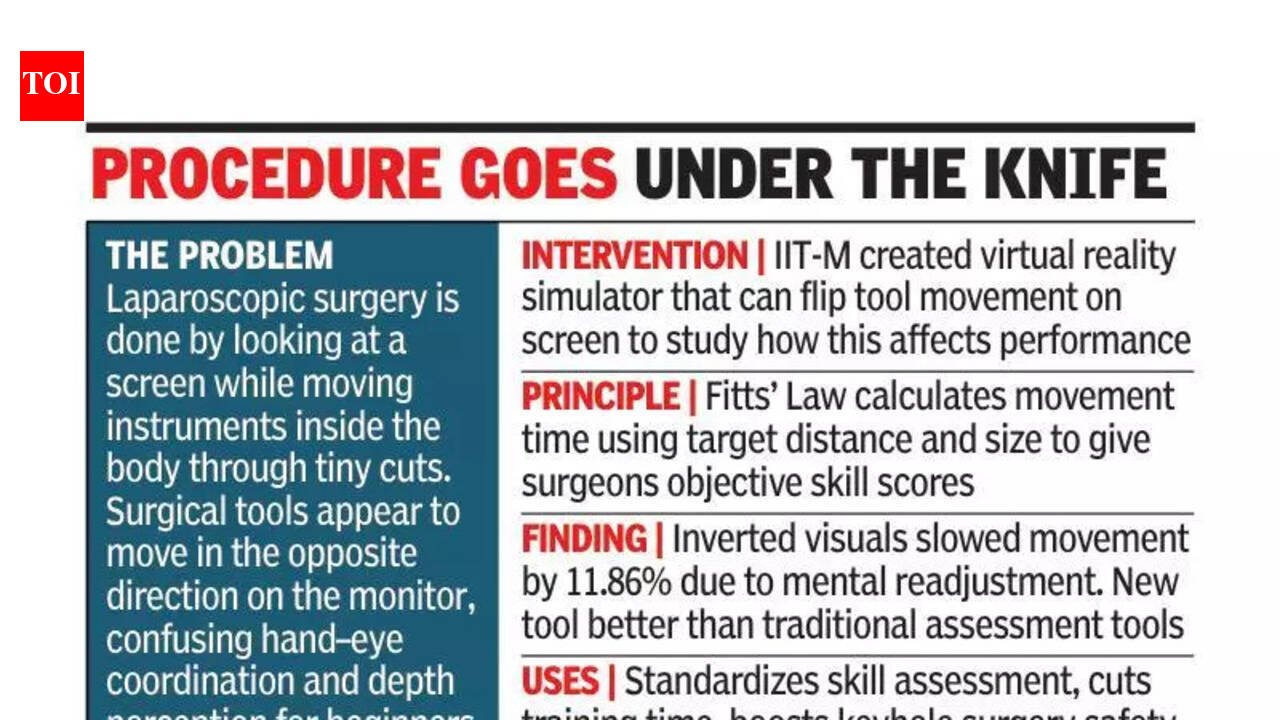
Chennai: Researchers at IIT Madras developed a tool to objectively measure how well surgeons performed laparoscopic, or keyhole, procedures — a breakthrough that could standardise how surgical skills are taught and tested.Laparoscopic surgery, commonly used for gallbladder removals and bariatric weight-loss operations, presents unique challenges. Surgeons operate through tiny incisions using long instruments, watching their movements on a monitor. This limits tactile (touch) feedback, complicates depth perception, and inverts hand movements due to the fulcrum effect — tiny cut in the skin acts like a seesaw pivot.“When surgeons insert instruments through tiny cuts, they pivot at entry point. When the hand moves left, the tool tip moves to the right. This inversion demands mental remapping. It slows tasks by forcing extra brain processing,” said Prof Manivannan M, head of IIT-M’s Touch Lab in department of applied mechanics and biomedical engineering.Traditional training programmes relied on subjective evaluation tools to help surgeons overcome these hurdles. Though structured, these methods depend heavily on an instructor’s judgement, leading to variability in scoring precision, efficiency, tissue handling, and overall competence.The IIT team took another approach, drawing on computer science principles. They applied Fitts’ Law — a concept from human-computer interaction that predicts movement time based on a target’s distance and size — to design a custom VR haptic (touch) simulator. This system replicates laparoscopic conditions, including inverted visuals, and quantifies performance metrics such as movement time and throughput during standardised tapping tasks.The study was published in the peer-reviewed International Journal of Human–Computer Interaction. Scientists tested the model on 24 young surgeons and found that inverted tool visuals increased movement time by average of 11.86% compared to non-inverted movement. The VR method addresses training hurdles — the fulcrum effect, reduced touch feedback, and mirror (reversed) movements — outperforming subjective systems by providing consistent, data-driven scores. The research bridges computer science, engineering and neurosurgery, setting the stage for global adoption of standardised VR assessments that could revolutionise minimally invasive training worldwide, said the study’s co-author and US-based senior neurosurgeon Dr Venkatraman Sadanand, who passed out of IIT-M as an electrical engineer.With India facing surgeon shortages and rising demand for minimally invasive procedures, this innovation could accelerate skill development, reduce training costs, and improve patient safety, he said. Scientists said larger trials on the scoring system were necessary to validate findings across experience levels and surgical specialties.


