





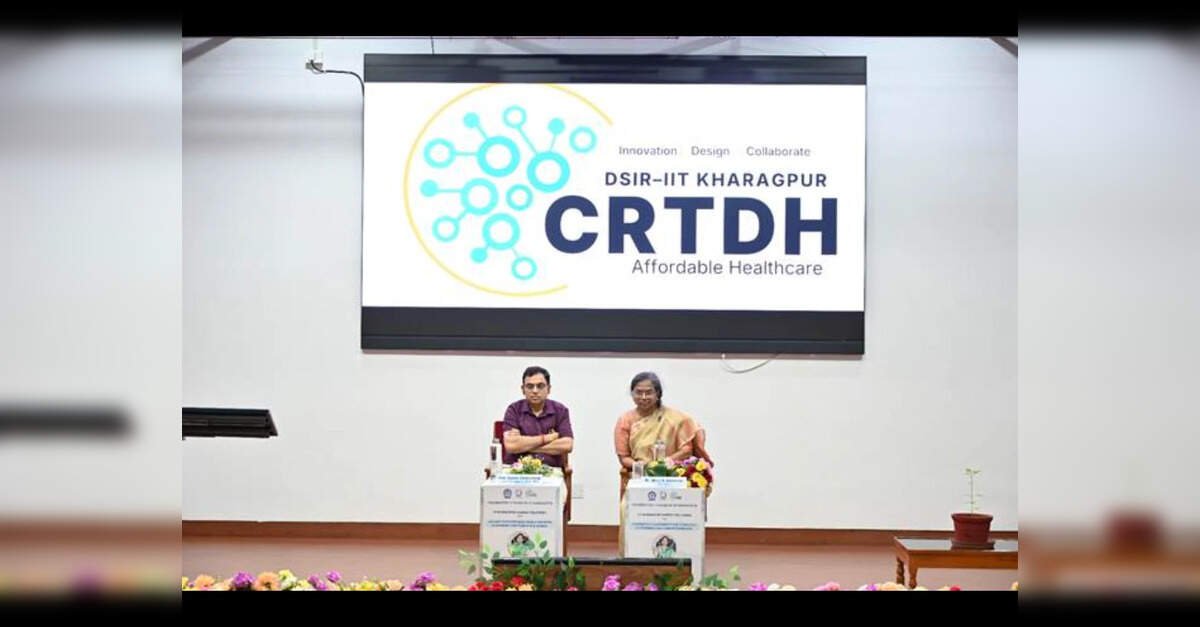
New Delhi: An affordable healthcare technology hub at IIT Kharagpur, set up under the Department of Scientific and Industrial Research (DSIR) in 2019, has moved into a self-sustaining phase after facilitating more than 20 technology transfers, several of which have already been commercialised.
The Common Research and Technology Development Hub (CRTDH) on Affordable Healthcare has completed its initial grant-supported phase and will now meet its operational costs through user fees, industry sponsorships and translational partnerships, according to the Ministry of Science and Technology.
The transition is aimed at allowing the facility to continue providing research infrastructure, technical expertise and technology development support to startups, MSMEs, innovators and other stakeholders without relying on the initial government grant model.
The hub, operating from a 5,000-square-foot facility at IIT Kharagpur, focuses on developing affordable healthcare technologies that can work in settings where sophisticated infrastructure may not be available.
Since its establishment in 2019, it has facilitated more than 20 technology transfers and worked with clinical and non-governmental organisations to establish rural health units for deploying affordable healthcare technologies.
Taking healthcare technology to rural communities
A key part of the hub’s model is the deployment of technologies through trained frontline health workers.
Fifteen health workers from remote villages, including areas in the Sundarbans and Birbhum, shared their experiences of using affordable diagnostic technologies at the community level during an event at IIT Kharagpur marking the transition to the sustainable phase.
The health workers have been trained and certified through the hub’s skilling programmes and are operating rural health units alongside health delivery structures under the National Health Mission.
These units support screening, referral and follow-up services in communities where access to diagnostic facilities remains limited or intermittent.
The model is intended to address a common challenge in healthcare technology: moving a product beyond the laboratory and into settings where it can be used by frontline workers and patients.
From prototypes to commercial products
The hub has also worked with MSMEs, startups and individual innovators to translate laboratory prototypes into commercial products.
During an MSME session at the event, enterprises mentored by the CRTDH shared their experiences of taking technologies from prototype development to commercialisation.
DSIR Secretary and CSIR Director General N Kalaiselvi, who inaugurated the sustainable phase, said the continued functioning of a CRTDH after the period of DSIR support demonstrates the intended outcome of the programme, with the facilities serving industry and innovators in a self-sustaining manner.
She also highlighted the role of such centres in strengthening indigenous capabilities in medical technology and supporting greater use of shared research and technology development infrastructure.
The transition comes as part of IIT Kharagpur’s Platinum Jubilee celebrations and marks the next phase of the healthcare hub’s operations, with its focus shifting from grant-supported development to sustained technology translation and industry engagement.


