






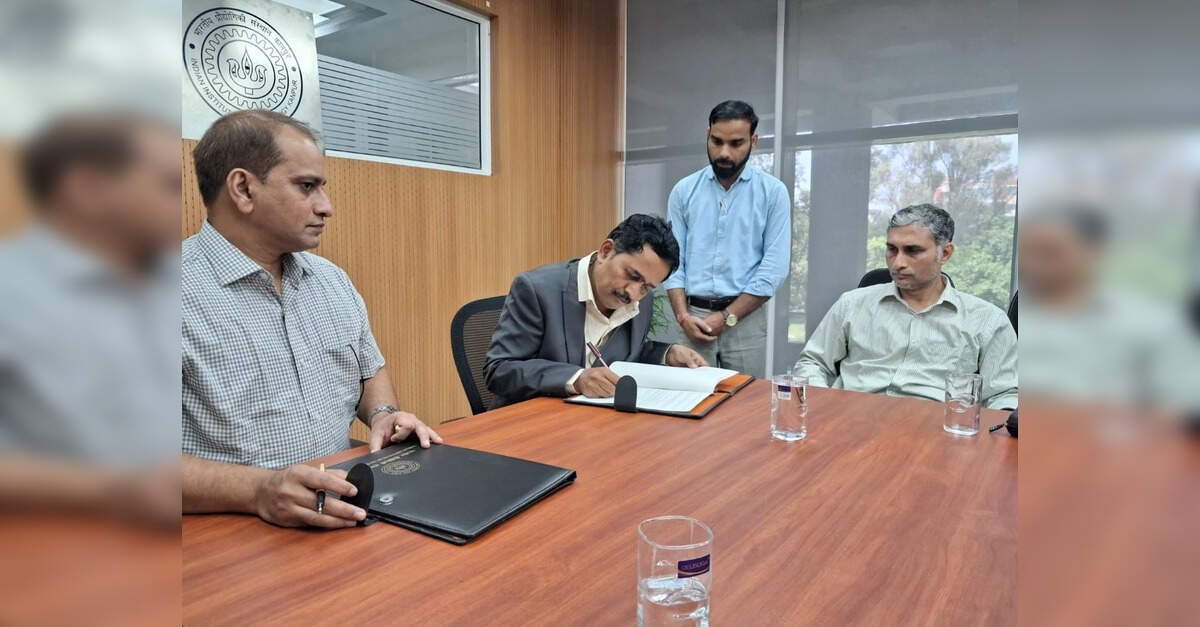
IIT Kanpur has signed an agreement with Bengaluru-based NexPV Energy Systems to develop what the institute says will be India’s first Sun Simulator designed specifically for Concentrated Photovoltaic (CPV) systems.
The facility will enable CPV modules to be tested and characterised at production lines in India, a capability that is currently not available domestically, according to IIT Kanpur.
The project is being led by Prof Ashish Garg and his team at IIT Kanpur’s Department of Sustainable Energy Engineering. Invariance Automation, a member company of IIT Kanpur’s Research and Technology Park Foundation (Technopark@iitk), is facilitating the collaboration.
Unlike conventional solar panels, CPV systems use optical lenses to concentrate sunlight onto small, high-efficiency multi-junction solar cells. The technology requires direct and nearly parallel sunlight and is sensitive to factors such as the angle and spectral characteristics of the light, making conventional flat-panel testing systems unsuitable.
The proposed simulator will be designed to reproduce these conditions under controlled settings, allowing CPV modules to be evaluated for their performance and characteristics before large-scale deployment.
Prof Ashish Garg said the development of domestic testing infrastructure was important for scaling emerging solar technologies. He said CPV modules behave differently from conventional flat-plate panels and therefore require specialised testing systems.
NexPV Energy Systems has developed indigenous CPV technology and has been operating proof-of-concept systems in the field for around three years, according to the company. It is now working towards large-scale manufacturing.
Chidananda Murthy R, Director, NexPV Energy Systems, said a domestic CPV simulator would help the company establish quality-control capabilities as it scales manufacturing.
CPV technology uses multi-junction cells made from multiple semiconductor layers, allowing different portions of the solar spectrum to be captured. Because the cells are used in combination with optical concentration, CPV systems require substantially less cell area than conventional photovoltaic modules.
The project is also intended to create a pathway for taking the simulator from prototype development to manufacturing. Invariance Automation is expected to serve as the preferred manufacturing partner for future production of the system.
The collaboration comes as India expands domestic solar manufacturing and seeks to build capabilities across the solar technology value chain, including testing and validation infrastructure.


