



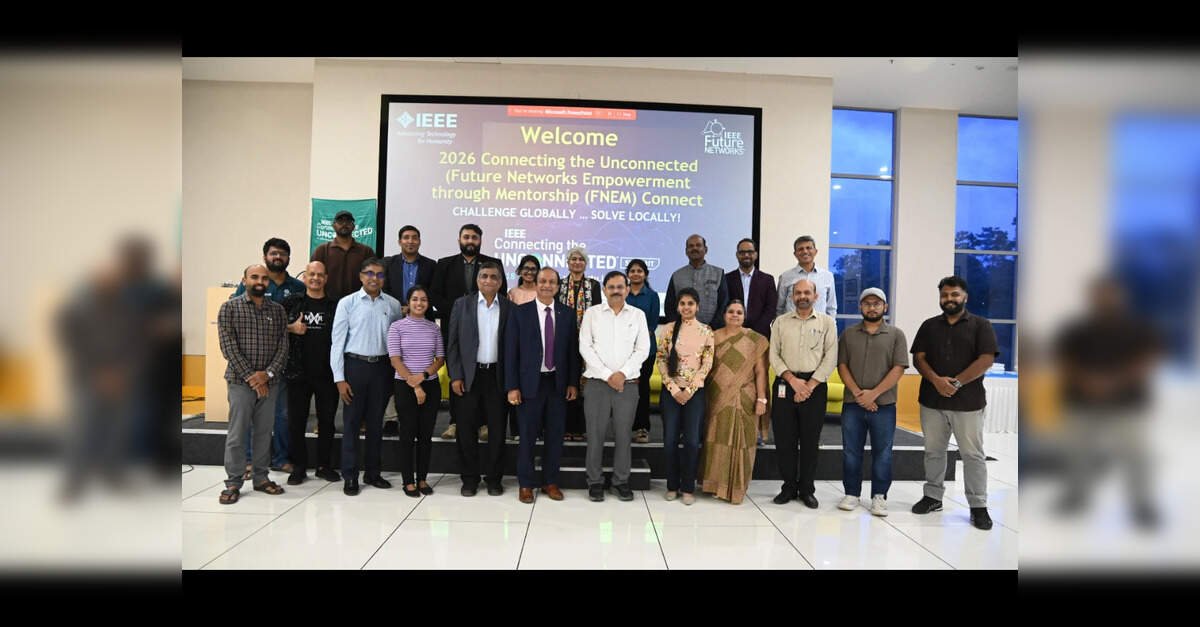
Bengaluru: The Institute of Electrical and Electronics Engineers (IEEE) has launched its Future Networks Empowerment through Mentorship (FNEM) – Powering Connecting the Unconnected (CTU) programme in India at the International Institute of Information Technology Bangalore (IIIT-Bangalore), with an inaugural cohort set to undergo a 1,000-day mentorship journey focused on developing solutions for rural and underserved communities.
The programme will support early-stage technology innovators, start-ups, researchers and engineers working on connectivity challenges, taking participants from idea development and proof-of-concept to validation, commercialisation and business growth.
The initiative comes against a persistent global connectivity gap. The United Nations estimates that around 3.7 billion people remain without meaningful internet connectivity, with rural and underserved communities among those most affected.
Under the FNEM programme, participants will receive structured technical and entrepreneurial mentorship from IEEE experts and industry leaders. The 1,000-day LAMP journey – Learning, Action, Mentorship and Practice – is designed to provide support across different stages of technology development.
The programme’s curriculum will cover five areas: technological entrepreneurship, technology skill development, business skill development, community and user engagement, and local context and regulatory navigation.
Participants will also receive guidance on technology commercialisation, standards development, investment readiness and business strategy, with the aim of helping them develop scalable connectivity solutions.
The India launch brought together researchers, start-up founders, engineers, investors, standards experts, industry leaders, faculty and students. The daylong programme included sessions on entrepreneurship, mentorship, intellectual property and IEEE rural broadband standards.
Prof Ashutosh Dutta of Johns Hopkins University, Dr Sudhir Dixit of Basic Internet Foundation and Prof Ruolin Zhou of University of Massachusetts Dartmouth, co-chairs of the IEEE CTU programme, outlined the initiative’s focus on connecting innovators with technical expertise and long-term mentorship.
“The programme is helping transform promising ideas into practical and scalable solutions. Through this 1,000-day mentorship journey, we aim to empower innovators to develop sustainable technologies that expand connectivity and bridge the global digital divide,” Zhou said.
Dr Dilip Krishnaswamy, executive vice-president, C-DOT Bengaluru, said entrepreneurs working on social-impact applications such as connecting the unconnected could be at different stages, ranging from idea development and early proof-of-concept to mature pilot projects.
The programme will support participants in developing proof-of-concepts for rural connectivity and engineering challenges, while providing access to mentors, industry networks and expertise in technology and business development.
IIIT-Bangalore director Prof Debabrata Das said hosting the India launch aligned with the institute’s focus on research, innovation and technology-driven social impact, particularly in rural connectivity.
The first Indian cohort is being supported by the Lemelson Foundation and IEEE Foundation, with IIIT-Bangalore serving as the academic and innovation partner. The COMET Foundation at IIIT-Bangalore and IEEE Standards Association are also part of the initiative.
IEEE said the programme is intended to create a pipeline of innovators developing affordable, sustainable and inclusive connectivity solutions for underserved communities.


