



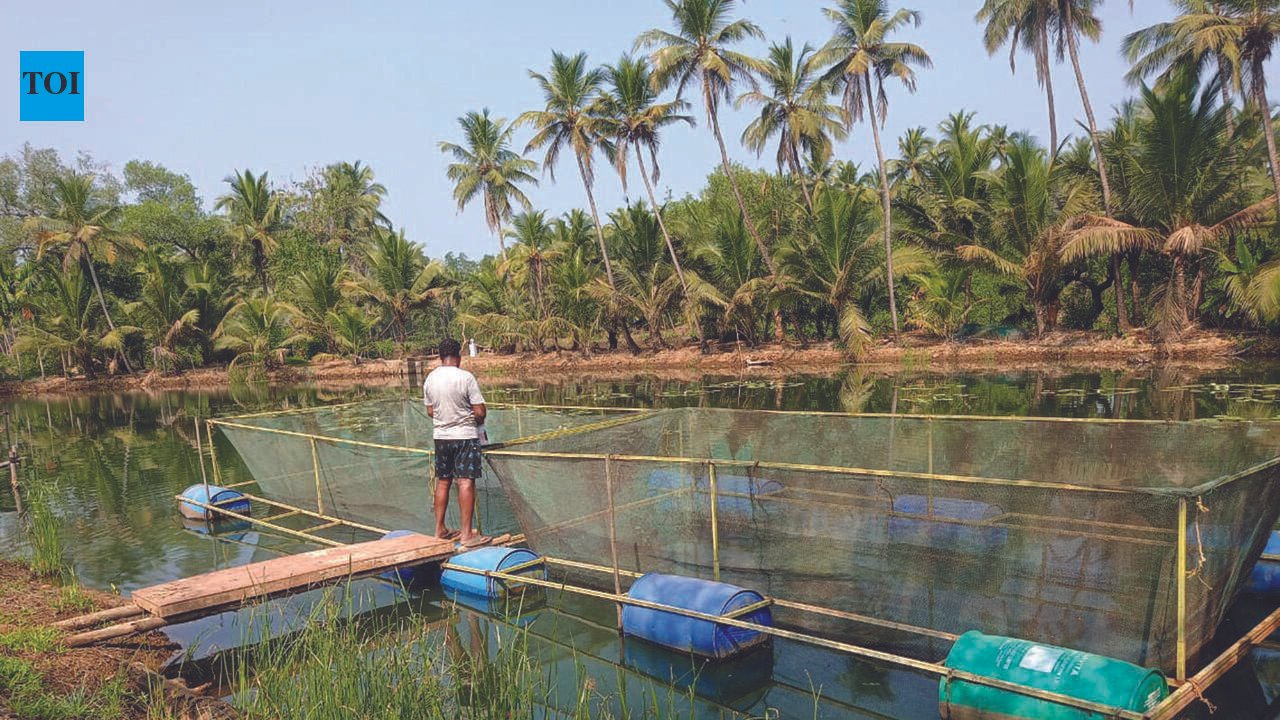
Panaji: In conventional fish farms, farmers have to manually collect samples or use individual instruments for water-quality testing.The ICAR-Central Coastal Agricultural Research Institute (ICAR-CCARI), Goa, is experimenting with an artificial intelligence-based water quality monitoring system to help fish and shrimp farmers monitor water parameters in real time and take timely corrective measures.“The system uses sensors to continuously monitor water quality parameters that are critical for aquaculture. These include pH and dissolved oxygen, among other parameters, with the data transmitted digitally for monitoring,” said fisheries scientist, ICAR-CCARI, Trivesh Mayekar.The system also allows farmers or farm managers to monitor water conditions through their device remotely.“For example, if the dissolved oxygen level falls below a predetermined safe threshold, the system can send an alert to the farmer’s mobile phone,” he said.The technology is being developed in collaboration with Business Kendra, a Kerala-based technology venture specialising in sensor-based Internet of Things (IoT) and machine-learning solutions. ICAR-CCARI and Business Kendra signed a memorandum of understanding in July last year to evaluate, calibrate and optimise sensor-driven decision-support technologies for coastal agriculture and allied sectors.As part of the collaboration, a BlueTechFins real-time water quality monitoring unit was installed at one of ICAR-CCARI’s aquaculture ponds for field-level demonstration and evaluation.Based on the water-quality data, the AI component is intended to provide scientific recommendations on the corrective measures that may be required.For instance, if the pH of a pond falls outside the desired range, the system could advise the farmer on the quantity of lime or another suitable treatment to be applied.The technology is currently undergoing validation of its data and performance at ICAR-CCARI. However, researchers are cautious about drawing conclusions on its performance in commercial aquaculture conditions because the institute’s farm is primarily an R&D facility and does not have the high stocking densities typically found in commercial fish or shrimp farms. This means there is limited accumulation of waste and comparatively little fluctuation in water-quality parameters at the institute’s farm.The system therefore needs to be tested under more demanding commercial conditions, particularly in shrimp farms and other intensive aquaculture operations where stocking densities and feed usage are considerably higher.“Such farms can experience greater fluctuations in water quality because of increased biomass, feeding and organic waste, making them an important environment for validating the technology,” he said.The present device is estimated to cost around Rs 3 lakh to Rs 4 lakh, largely because of the high cost of the sensors and other components used in its development.Researchers at ICAR-CCARI are therefore working on developing a lower-cost version without compromising the accuracy and reliability of water-quality monitoring, so that the technology can become accessible to individual farmers and smaller aquaculture operators.


