



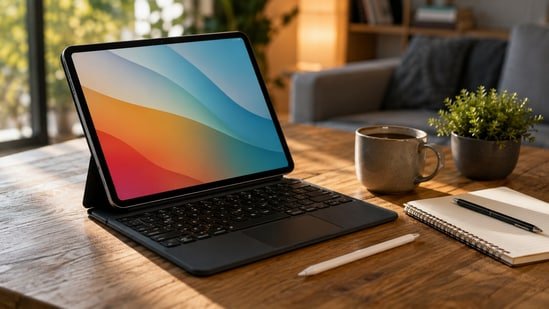
For years, my laptop has been the centre of my workday. It’s where I write my articles, reply to emails, do research, edit videos, and keep dozens of Chrome tabs open at the same time. But there was one question that had always been on my mind: could I use a tablet as my primary work device for a week? Today’s tablets are powerful enough to handle heavy workloads, so I thought this was the right time to put that idea to the test.
Don’t Delay Your Upgrade
Explore personalized EMI offers for your next purchase
So, I packed my laptop away for an entire week and relied only on a tablet for work and entertainment. Some things genuinely surprised me, while others reminded me why laptops still exist. Here’s how the experiment went.
Typing feels different, but touch changes the experience
Since most of my work involves writing, this was the part I was most worried about. A tablet keyboard gets the job done, but there’s no denying that it feels different from a proper laptop. The keys have less travel, the layout is slightly cramped, and you never quite get that same typing comfort. Even after using it for a week, I still preferred typing on my laptop.
What I didn’t expect was how little I used the trackpad. Instead of moving a cursor around, I found myself simply touching the screen. Opening Chrome tabs, selecting text, scrolling through long articles, switching between apps, or replying to emails felt much quicker with touch. In many situations, tapping the screen was actually faster than using a trackpad.
By the end of the week, I had completely stopped thinking about it. The typing experience never became laptop-like, but the touchscreen made up for it in ways I hadn’t expected. Add to that the excellent battery life, and I was able to get through an entire workday without reaching for the charger.
Multitasking is good, but it still isn’t laptop good
A typical workday for me isn’t just writing one article. I usually have around 15 Chrome tabs open for research, another document open for notes, Spotify playing in the background, Slack notifications coming in, images downloading, and sometimes even YouTube running while I cross-check information. On my laptop, this is just another day at work.
The tablet can handle multitasking, but not in the same effortless way. Split-screen mode works well, floating windows are useful, and switching between apps is fairly quick. The problem starts when everything needs to stay open at once. I found myself constantly jumping between apps instead of simply glancing at another window.
Then there were the smaller things. Some websites loaded their mobile versions, a few desktop features weren’t available, dragging files between apps took more effort, and managing downloads wasn’t as straightforward as it is on Windows. None of these stopped me from finishing my work, but they definitely slowed me down.
If I had just one article to write, the tablet was perfectly fine. But on days with multiple deadlines, research, image editing, and constant back-and-forth between apps, I started missing the flexibility of a laptop.
Entertainment is where the tablet completely wins
The moment I finished work, I simply removed the keyboard, sat back on the couch, and the tablet instantly became an entertainment device. There’s no opening and closing a laptop or balancing it on your lap. It just feels far more comfortable for watching movies, binge-watching shows, scrolling through social media, reading articles, or even playing casual games.
The speakers on modern tablets are also surprisingly good. I rarely felt the need to connect headphones while watching Netflix or YouTube, and the larger display made everything feel more immersive than watching on my phone.
This is something a laptop simply can’t match. During the day it’s a productivity machine, and within seconds it transforms into a device that’s perfect for relaxing. That versatility ended up being one of my favourite parts of using a tablet for an entire week.
Creative work and file management still favour laptops
Managing large folders, downloading assets, organising images, uploading files to different platforms, and working with external storage all took more effort than they normally do on my laptop. Tablet software has improved a lot over the years, but desktop operating systems are still much better at handling files.
The same thing happened with creative work. Editing a few images wasn’t a problem, but larger projects reminded me why I still keep a laptop on my desk. Professional software is still more capable on Windows or macOS, and managing multiple files alongside those applications feels much easier.
I also realised how often I connect accessories during a normal workday. External SSDs, USB drives, memory cards, and other peripherals usually just work on a laptop. With a tablet, I occasionally needed adapters or an extra step to get everything working.
None of these issues were major on their own, but together they reminded me that tablets are designed around simplicity, while laptops are built for flexibility. If your work regularly involves heavy creative tasks or complicated file management, a laptop is still the better choice.
So, would I replace my laptop?
After spending an entire week working only on a tablet, I walked away with a completely different opinion about what these devices can actually do.
If your work mainly involves writing, emails, browsing the web, attending meetings, watching videos, and some light editing, a tablet can comfortably replace a laptop. It’s lighter to carry, battery life is excellent, and once work is over, it becomes one of the best entertainment devices you can own.
But my workflow goes beyond that. I regularly work with dozens of browser tabs, large research projects, image editing, file management, and desktop applications that simply work better on a laptop. That’s where I started missing my computer.
The research and expertise
I have been covering consumer technology for years and have reviewed a wide range of laptops and tablets across different price segments. For this buying guide, I compared each device based on performance, display quality, battery life, build quality, portability, and overall value for money. I also analysed customer reviews on Amazon to understand real-world user experience before shortlisting these recommendations.
Similar articles for you
Need a new laptop before the next semester? Amazon Mega Deal Days offers can help
Budget laptops are getting surprisingly good but only if you choose wisely
Think twice before buying a laptop with 8GB RAM in 2026, here’s why
Disclaimer: At Hindustan Times, we help you stay up-to-date with the latest trends and products. Hindustan Times has an affiliate partnership, so we may get a part of the revenue when you make a purchase. We shall not be liable for any claim under applicable laws, including but not limited to the Consumer Protection Act, 2019, with respect to the products. The products listed in this article are in no particular order of priority.


