






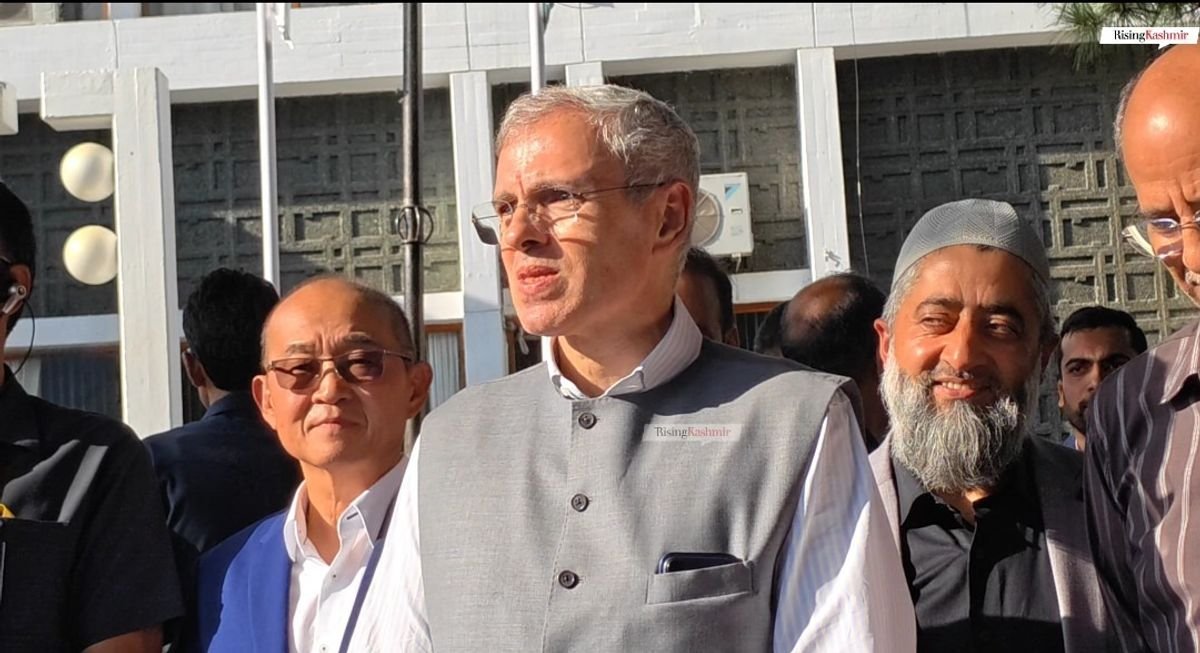
Srinagar, Sep 23: Chief Minister Omar Abdullah on Wednesday questioned the practice of banning books, saying that while he has his own views on the issue, the elected Jammu & Kashmir government presently does not have the authority to decide such matters.
His remarks came amid a growing controversy over the scrutiny and withdrawal of books from college libraries across Jammu and Kashmir, with the government informing the Legislative Assembly that more than 21.81 lakh books and publications had been examined as part of the exercise.
“I have my own views on whether books should be banned or not. But unfortunately, in the current system, we in the elected government don’t get to decide these things,” Omar told reporters here.
The Chief Minister said the government would have to wait for the situation to change before taking another look at the matter. “Therefore, we just have to wait for that situation to change. We will take a fresh look at what’s happening,” he said.
The statement comes days after the issue was raised in the Legislative Assembly, where Langate MLA Sheikh Khursheed Ahmad sought details of books removed from college libraries, the criteria used for identifying objectionable material and the authority under which such action was taken.
According to the government’s reply, 21,81,582 books and publications have been examined across the Union Territory. Of these, 4,249 books were withdrawn from circulation, while 518 copies of 19 already banned titles were also withdrawn.
Another 1,752 books have been referred for expert examination, indicating that the scrutiny process has not ended with the withdrawal of books already identified. The figures show that the exercise has covered libraries on a large scale. Of the publications examined, 12,48,641 were in Kashmir and 9,32,941 in Jammu. Among the 4,249 books withdrawn from circulation, 3,996 were from Kashmir and 253 from Jammu. The Higher Education Department has maintained that the scrutiny was conducted on the basis of a “clear and objective criterion” under Circular No. 02-JK(HE) of 2026.
The department has said the exercise is aimed at ensuring that educational institutions uphold constitutional values, academic freedom, critical thinking, scientific temper, responsible citizenship and respect for the sovereignty, unity and integrity of India.
However, the government’s decision has triggered questions over how books are classified as objectionable and whether withdrawal from institutional libraries amounts to a restriction on access to literature and ideas. The controversy has also brought renewed attention to the distinction between formally banned books and books withdrawn from circulation pending scrutiny.
The government’s Assembly reply makes clear that the two categories are not identical. While 518 copies of 19 titles that had already been formally banned were withdrawn, 4,249 other books were withdrawn as part of the present scrutiny exercise. A further 1,752 publications have been sent for expert examination.
The issue has consequently moved beyond the question of individual titles to a larger debate over the role of libraries, academic freedom and the mechanisms used to determine what students should or should not have access to.
Omar’s remarks add another layer to the debate. While he expressed his personal position on book bans, he stopped short of announcing any immediate reversal of the ongoing scrutiny or withdrawal process. The Chief Minister’s comments are likely to keep the issue alive in the political and public discourse, particularly as the Assembly has sought greater transparency over the books removed from libraries and the criteria applied to them.


