



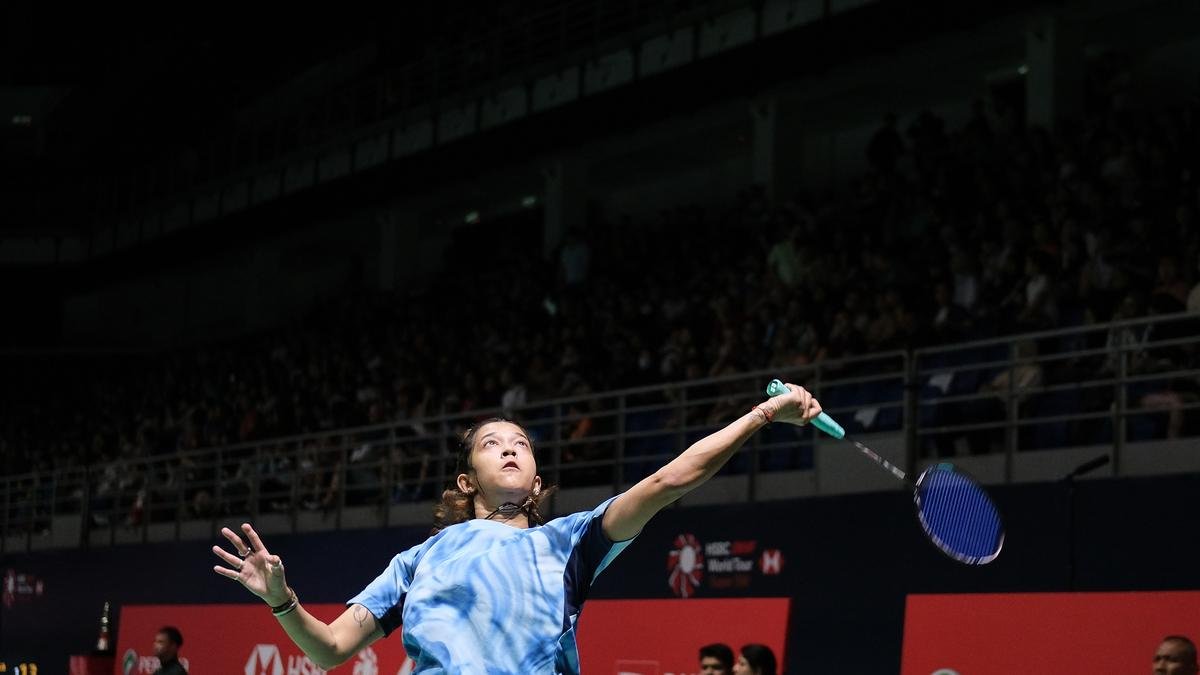
Her maiden BWF World Tour title came with a sense of redemption. Two years after suffering a knee injury in South Korea, the 26-year-old Ashmita Chaliha returned to the country and won the Korea Masters title, fighting back from a game down to beat China’s Han Qianxi in the final. The triumph came after a difficult phase in which Ashmita slipped outside the world’s top 200, lost her sponsorship and had to carefully select tournaments.
The fall in ranking was particularly difficult because Ashmita had previously broken into the world’s top 40. With limited financial support, she began choosing tournaments she could afford, while setting herself the target of reaching at least the semifinals to rebuild her ranking.
The Assam shuttler, once regarded as one of India’s most naturally talented attacking players, has also had to contend with the criticism that her talent was undermined by errors and inconsistency. Her response has been to work more on rallies and stamina without taking away the attacking instincts that define her game.
She used to train at the Prakash Padukone Badminton Academy in Bangalore. After the injury she moved back to Guwahati to train with Coach Park Tae-sang at the National Centre of Excellence and that helped her deal with a period when she felt mentally drained. Along the way, she has also learnt to travel alone, manage tournament logistics and finances, and, most importantly, believe in herself again.
In a conversation with The Hindu, Ashmita spoke about her difficult period, returning to Korea, the changes she has made to her game, and why she now feels capable of consistently competing at the highest level. Excerpts:
Two years ago, you suffered an injury in Korea. When you returned to the country this time, did being there bring back memories?
Yes, definitely. When I was going back to Korea, I was like, okay, maybe this time it will be a little bit better. I didn’t know that I could win. I was just like, I’ll just take one day at a time, one match at a time. So I was just thinking of one match at a time.
And then you ended up winning the title. What was the first feeling when you won?
I was actually blank after winning. In my mind, I was literally blank. So for some time, I was trying to process whatever happened. It took some time for me to process and eventually I came to terms with it, that alright, I made it.
How different is the Ashmita who used to lose to players a few years ago from the Ashmita who now believes she can beat them?
I had a tough time believing in myself. I underestimated myself a lot. But these past tournaments and the performances I gave really built me up. Surely, I believe I can continue to play this way and consistently.
Ashmita Chaliha makes a return to Goh Jin Wei at the Malaysia Masters.
| Photo Credit:
File photo: Getty Images
Did the pressure of living up to your potential ever become a burden?
A lot of people keep telling me that I’m talented, but then error-prone and all of that. I know that. I know that I’m error-prone. But it’s not like I try to make errors on my own. It just happens.
Usually people keep telling you that you should have played like that, you should have played like this. But the player usually knows what is going on inside the court. We have to deal with the conditions regarding the air-conditioning or wind, whatever is going on inside the court.
For me, the players know how to handle it. So it’s not that we are doing it on purpose. But I also take it in a positive way that I have to work on it.
What changed in your head that allowed you to become more patient and consistent without losing the attacking style that is such a big part of your game?
Nothing much changed, but I did a lot of training with my coach, especially rallies. So that I can keep up with the rallies and make fewer errors, while also using my attacks.
There was a difficult phase when your ranking fell outside the top 200 and you lost your sponsorship. Did you ever think about whether continuing professionally was financially sustainable?
A lot of thoughts like that came to my mind because, after all, financially I have to be strong to compete in tournaments. At that time, I did not have much financial support. When I was out of the top 200, my mind was like, how do I go about it?
Because after coming into the top 40 and then going back to zero, it was really tough. But then I had to select some tournaments which I could afford. Whichever tournaments I was going to, I made sure that at least I had to play the semifinals or something like that, so that my points also increased. That was my plan before.
Why did you move back to Guwahati? Was training in Bengaluru becoming an issue?
I needed a little bit of a change in the environment. No, training wasn’t an issue. In Bengaluru, I was mentally drained out. Also, South Indian food doesn’t suit me well. I was having a hard time with food…so I thought I would just come back to Guwahati.
There was also a period when you had to become more independent. Did you have to figure out travelling, managing finances and tournament logistics yourself?
Yeah, I had to figure out everything by myself. But my parents were always ready to help. They were always there.
Is there one incident that you particularly remember?
Yes, I have a lot of difficulties with trains, especially trains outside India. While returning, I was going to Malaysia, but I had to take a train in China. It was really difficult because no one understands English. I have always missed trains, or I have gotten on the wrong trains in Europe.
So I was very scared to travel alone. But in China, I managed to get on the correct train, and I was in the correct place. So I felt really proud of myself.
You have now become one of the biggest names to emerge from Assam. Do you feel any responsibility towards young players from the Northeast?
I wouldn’t say I would take that kind of responsibility. But there are a lot of talented kids in the Northeast. A lot of badminton players in Assam are also quite talented. So I hope they can also do well internationally.
How did badminton first enter your life? And were you always this competitive fighter?
My dad was a tennis player. So he wanted me to play a sport.
But then the badminton stadium was near to our home. So, I picked up badminton, at first. I didn’t choose badminton as a career then. I was playing for fun. But then eventually, I started taking part in tournaments, like district tournaments or school tournaments.
And, I think that [competitiveness] came a bit late. But then when I used to play in school or district tournaments and I used to lose, then I used to cry a lot.
What does a typical training day look like for you now?
We train every day. Only Saturday and Sunday are off days. In the morning, we start from 8.30 to 11.30 on court, that is playing. From 4 pm to 5 or 5.30, we have either a running session or a gym session. And from 5.30 to 6.30 or 7, we have our skill session.
The biggest influence in your career…
I have been a very big fan of Lee Chong Wei and Carolina Marin since the beginning. I have always looked up to them. Even Marin has suffered so many injuries and has come back. So I have always looked up to her.


