


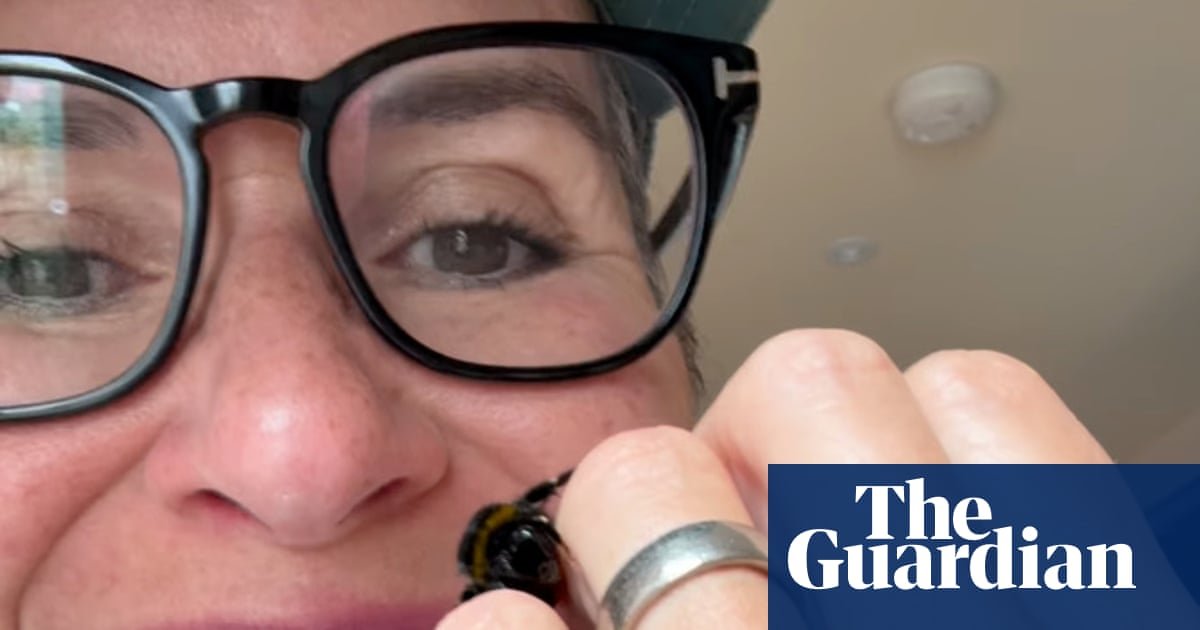
Fifty-two days ago, Phoebee was lying by the side of a road in the blistering sun with a broken wing. Today, she’s clambering up the arm of Gilly McArthur, around the nape of her neck and disappearing into her hair.
“I couldn’t leave her by the roadside,” McArthur says. “So I bought her home and made her a bed of flowers. I thought she’d be dead in a day or so.”
Instead of dying, Phoebee did something McArthur didn’t expect: she went viral. McArthur says: “A few days after I rescued her, I was due to go on a sailing trip for a week. I couldn’t leave her here, so I took Phoebee with me – and put a post on my Instagram account of her enjoying the trip.”
The following morning, McArthur woke to find messages from around the world. “It was amazing: there were so many posts from people across the globe telling me their lovely stories of capturing bumblebees or helping butterflies with broken wings – and the stories kept coming.”
Allow Instagram content?
This article includes content provided by Instagram. We ask for your permission before anything is loaded, as they may be using cookies and other technologies. To view this content, click ‘Allow and continue’.
McArthur, an author, is touched but slightly baffled by the furore. “I think it might be because the world is in such a polycrisis at the moment, and everyone is wanting to pull back to something authentic and kind,” she says.
“Perhaps Phoebee reminds people of a time when bumblebees were more prolific, in a world that isn’t on fire: lots of the messages said the videos helped them feel more grounded in a world where the algorithms are usually so grounded in clickbait and violence.”
Britain has 24 species of bumblebee and more than 240 species of solitary bee. Most bumblebees live for just one year. New mated queens have a bit more of a lifeline: they hibernate in the autumn and emerge in spring to establish colonies of their own.
Phoebee has not mated. While McArthur does not know what that will mean for her, she is stalwart in the face of possible tragedy.
“If I check on her one day and she’s not moving, I’ll check her bum. When she sleeps, her bum goes up and down very slightly,” she says. “If her bum is still, I won’t give up – I’ll put her in a quiet room and hope she’s hibernating. But her lifespan is her lifespan.”
For now, McArthur spends a lot of time watching her. “She’s fascinating: she spends a lot of time cleaning herself like a cat. And I could watch her putting her long tongue out and getting the nectar out of the flowers for hours.”
Andy Benson, of the Bumblebee Conservation Trust, has watched the brouhaha with similar bemusement. He thinks passions would have been cooler had Phoebee not been a buff-tailed bumblebee, the biggest and fluffiest bee, and a queen, “the biggest and fluffiest of them all”.
Benson says that while McArthur’s heroic salvation of a single bumblebee is heartwarming, the advice is to gently place lost bees on a flower and let nature take its course.
“A third of British wild bees and hoverflies are in decline and a quarter of European species are at risk of extinction because of the loss of their natural habitat, climate change and bee-killing pesticides,” he says.
This matters because one in three mouthfuls of our food depend on pollinators such as bees, with the crops that depend on pollination – including apples, beans, squashes and almonds – being five times more valuable than those that do not.
Benson says if people want to help bees, they don’t have to take them into their home, or on a sailing trip, or let them nestle in their hair. “We can instantly help hundreds of bees in the smallest of spaces by simply planting a few flowers in their garden,” he says.
McArthur knows she hasn’t stayed the plummeting bee numbers by prolonging Phoebee’s short lifespan. But she hopes she may have made a difference in another way.
“Maybe this is something nice that people can pull back to and just go: ‘Oh, maybe I won’t blow my leaves away this winter – maybe I might plant more plants for pollinators – maybe I might just stop and look at the smaller things with more curiosity’,” she says.
“And maybe Phoebee’s videos will help people realise that looking at the smaller things in more detail can make the bigger things feel more manageable.”
