


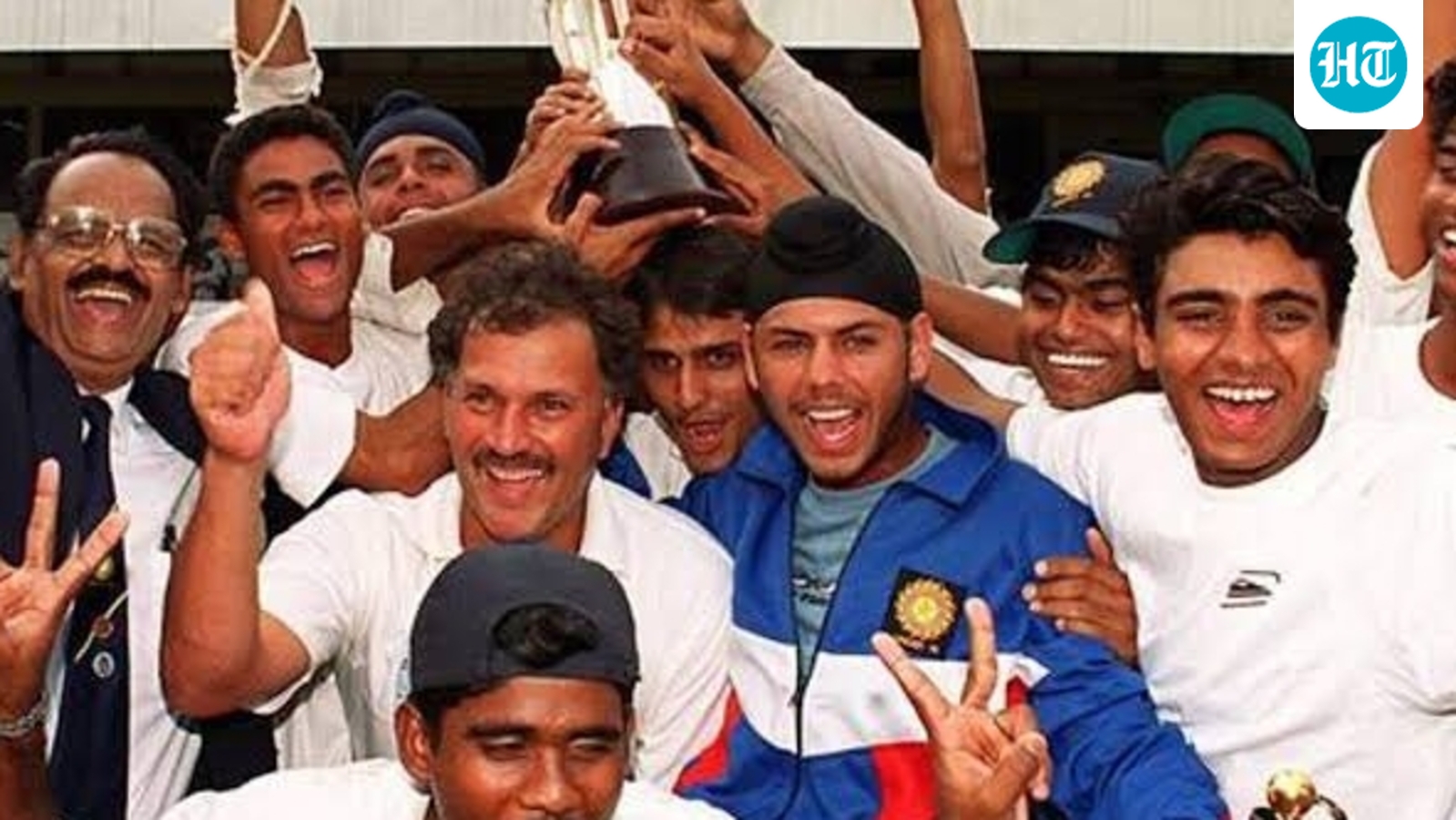
Lord’s has a way of making even accomplished cricketers conscious of history. In August 1996, however, the old ground seemed to exert no such intimidation over the 15-year-old leading India in the final of the Lombard Under-15 Challenge Cup. Pakistan had made 222 for seven, and the Indian captain had already imposed himself on the match with the ball. The more exacting examination was still to come. A global title now depended on a chase, and the teenager entrusted with leading it appeared entirely untroubled by either the setting or the occasion.
He remained unbeaten on 82 as India reached their target with four wickets in hand. Earlier, his 3 for 34 had accounted for Taufeeq Umar, Yasir Arafat and Kamran Akmal in a Pakistan side containing several players who would later become senior internationals, among them Shoaib Malik, Hasan Raza, Faisal Iqbal and Bazid Khan. By the close of the afternoon, a 15-year-old had captained India to a global age-group title at Lord’s, decided the final with both bat and ball, and been named Player of the Match. It was less an introduction than an announcement.
Four years later, another final arrived, this time in Colombo. India were chasing their first Under-19 World Cup title, with Mohammad Kaif as captain and the boy from Lord’s now serving as his deputy. Sri Lanka had been restricted to 178, yet the chase was still vulnerable at 116 for four. Once again, the decisive innings belonged to the same cricketer. He made an unbeaten 39 from 43 balls after conceding only 26 from his ten overs, and India crossed the line without further damage. Once again, he was Player of the Match in a major final.
The name was Reetinder Singh Sodhi. Before his senior international career receded into the statistical anonymity of 18 One-Day Internationals, he had assembled one of the most remarkable junior résumés in Indian cricket. For a brief period at the end of the 1990s, Sodhi appeared not merely gifted but almost preordained for a substantial international career.
A prodigy before India knew what to do with him
Between those two finals came an achievement that remains extraordinary even now. In November 1997, playing for Punjab against Delhi in the Ranji Trophy at Patiala, Sodhi made an unbeaten 200. He was 17 years and 15 days old when the match began, making him the youngest Indian to score a first-class double-century. In the standard historical lists, only Pakistan’s Hasan Raza and Ijaz Ahmed reached the landmark at a younger age.
There were further signs that Lord’s had not been an isolated eruption of youthful brilliance. At the 1998 Under-19 World Cup in South Africa, Sodhi struck 126 from 150 balls against Kenya, including eight fours and five sixes. That Indian squad included Virender Sehwag, Harbhajan Singh and Mohammad Kaif, players whose names would soon become inseparable from a transformative period in Indian cricket. Sodhi, however, had already been carrying the aura of precocity for years.
By the beginning of 2000, the progression seemed almost unnervingly neat. He had captained India to one global age-group title, helped secure another, played in two Under-19 World Cups and become the youngest Indian first-class double-centurion. His senior India debut followed in December 2000 against Zimbabwe at Cuttack, less than a year after the Under-19 World Cup triumph.
The early evidence at the international level did little to puncture the optimism. In Rajkot later that month, Sodhi made 53 not out and took 2 for 43 against Zimbabwe. Then, in July 2001, came his most complete performance for India. In the final of the Coca-Cola Cup against the West Indies in Harare, he first took 2 for 31 before walking in with India’s pursuit of 291 in disarray at 80 for five. His 67 from 75 balls, in a century partnership with Sameer Dighe, transformed a rout into a contest. India eventually fell 16 runs short, but Sodhi had recorded his best ODI score and best bowling figures in the same match.
His appeal lay in accumulation rather than specialisation. He could bat in the middle order, offer medium pace, attack the ball in the field and alter the tempo of a game without requiring it to revolve around him. His athleticism even earned him the nickname “Jonty Singh”, an obvious homage to Jonty Rhodes. In an era when India were perpetually searching for an all-rounder capable of giving the side greater balance, Sodhi seemed to represent an unusually attractive possibility. The desire to strengthen that possibility would prove ruinous.
The body interrupts the story
After India’s 2001 tour of South Africa, Sodhi suffered a serious back injury while attempting to increase his bowling pace. He later described multiple stress fractures and an extended period during which cricket ceased to be a professional concern and physical recovery became the only meaningful objective. By his own account, he spent roughly two years largely bedridden.
The cruelty was not simply in the injury but in its timing. At 21, Sodhi had already entered the senior Indian side and had begun to establish the outlines of a useful role. This was supposed to be the period in which promise became permanence. Instead, momentum gave way to rehabilitation, and a career that had accelerated almost continuously since adolescence suddenly stalled.
He returned to play one further ODI, against the West Indies in November 2002. It was his last. His international record was ultimately unremarkable: 18 ODIs, 280 runs at 25.45, two half-centuries and five wickets. Read without context, those numbers offer little explanation for the excitement that once surrounded him. They cannot convey the teenager who won India a global final at Lord’s, nor the young vice-captain who repeated the feat four years later, nor the 17-year-old who made a first-class double-century before any Indian of his age had done so.
There were later reminders of the ability that had once made his ascent seem inevitable. In 2004, Sodhi made a career-best 251 not out for Punjab against Maharashtra. His List A career eventually yielded 2,922 runs at an average of 45.65, figures that suggest his batting remained of considerable quality long after his international prospects had diminished.
The most poignant detail, however, came from a conversation after the 2000 Under-19 World Cup. Sodhi later recalled an English journalist observing that he had now been Player of the Match in a global Under-15 final and an Under-19 World Cup final. There was, the journalist suggested, one final act left to complete the sequence: the 2003 senior World Cup.
For a young cricketer whose career had thus far obeyed almost every expectation placed upon it, the idea cannot have sounded absurd. Yet cricket is particularly merciless towards narratives that appear too perfectly arranged. By the time India reached the 2003 World Cup final, Sodhi was no longer part of the side.
That is what makes his career worth remembering. It is not the story of an international great cut down at his peak, because he had not yet become one. It is the story of something more elusive: a career whose early chapters were so persuasive that the unfinished ending still feels strangely disproportionate. Two major finals, two Player-of-the-Match awards, a record-breaking double-century before adulthood, and an India career that disappeared almost before it had properly begun.
